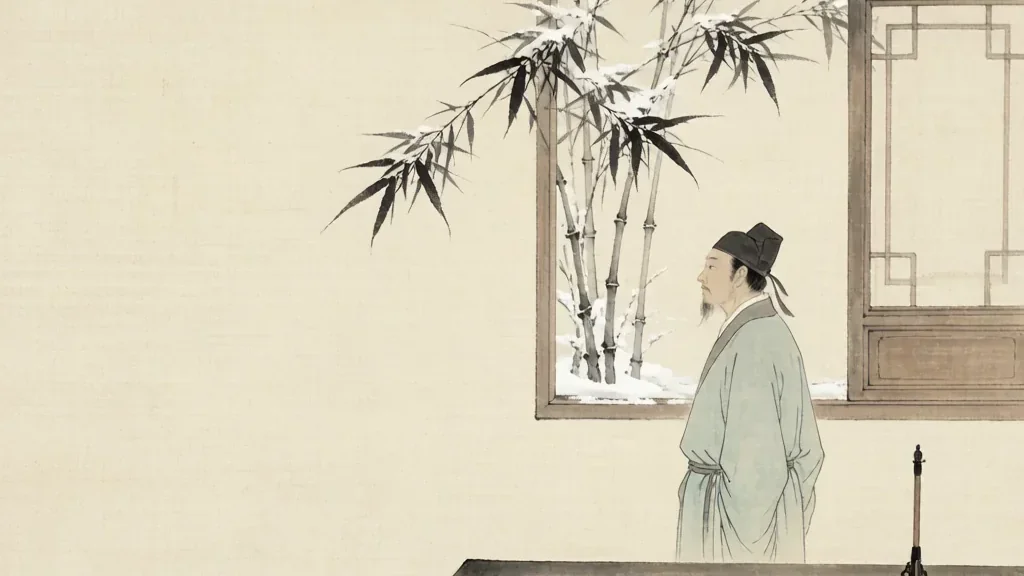
The idiom 胸有成竹 means to have a complete bamboo already formed in one's chest, and it describes a person who approaches a task with a clear, fully formed plan. Its source is the Song dynasty painter Wen Tong, celebrated for his bamboo studies, who according to the writer Su Shi knew every curve of the plant so thoroughly that the image existed in his mind before the brush touched paper. The phrase has since expanded far beyond painting to praise anyone who prepares so deeply that execution becomes calm and confident. It remains one of the most quoted Chinese idioms about the value of internal preparation, mental rehearsal, and the quiet mastery that comes from long, close observation of one's subject.
The Painter Wen Tong and His Bamboo
Wen Tong, also known by his courtesy name Yuke, was a literatus of the Northern Song period who devoted himself to painting bamboo with such devotion that contemporaries said he thought of nothing else. He studied living bamboo in every season and weather, noting how joints, leaves, and stalks responded to wind and light. This intimacy allowed him to render the plant with seeming ease and natural accuracy that impressed even the most critical collectors of his day.
The historian and poet Su Shi, Wen Tong's cousin by marriage, recorded that Wen Tong never painted from uncertain memory but from a fully visualized image held in advance. Su Shi explained that the painter first conceived the complete bamboo in his breast, then brought it forth in a single fluent stroke. This account is the textual root of the idiom, and it turned a private artistic habit into a public lesson about the discipline behind apparent spontaneity.
Su Shi's Famous Essay on the Subject
In a long prose piece on bamboo painting, Su Shi contrasted Wen Tong's prepared mind with lesser artists who seized the brush without a plan and produced confused, lifeless work. He described how the true painter lets the formed image in the chest guide the hand, so that intention and motion become one. The essay became a touchstone for later discussions of creativity in China.
Su Shi's wider point was philosophical: mastery is internal before it is external. He warned against rushing to the page before the idea is whole, arguing that the visible work is only the trace of an already-complete thought. Generations of scholars quoted this essay to defend careful study and to explain why some fluent performances look effortless while ordinary ones look strained, locating the difference in preparation rather than in the moment of action.
Literal Meaning of the Phrase
The four characters name a paradox: a bamboo, a large plant, residing inside the chest, the seat of thought and feeling. 胸 is the chest or mind, 有 is to have, 成 is complete or formed, and 竹 is bamboo. The image suggests that the creator carries a finished model within, ready to be delivered rather than invented on the spot.
Because the chest is invisible, the idiom also implies that confidence should be grounded in something unseen but real. A person described as having a bamboo in the chest is not merely hopeful but actually prepared, having done the inner work that outward calm requires. The physical metaphor makes an abstract mental state concrete and memorable, which is a large part of why the phrase entered everyday speech.
From Painting Theory to Daily Wisdom
Although born in an essay about ink bamboo, the idiom quickly escaped the studio. Writers applied it to statecraft, arguing that a good official should hold the whole situation in mind before acting, just as Wen Tong held the bamboo. Military leaders used it for strategy, merchants for business planning, and teachers for instruction, each borrowing the painter's model of prior visualization.
The phrase fit neatly into a Chinese emphasis on foresight and composure, the idea that fortune favors the prepared mind. Its transfer from art to life shows how deeply aesthetic concepts shaped general ethics: to paint well and to govern well were both matters of first forming the thing within. The idiom thus became a quiet endorsement of reflection as the foundation of effective action in any field.
Psychological Idea of Mental Rehearsal
Modern psychology recognizes something like the idiom in the practice of mental rehearsal, where athletes and performers visualize a complete successful action before executing it. Wen Tong's internal bamboo anticipates this technique by nearly a millennium, suggesting that the mind can rehearse a skill so thoroughly that the body follows smoothly. The prepared image reduces hesitation and error.
The idiom also guards against a common failure mode: beginning work before the plan exists, which produces the scattered results Su Shi criticized. By insisting that the bamboo be complete before the brush moves, the phrase promotes a discipline of closure in planning. Contemporary coaches echo the same advice when they tell students to see the outcome clearly before starting, confirming the idiom's lasting practical insight.
Contrast With Other Creative Idioms
Chinese has many idioms about talent and creation, but xiongyou-chengzhu is unusual in stressing preparation over inspiration. Where phrases about sudden literary brilliance celebrate the spark, this one celebrates the stored image, the quiet mastery earned through observation. It pairs naturally with idioms about deep familiarity born of long practice rather than with those about accidental genius.
It also contrasts with armchair theorizing, the empty discussion of strategy without real contact with the subject, because Wen Tong's bamboo came from intimate study of actual plants, not from books alone. The idiom thus occupies a careful middle: it values internal planning but insists that the internal image be fed by genuine experience. That balance is why it suits both artists and practical strategists without contradiction.
Use in Calligraphy and the Arts
Beyond painting, the idiom became a standard compliment in calligraphy, where masters speak of holding the whole character or composition in mind before the first stroke. The same principle appears in music, chess, and garden design, all fields where Chinese critics prized a foreseen total form. To say a work showed a bamboo in the chest was high praise for its unity.
In art criticism the phrase also served as a standard against which to judge hasty or imitative pieces, those lacking the inner model. Collectors and teachers used it to explain why two technically similar works could feel different, attributing the better one to genuine prior conception. The idiom thereby shaped taste, encouraging viewers to look for coherence that only preparation can produce, and to value the invisible mental work behind a finished object.
Legacy in Modern Chinese Speech
Today the idiom is used whenever someone handles a challenge with calm assurance because of thorough preparation, from a student facing an exam to a manager launching a project. It reassures listeners that confidence is legitimate when built on real mastery, and it gently criticizes those who act before they understand. The bamboo has become a universal symbol of readiness.
The phrase also appears in self-help and education writing that urges planning before action, linking ancient painting lore to contemporary productivity advice. Its survival across a thousand years shows how a single vivid image, rooted in one painter's method, can generalize into a durable principle of human effectiveness. Few idioms connect a specific artwork so directly to a general rule for living well.
❓ Frequently Asked Questions
What does xiongyou-chengzhu mean?
It means to have a complete bamboo already in one's chest, describing someone who begins a task with a clear, fully formed plan.
Who originated the idea?
The painter Wen Tong of the Song dynasty, as described by his cousin Su Shi, who said Wen held the whole bamboo in mind before painting.
Why a bamboo?
Wen Tong specialized in ink bamboo and studied the plant so closely that its full image lived in his mind, making it the natural symbol of prior visualization.
How did the idiom spread beyond art?
Writers and officials adopted it for strategy, governance, and study, treating internal preparation as the basis of effective action in any field.
Is it like mental rehearsal?
Yes, it resembles modern visualization techniques in which a person imagines a complete successful action before performing it.
What does it warn against?
It warns against acting before the plan is whole, which produces scattered results, and it favors preparation fed by real experience over empty theory.