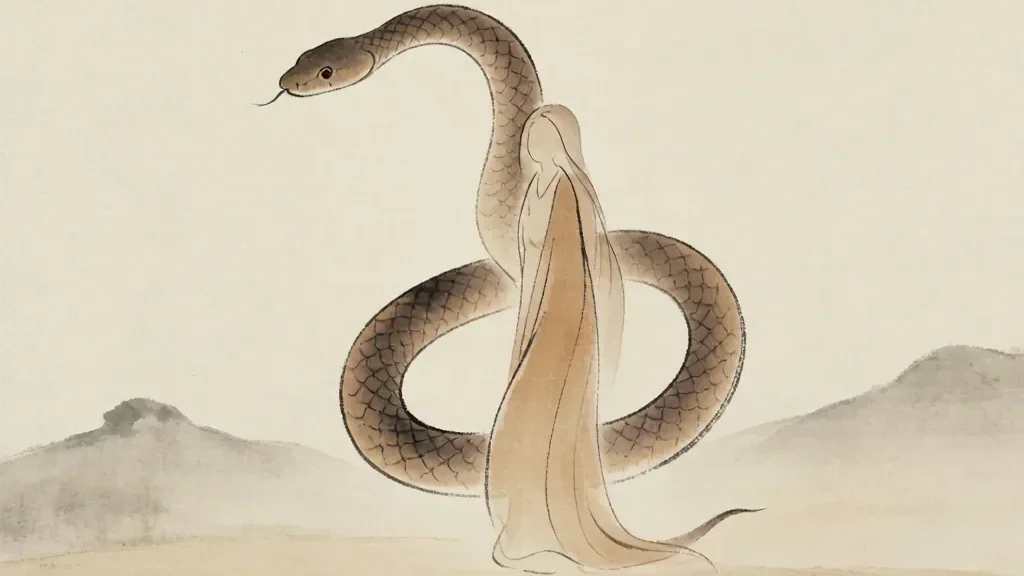
Among the many forms failure that haunts artists, cooks, writers, and lovers alike — the failure of adding too much. A sauce ruined by one extra pinch of salt. A poem killed by one final adjective. A perfectly good apology destroyed by a single defensive sentence. The Chinese have spent over two thousand years compressing this mistake into four sharp characters: 画蛇添足 (huà shé tiān zú), "drawing legs on a snake." The story behind it is short, almost farcical, and its point has never stopped being relevant.
The idiom comes from the "Zhan Guo Ce" (战国策), the "Strategies of the Warring States," a Han Dynasty compilation of political speeches and parables from the chaotic centuries before China's unification. Its author, Liu Xiang, gathered these stories not for entertainment but for instruction — they were meant to teach rulers and diplomats how to think, how to persuade, and above all, how to know when to stop. Of all the parables in that vast collection, few land as cleanly as the one about a drinking contest in the state of Chu.
The Pot of Wine in Chu
Long ago, in the southern state of Chu (楚国), a group of officials gathered to help conduct a sacrificial rite. Sacrifices in ancient China were solemn occasions, but they ended in celebration — and at this particular celebration, the participants were presented with a single pot of fine wine. The problem was obvious: there was only one pot, and there were several of them. The wine could not be divided without being watered down to nothing, and to drink it in turn would be a poor sort of ceremony.
After some discussion, one of the officials proposed a contest. "Let each of us draw a snake on the ground," he said. "Whoever finishes first drinks the wine." The others agreed. It was a simple, elegant solution — a game of skill to settle a question of sharing, the kind of solution the people of Chu, famous for their love of poetry and ritual, would have appreciated.
The men crouched on the ground, took up sticks, and began to draw. The lines of the snakes took shape quickly — curved bodies, forked tongues, slim heads. One man, faster and more confident than the rest, finished his snake well before the others. He stood up, looked at his work with satisfaction, and looked around at his slower companions. He had clearly won. The wine was his.
The Fatal Stroke of Confidence
But here the story turns. The man, pleased with himself and bored by how easily he had won, decided that his snake was not quite enough. He had time to spare, after all. The others were still bent over their work, scratching lines into the dirt. So he picked up his stick again and, with a small laugh, began to add feet to his snake. "I'll give it legs," he said. "That will make it even better."
While he was carefully drawing the little feet, one of the other officials finished his own snake. That man snatched up the pot of wine and claimed it. The first man stared, indignant. "That wine is mine," he said. "I finished first."
The other man smiled and answered with the line that would become immortal: "Snakes do not have feet. What you have drawn is not a snake at all. You may have finished first, but you kept going — and so you never finished."
The first man had nothing to say. He looked down at his drawing — a perfectly good snake, now disfigured by four little legs that did not belong to it — and understood, too late, that he had not improved his work. He had destroyed it. The wine passed into the hands of the man who knew when to set down his stick.
The Political Point Behind the Joke
In the "Zhan Guo Ce," this story was not told merely to amuse. It appears in a speech by the strategist Chen Zhen, who was advising King Wei of Chu. The king's minister, Zhao Yang, had just won a great military victory and, emboldened by success, was demanding additional lands and titles as a reward. Chen Zhen told the story of the drinking contest to warn the king: a general who has already won should be rewarded and then told to rest. To let him keep pushing, keep grabbing, keep adding to his accomplishments, would be like drawing legs on a snake. The very success that had made him valuable would become the thing that ruined him.
The warning cuts in two directions, which is part of the idiom's enduring power. On one level, it is about restraint: knowing when a thing is finished and having the discipline to stop. On another level, it is about the danger of pride — the man who drew legs on his snake did so not because the snake needed them, but because he could not bear to simply sit with his victory. He had to prove, again, that he was the best. And that need to prove undid him.
Why the Idiom Still Bites
The reason 画蛇添足 has survived for two millennia is that the mistake it describes is eternal. Every culture has some version of the phrase "less is more," but few express it with such vivid absurdity. A snake, after all, is a complete creature. It moves beautifully, hunts efficiently, and has survived for millions of years exactly as it is. To look at a snake and think "this would be better with legs" is to mistake addition for improvement — the cardinal error of the overconfident.
In modern Chinese, the idiom is used everywhere. A manager who keeps "improving" a finished proposal until it is unreadable is drawing legs on a snake. A host who adds one more dish to an already complete banquet and throws off the balance of the meal is drawing legs on a snake. A painter who cannot leave a canvas alone, a writer who cannot stop revising, a lover whose third apology undoes the sincerity of the first — all of them are, in their small way, crouched in the dirt of ancient Chu, adding feet to a creature that was already whole.
The story's quiet wisdom is that completion is itself a skill, and often a harder one than creation. To make a snake is something. To recognize that the snake is done, and to set down the stick — that is something else entirely. The man who won the wine was not the fastest artist. He was simply the one who understood that a finished thing, left alone, is more powerful than a finished thing improved to death.
Craft as a Mirror of Wisdom
Chinese idiom-makers reach for the workshop again and again: carving, painting, cooking, forging. 画蛇添足 belongs to a whole family of four-character phrases built from craft images, because a made object has a clear moment of completion that a person can spoil. A snake drawn on the ground is done the instant the tail closes; everything after that is risk. Readers who notice this pattern start to see Chinese moral teaching as a kind of craft etiquette, where knowing when to lay down the tool is as admired as skill with it. The idiom is less a story about a contest than a small manual for restraint, and the frog parable of the well is a cousin in this respect, each using a made or bounded thing to stage a lesson about knowing when to stop.
Two Snakes, Two Lessons
The same classical world that warns against adding legs to a snake also celebrates adding eyes to a dragon. In 画龙点睛, the painter finishes a row of dragons by dotting in their pupils, and the creatures fly off the wall to life. Set beside 画蛇添足, the pair teaches a subtle art: some additions awaken a thing, others bury it. The difference lies in whether the addition is demanded by the work or imposed by the maker's vanity. A dragon needs eyes to live; a snake needs no legs to be a snake. Together the two idioms give Chinese speakers a ready vocabulary for praising the right finishing touch and mocking the wrong one, and they show how a single culture could admire both restraint and a well-judged flourish.
Restraint as a Virtue
Underneath the fable sits a long Confucian and Daoist respect for restraint. The gentleman who knows when enough is enough is a recurring ideal, and the over-reacher who cannot quit is a recurring fool. 画蛇添足 gives that ideal a comic, memorable shape. In a culture that also prizes diligence, the idiom performs a useful balance: it tells the hard worker that effort past the point of completion is not virtue but vanity. Modern essayists still cite it when arguing against overlong speeches, overbuilt software, or overdecorated prose, always with the same quiet premise that a finished thing left alone is more powerful than a finished thing improved to death. The lesson is not to do less, but to know the moment the doing is done.
The Idiom in Modern Writing
Editors and managers have carried 画蛇添足 deep into contemporary Chinese working life. A proposal circulated one draft too many, a presentation loaded with effects no one asked for, a contract weighed down with clauses that frighten the other side — all are 'snakes with legs'. Business columns use the phrase to plead for simplicity, and writing guides quote it to defend the plain sentence. What keeps the idiom alive is that the temptation it names is constant: the urge to prove oneself once more after the work is done. The ancient Chu official and the modern office worker share the same weakness, and the same remedy the story offers is simply to recognize the snake is finished and walk away with the wine.
❓ Frequently Asked Questions
📝 Chinese Vocabulary
画蛇添足 — : "To draw a snake and add feet" — to ruin something that is already complete by adding unnecessary extra elements.
楚国 — : The State of Chu, a powerful southern kingdom during the Spring and Autumn and Warring States periods, known for its shamanistic culture and lyrical poetry.
战国策 — : "Strategies of the Warring States," the Han Dynasty compilation of political speeches and parables that preserves this story.
祭祀 — : "Sacrificial rite" — the ritual occasion that preceded the drinking contest in the story.
蛇固无足 — : "Snakes inherently have no feet" — the punchline spoken by the second official, which has become a proverbial phrase in its own right.
足 — : Foot — the absent limb the losing official added to his finished snake, and the crux of the idiom.
酒 — : Wine — the single pot that triggered the Chu drinking contest and the whole parable.
添 — : To add — the verb at the heart of the idiom, warning against adding what was never needed.
🎉 Fun Facts
- The "Zhan Guo Ce" that preserves this story was compiled by Liu Xiang (刘向) around 26 BCE, but its material comes from the actual diplomatic records of the Warring States period — meaning the parable was already centuries old when it was first written down.
- The story is sometimes attributed to a specific historical figure, the Chu general Zhao Yang, but historians debate whether he is the real subject of the warning or simply a convenient name attached to it.
- A related Chinese phrase, 多此一举 (duō cǐ yī jǔ, "one unnecessary action"), is often used alongside 画蛇添足 to describe redundant effort, but lacks the vivid imagery of the snake.
- Chinese art teachers still cite this idiom to students learning brush painting, where the discipline of knowing when to lift the brush is considered as important as knowing how to apply it.
- The parable is still invoked in Chinese culinary schools, where a teacher may say 'drawing legs on a snake' to a student who keeps seasoning a dish that is already balanced.
- In legal and diplomatic writing, 画蛇添足 is a favorite metaphor for a negotiator who appends one unnecessary clause and loses the deal they had already won.