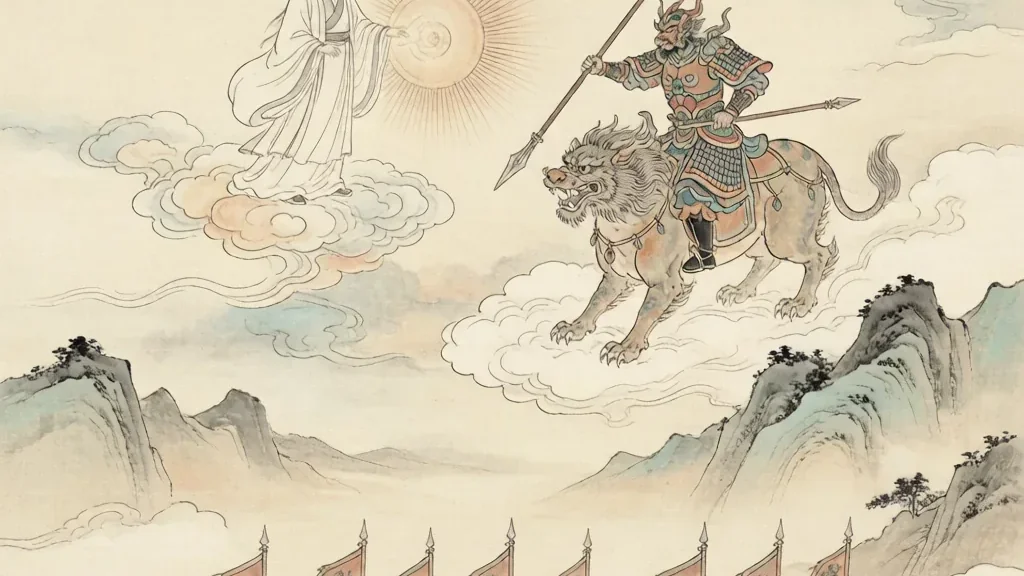
When gods go to war, the rules of heaven and earth are rewritten. Fengshen Yanyi, "Investiture of the Gods," is the Ming-dynasty novel that turns a fragment of ancient history into a meteor shower of immortals, demons, and magic weapons. Set at the end of the Shang dynasty, it tells how a corrupt king and a heavenly plot force gods and humans alike into a vast war whose losers are rewarded with divinity. For English readers, it is China's great fantasy epic — a mash-up of myth, martial spectacle, and moral allegory where the line between god and warrior barely exists. If you liked "Journey to the West," this is its darker, more political cousin.
The Frame: A Heavenly Decree
The novel opens not on earth but in heaven. The primordial goddess Nuwa, offended when the last Shang king inscribes a lustful poem on her temple wall, resolves to end his dynasty. Meanwhile the Jade Emperor and the Primeval Lord of the East decide that the old order of gods needs replenishing: a roster of 365 divine posts must be filled, and the coming human war will supply the souls. Thus the earthly conflict is really a celestial hiring plan. Humans die; their spirits are "invested" as gods. The title itself means the "romance of the investiture of the gods," and the whole plot is a machine for turning the dead into the divine.
This framing is the book's distinctive twist. War is not merely tragic or heroic; it is administrative. The carnage has a bureaucracy behind it, and the novelist delights in the irony of souls being promoted precisely because they lost.
Historical Roots and the Shang-Zhou Transition
Behind the fantasy lies a real event: the overthrow of the Shang by the Zhou around the eleventh century BCE, remembered in early texts as the victory of a virtuous king, Wu, over a tyrant, Zhou Xin. The novel turns that founding myth into spectacle. King Zhou of Shang is recast as a near-demonic libertine manipulated by the fox-spirit Daji, while the Zhou side gathers righteous generals and heavenly helpers. The historian's bare fact — one dynasty replaced another — becomes a cosmic morality play about legitimate rule.
The book thus belongs to a long Chinese habit of reading politics through heaven. A ruler's loss of the "mandate of heaven" is shown not as abstract theory but as foxes, floods, and falling generals. For readers, the fantasy is also a civics lesson dressed as fireworks.
Characters: Humans, Immortals, and Spirits
The cast is enormous. On the Shang side, the doomed king is pushed toward evil by Daji, a fox demon disguised as a beautiful woman, who becomes the archetype of the femme fatale spirit. On the Zhou side, the boy-general Nezha, born from a lotus after a violent break with his father, is a fan favorite — a reborn child-soldier who fights with rings and a fiery spear. Jiang Ziya, the aged strategist who finally "invests" the gods, serves as the mortal conductor of the whole celestial orchestra. Countless immortals from the two great monastic mountains take sides, each with a flying sword, a wind-bag, or a golden pillar.
What makes the characters stick is their mixture of the sublime and the absurd. An immortal may recite profound Daoist truths and then hurl a snake-shaped whip. The novel never asks you to take its theology too seriously; it asks you to enjoy the spectacle of personalities clashing across the planes of existence.
Magic, Weapons, and the Logic of Battle
The battles are the book's engine. Unlike ordinary war stories, here defeat often comes from a talisman or a summoned beast. A general rides a deer into the sky; a queen traps an enemy in a "soul-falling bell"; a mystic releases a plague. The arms race of magic is endless and comic in its inventiveness. Each side counters the other's wonder with a greater wonder, until the war becomes a contest of imagination as much as of armies.
This "magic arms race" has a structural purpose. It keeps the narrative spinning through a hundred chapters and lets the author stage set-piece after set-piece without repeating himself. It also reflects a folk understanding of the cosmos as crowded, competitive, and deeply personal — every mountain has a lord, every river a spirit with grievances.
Themes: Loyalty, Fate, and the Cost of Power
Beneath the fireworks, "Investiture of the Gods" worries about loyalty and the price of ambition. Many characters are torn between loyalty to a doomed king and loyalty to what is right; some perish precisely because duty and justice pull them apart. The novel also meditates on fate: the roster of 365 gods is fixed in heaven, so every death is also a promotion already written. Free will flickers inside a scripted universe, a tension the book never fully resolves and perhaps does not want to.
There is also a current of skepticism about power itself. The gods who win their posts are often the ones who suffered most, and the heavenly bureaucracy they join looks suspiciously like the earthly one they died escaping. The comedy of the divine office hints that even immortality comes with paperwork.
Legacy and Cultural Reach
Like "Journey to the West" and "Romance of the Three Kingdoms," "Investiture of the Gods" escaped the page into opera, storytelling, film, and television. Its characters — Nezha, Erlang, Daji — became household names and visual staples of Chinese popular culture. The "list of gods" idea shaped how ordinary people imagined the spirit world: not as a fixed pantheon but as a roll that could always add new names from the honored dead.
For a modern reader, the novel is best met as exuberant popular myth rather than polished literature. Its prose is uneven and its pacing wild, but its imagination is inexhaustible. It teaches that China's heavens were never quiet or orderly; they were a parliament of quarrelling immortals, and the stories mortals told about them were gloriously, productively messy. Whether you come for the battles or the theology, "Investiture of the Gods" delivers a universe where the war never really ends — it just promotes its casualties.
Daji and the Demon Queen
The novel's most enduring villain is Daji, a fox spirit who possesses a beautiful woman and drives the Shang king to ruin. She belongs to a long line of demon-women in Chinese lore, from the fox spirits of Liaozhai to the snake of the White Snake legend, and she crystallizes a recurring fear: the seductive woman as agent of a ruler's fall. Yet Daji is also a product of heaven's plan, sent to punish a king who insulted the goddess Nüwa. The book thus blames both demonic temptation and heavenly design, leaving the reader unsure whether the catastrophe is moral downfall or cosmic script. Her popularity in opera and film shows how firmly she entered the imagination.
Heaven as a Bureaucracy
One of the novel's strangest ideas is that the afterlife is an office. The 365 divine posts to be filled after the war are ranks in a celestial administration, complete with appointments, titles, and a chain of command under the Jade Emperor. This mirrors the imperial Chinese state, where heaven itself was imagined on the model of the bureaucracy. Souls are not judged as good or bad so much as assigned to staff the heavenly government, sometimes regardless of merit. The image is comic but revealing: even immortality comes with a job. It shows how thoroughly Chinese cosmology pictured the universe as an ordered hierarchy rather than a free spiritual realm.
❓ Frequently Asked Questions
📝 Chinese Vocabulary
封神演义 — : Investiture of the Gods, the Ming fantasy epic.
封神 — : To invest or enfeoff a god, enrolling a spirit into the divine roster.
哪吒 — : Nezha, the reborn child-warrior who fights with rings and a fiery spear.
妲己 — : Daji, the fox-spirit who tempts and destroys the Shang king.
姜子牙 — : Jiang Ziya, the aged strategist who finally invests the gods.
女娲 — : Nüwa, the primordial goddess whose offended honor sets the novel's plot in motion.
雷震子 — : Leizhenzi, a winged thunder-born immortal who fights for the Zhou side.
二郎神 — : Erlang Shen, the three-eyed god who hunts the novel's protagonists.
🎉 Fun Facts
- The novel's heavenly plan calls for exactly 365 divine posts to be filled from the war's dead.
- Nezha is so popular he appears across Chinese opera, film, and comics as a child-god of defiance.
- The "mandate of heaven" is acted out literally: the tyrant's fall is engineered by offended gods.
- The book turns a real eleventh-century BCE dynastic change into a cosmic war of magic weapons.
- The novel grew out of earlier oral storytelling and a Yuan dynasty drama cycle about the fall of Shang, which writers expanded into a full fantasy epic.
- Many of its deities, such as Nezha and Erlang, were later absorbed into local temple worship and the popular pantheon of Chinese folk religion.