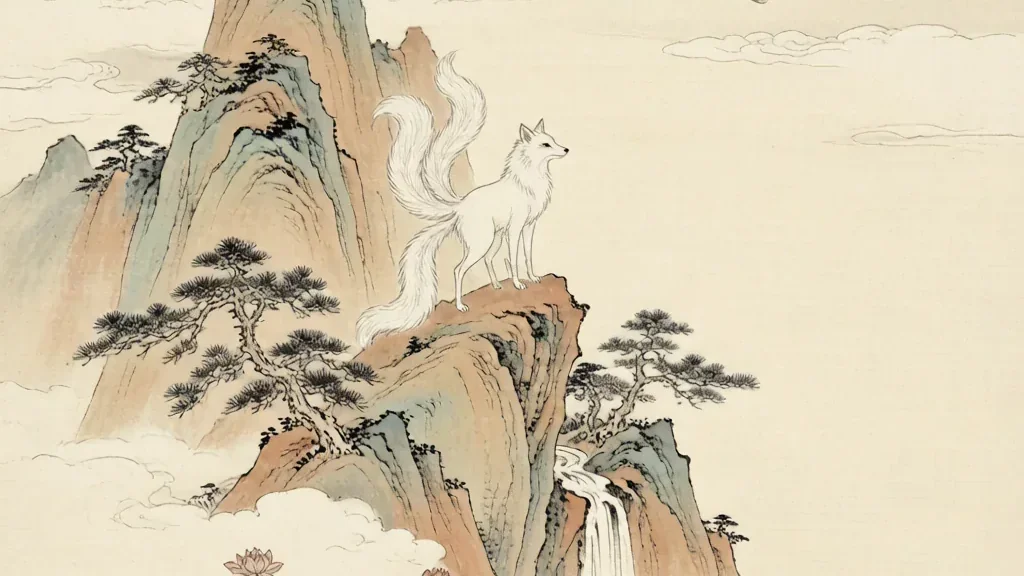
Long before China had a single map, it had a book of monsters. Shanhai Jing, "The Classic of Mountains and Seas," is the strangest survivor of ancient Chinese literature — a compendium of mountains, rivers, creatures, gods, and far-off lands, part geography, part mythology, part natural history, and wholly unlike anything else. Compiled between roughly the fourth and first centuries BCE, it describes nine-tailed foxes, one-eyed giants, birds that ward off plague, and a queen mother of the west who wears a tiger's tail. For English readers it is China's "Book of Monsters," the seedbed of fantasy that fed "Journey to the West" and "Investiture of the Gods" a thousand years later.
What Kind of Book Is It?
The Shanhai Jing is not a novel or a poem but a catalogue — a sequence of regional sections listing the mountains and seas of a known and imagined world. Each entry typically names a mountain, says what rivers flow from it, what plants and animals live there, what minerals are found, and which god or spirit rules it. The tone is dry and bureaucratic, like a surveyor's report, which only makes the creatures stranger when they appear. Scholars still debate whether it began as a guide for shamans, a lost atlas, or a ceremonial text; the truth is probably a mix.
What is certain is that the book preserves myths older than Confucius and Laozi. It is our richest early window onto the prehistoric imagination of the Chinese-speaking world, before that imagination was tidied into philosophy and history.
Origins and Layers
The text grew in layers over centuries, drawing on the lore of the Yellow River heartland and the wider Yangzi and southern cultures. Later hands added illustrations — the book was famous for its pictures of beasts — and commentary. By the Han dynasty it was already treated as an antique curiosity. Its very messiness is a treasure: it caught myths in the act of being remembered, before they were smoothed into the court-approved stories of later ages.
Attribution to the sage Yu the Great, the flood-tamer, is a later pious fiction meant to lend the book authority. The real authors were unnamed compilers who gathered what villages, shamans, and travelers knew. The book is thus a collective dream, not a single mind's design.
The Creatures: A Bestiary of Wonders
The bestiary is the book's lure. The nine-tailed fox (huli) brings luck or ruin; the ros strife bird with one eye and one wing, "which finds a friend," warns of war; the zhuyan ape with a human face heralds drought; the qilin-like auspicious beasts appear beside man-eating giants. Many creatures are listed with a plain formula: "whoever eats it will not be frightened," or "whoever sees it will have a great harvest." The entries read like field notes from a world where the supernatural was simply part of the landscape.
These beings are rarely moral symbols; they are omens and resources. A mountain's animal is a sign to be read and a medicine to be used. The Shanhai Jing treats the strange as practical, which is why it feels both mythical and oddly scientific — a bestiary with a spreadsheet's soul.
Gods, Heroes, and the Edges of the World
Among the mountains dwell deities and culture heroes. The Queen Mother of the West (Xiwangmu) appears here as a fearsome, tiger-tailed figure dispensing plague and granting immortality — far from the gracious goddess she later became. The book also preserves fragments of the cosmic struggle between the sky-mender Nuwa and the rebel Gonggong who smashed the pillars of heaven. These snippets are priceless because they are among the oldest versions of stories retold for millennia.
The geography extends to lands of one-armed people, long-armed people, and nations where everyone has one eye. Whether these reflect real contact with distant tribes, misunderstood foreigners, or pure invention, they show an ancient China imagining a world far beyond its borders — a cosmology as curious as it is confident.
Why It Matters to Literature and Culture
The Shanhai Jing is the mythic root system of Chinese fantasy. When "Journey to the West" sends a stone monkey against heaven, or "Investiture of the Gods" populates the sky with immortals, they are drawing on a bestiary and a worldview this book first fixed. Countless later poems, paintings, and garden designs borrowed its creatures as auspicious or warning signs. Even the imperial obsession with rare tribute animals owes something to the book's cataloguing instinct.
For scholars it is also a document of early Chinese thought about nature: not separate from humanity but woven through with it, every mountain a person, every beast a message. That animist lens survived alongside Confucian order, resurfacing whenever Chinese culture wanted to dream.
Reading It Today
Modern readers meet the Shanhai Jing as a fragmentary, hypnotic list rather than a story — and that is its charm. It asks us to slow into the rhythm of "there is a mountain, and on it a beast," and to feel the ancient thrill of mapping the unknown. New illustrated editions and translations have made it a favorite among fantasy fans, who recognize in its pages the raw material of myth before it was moralized. For anyone curious about what China imagined before it wrote histories, the Classic of Mountains and Seas is the door — half atlas, half nightmare, wholly unforgettable.
The Illustrated Tradition
From early times the Shanhai Jing was as famous for its pictures as for its words. Antique editions paired each strange creature with a drawing, and readers often met the beasts through the image before the text, which is why the book was long treated as a picture book of the marvelous. Lost early illustrations were reconstructed in later dynasties, and Tang and Song painters drew on its menagerie for screens and scrolls. The visual habit shaped the writing too: the entries are brief, label-like, built to sit beside a figure. Modern illustrated editions and translations have revived this pairing, confirming that the book's power lies in the meeting of image and list, a catalog of wonders meant to be seen as much as read.
The Shanhai Jing and Early Chinese Cosmology
Beneath its monsters the Shanhai Jing encodes a strikingly early Chinese view of the world. Mountains are not scenery but the seats of spirits and the sources of rivers; every region is governed by a deity, and nature is woven through with persons and messages rather than set apart from humanity. The book's nations of one-eyed or long-armed people suggest an ancient imagination reaching beyond the central states to a wider, stranger earth. This animist outlook ran alongside the orderly Confucian worldview and resurfaced whenever Chinese culture wanted to dream. As a record of how a bronze-age society mapped the unknown, the Shanhai Jing is less a geography of places than a geography of wonder, the earliest surviving map of a Chinese cosmos.
❓ Frequently Asked Questions
📝 Chinese Vocabulary
山海经 — : The Classic of Mountains and Seas, the ancient book of myths and monsters.
九尾狐 — : The nine-tailed fox, one of the book's most famous omen-beasts.
西王母 — : The Queen Mother of the West, here a fierce tiger-tailed deity.
神话 — : Myth, the body of lore the book preserves.
异兽 — : "Strange beast," the fabulous creatures catalogued in its pages.
夸父 — : Kuafu, the giant who chased the sun and died of thirst, one of the book's earliest cosmic myths.
精卫 — : Jingwei, the bird who was a drowned girl and forever carries twigs to fill the sea, a symbol of stubborn devotion.
大荒 — : The Great Wilderness, the remote outer regions where many of the book's strange lands and peoples are placed.
🎉 Fun Facts
- The book was famous in antiquity for its illustrations of beasts, long before the text was widely read.
- The Queen Mother of the West started here as a scary plague-dealing figure, later softened into a benevolent goddess.
- It describes nations of one-eyed and long-armed people at the edges of the world.
- The Shanhai Jing directly fed the bestiaries of "Journey to the West" and "Investiture of the Gods."
- The Shanhai Jing reads like an omen manual: many entries state that eating or seeing a creature will prevent fear, bring a harvest, or warn of drought, blending myth with practical lore.
- Sima Qian, author of the Shiji, consulted the book but admitted its strange accounts were hard to verify, making it one of the earliest Chinese texts to draw both belief and doubt.