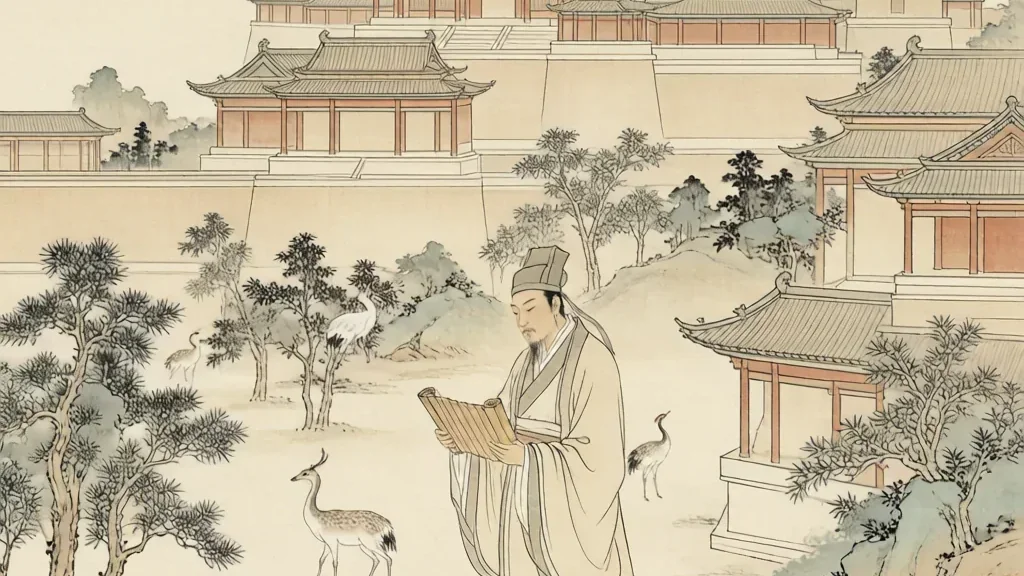
If the Tang dynasty is remembered for its poetry, the Han dynasty is remembered for its fu. Written in Chinese as the han fu, "Han rhapsody," this was the dominant literary form of the great empire that unified China, a vast, ornate, and hypnotic mode of writing that is part description, part argument, part word-music. A fu is not a poem in the modern sense and not quite prose; it is a sprawling set piece that names everything in sight — palaces, rivers, hunted beasts, rare birds, rituals, and virtues — in tightly rhymed, parallel lines. For English readers, the Han fu is a revelation of how Chinese literature could be at once encyclopedic and gorgeous, a verbal fireworks display staged for emperors.
What Exactly Is a Fu?
The fu is usually translated "rhapsody" or "prose-poem," and neither word is perfect. It is written in mostly four- and six-character lines, richly rhymed, and given to long catalogues and balanced pairs of phrases. Unlike the shorter, emotion-centered poems of the south, the fu aims at abundance: it wants to leave nothing out. A single fu might devote hundreds of lines to describing one imperial park, listing its plants, animals, hills, and the hunts staged there, then pivot to a moral lecture on moderation. The form loves excess and then, often, scolds itself for loving it.
The word fu itself can mean "to display" or "to set forth," and that is the heart of the mode. The writer displays the world in language, showing off both the glory of the empire and his own verbal dexterity. Reading a great fu in translation loses much of the sound-play, but the sheer scale and confidence still come through.
Origins: From the Songs of Chu to the Han Court
The fu grew out of the lyrical, shamanistic poetry of the south, especially the "Songs of Chu" associated with Qu Yuan, with their wandering rhythms and otherworldly flights. Early masters such as Sima Xiangru and Mei Sheng took that southern richness and yoked it to a new purpose: praising the Han empire. Under a dynasty that had just unified the warring states and built a central administration, the fu became the perfect art form — huge, ordered, and celebratory, mirroring the empire itself.
The Han court encouraged the form because it suited imperial display. Emperors commissioned fu to commemorate hunts, travels, capitals, and rituals. A successful fu could win a poet a post at court; a failed one could still win fame. The form thus became bound up with patronage and power, and many fu carry a buried tension between flattery and quiet warning.
Sima Xiangru and the Art of Magnificence
The towering name is Sima Xiangru, whose "Fu on the Imperial Park" and "Fu on the Capital Hunt" set the standard for grandeur. His descriptions pile image on image until the reader is dizzy with abundance: chariots like clouds, banners like forests, rivers parting for the royal progress. Sima Xiangru was also a famous lover, and his "Fu on the Beautiful Person" helped shape Chinese romantic writing. His career shows the fu at its most dazzling and most political, a spectacle staged for a ruler's pleasure.
Yet even Sima Xiangru often ended his grand fu with a turn, a moment where the indulgent description gives way to advice: the wise ruler enjoys the hunt but remembers the people's toil. This "conversion ending" became a convention, letting poets flatter and instruct at once. It is one of the form's great tricks — to spend a thousand lines on splendor and then suggest, gently, that splendor is not enough.
The Form's Double Life: Description and Debate
Not all fu were pure celebration. A popular sub-type is the "debating fu," in which two imaginary figures — often a guest and a host, or a "Mr. Quandary" and a "Master Resolve" — argue a question such as whether to retire from office or pursue fame. The form lets a writer stage a real inner conflict in public without saying which side is his own. This made the fu a vehicle for personal philosophy as well as public show.
Another strand used the fu for pure description of natural wonders, cities, or objects, indulging the cataloguing impulse for its own sake. Because the form had no fixed length, a writer could be as brief as a few lines or as long as several thousand characters. That flexibility helped it survive long after the Han fell, reappearing in every later dynasty in new clothes.
Decline, Transformation, and Lasting Influence
As the Han weakened, critics began to find the fu hollow — all sound and no substance, a feast of words with little thought. The great historian Ban Gu and others defended it, but taste shifted toward tighter, more meaningful forms. Still, the fu never died. It shrank, grew lyrical, and fed into the parallel-prose style of the medieval period and the song lyric that followed. The Tang and Song masters, even as they favored poetry and guwen prose, wrote fu on cities, autumn, and regret.
The "fu on the red cliff" by Su Shi, written a thousand years after the Han, shows how the old form could be remade into something intimate and philosophical. The DNA of the Han rhapsody — its rhythm, its catalogues, its turn from spectacle to reflection — runs through Chinese writing long after the empire that named it was dust.
Why Read the Han Fu Now
The Han fu is a challenge for modern readers, especially in translation, because it asks us to enjoy abundance for its own sake and to slow down inside a single description for pages at a time. But it rewards the effort. In its lines we see the self-image of China's first great empire: confident, orderly, and endlessly curious about the world it had gathered under one rule. To read a fu is to watch the Han dynasty describe itself into being, one gorgeous parallel phrase at a time. For anyone interested in how literature serves power — and quietly questions it — the Han rhapsody is essential reading.
Ban Gu and the Defense of the Fu
Not everyone admired the fu. The historian Ban Gu, himself a fu writer, recorded criticism that the form was devoid of substance, all sound and no meaning. Yet he also wrote some of the most ambitious fu of the Eastern Han, including descriptions of the two capitals, and he defended the form as a vehicle for displaying the empire's order and wealth. This tension runs through the whole tradition: poets knew the fu could be empty display, and they answered by adding moral turns and serious content. The debate shows the form was taken seriously enough to be worth arguing about, not merely enjoyed as entertainment.
An Encyclopedia in Verse
At its heart the fu is a way of naming the world. A single rhapsody might list every bird in an imperial park, every tribute brought to the capital, every ritual vessel in a temple, building a verbal map of the empire's reach. This cataloguing was more than boast; it expressed a belief that to know things by name is to hold the world in order. The fu thus served as a kind of encyclopedia dressed as art, teaching readers the geography, flora, and ceremonies of a unified state. Its abundance is its argument: the Han empire is so vast that only an endless list can begin to contain it.
❓ Frequently Asked Questions
📝 Chinese Vocabulary
汉赋 — : The Han rhapsody, the dominant elaborate poetic form of the Han dynasty.
赋 — : Rhapsody or prose-poem; to display or set forth in language.
司马相如 — : Sima Xiangru, the acknowledged master of the grand fu.
楚辞 — : Songs of Chu, the southern poetic source from which the fu developed.
辞赋 — : A general term for the rhapsodic, descriptive poetic mode.
班固 — : Ban Gu, the historian who both wrote grand fu and defended the form against critics.
张衡 — : Zhang Heng, the scientist-poet known for descriptive and lyrical fu.
七发 — : Seven Stimuli, a famous fu by Mei Sheng that opens the debating-fu tradition.
🎉 Fun Facts
- A single Han fu could run to several thousand characters, devoting hundreds of lines to describing one imperial park.
- Many grand fu end with a "conversion" in which the poet suddenly warns the emperor that splendor is not enough — flattery with a hidden lesson.
- Sima Xiangru was as famous for his love poetry and elopement as for his imperial rhapsodies.
- The fu survived a thousand years after the Han; Su Shi's "Fu on the Red Cliff" is a later masterpiece in the same tradition.
- The fu was sometimes performed aloud at court, since its rhyme and rhythm made it a kind of spoken spectacle as much as a written one.
- A sub-genre called the fu on things described a single object, such as a sword or a screen, in painstaking detail, showing the form's love of cataloguing.