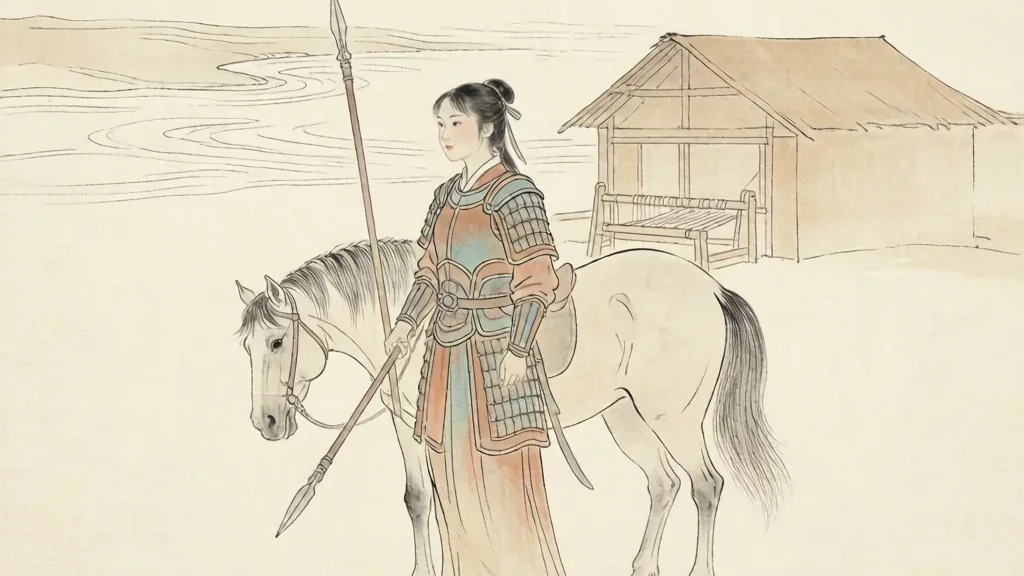
Before she was an animated Disney heroine, Mulan was a few dozen lines of anonymous Chinese verse — and those lines have outlasted empires. Mulan Ci, "The Ballad of Mulan," is a northern folk song preserved in a sixth-century collection, the story of a girl who takes her aged father's place in the army, fights for a dozen years, and returns home to put on her old clothes. It is one of the most famous poems in the Chinese language and a rare early voice for female courage. For English readers, Mulan is the original "she disguised herself and won," a ballad that asks what a daughter owes her family and what a person owes no one but themselves.
Where the Ballad Lives
"The Ballad of Mulan" survives in the "Musical Records of the Old and New" compiled by Guo Maoqian in the twelfth century, though the poem itself is much older, probably from the Northern Wei period (fourth to sixth centuries). That was an era of constant frontier warfare between Chinese states and steppe peoples, when conscription reached deep into villages. The ballad's origins in that hard, militarized north explain its plain, urgent tone: this is a song from a society that knew what it cost to send a son to war.
Because it entered the yuefu folk-song tradition, the poem was meant to be sung. Its short lines and repeated refrains — the famous opening "Click-clack, click-clack" of the loom — are the sound of a household at work and a daughter at a decision. The music is long gone, but the rhythm still carries the urgency.
The Poem: From Loom to Battlefield
The ballad opens with Mulan sighing at the loom: a conscription list has come, and her father is too old, her young brother too small, to go. She resolves to buy a horse and saddle and take his place. In quick, vivid strokes the poem follows her march to the army, her years at the cold frontier, and the campaigns won. "The sentry geese cry in the dawn frost; the general dies in a hundred battles; the brave warrior return after ten years." The war is evoked in a handful of images, not described at length — the folk song trusts the listener to feel the cold.
After victory, the emperor offers Mulan high office and riches; she asks only for a swift camel to carry her home. There the poem slows into domestic joy: she changes back into a girl's clothes, sits by the window, puts up her hair, and greets her astonished comrades. The famous closing riddle compares Mulan to a he-foot and she-foot rabbit: you cannot tell the male from the female once they run side by side.
Themes: Filial Devotion and Female Agency
The poem's first impulse is filial piety. Mulan goes to war not for glory but to spare her father — the Confucian virtue of children repaying parents is the stated motive. Yet the ballad also quietly subverts the gender order. A girl proves herself the equal of any soldier and then refuses the rewards of masculinity, choosing the window and the mirror over the court. She is neither punished nor married off as a prize; she simply goes home. That resolution was strikingly unusual in early Chinese literature.
Mulan's appeal lies in this balance. She honors her family and asserts herself; she enters the male world and leaves it intact, having never wanted to live there. The ballad does not preach liberation, but it shows a woman doing what no one thought a woman could, and being celebrated for it by the very state she served.
Mulan and the Question of History
Scholars agree Mulan is a legend, not a documented person. The name "Mulan" may be a flower name rather than a surname, and the setting blends Chinese and steppe elements typical of the Northern Wei frontier. What matters is that the figure crystallized a real social fact: in wartime, women's labor and even women's bodies were borrowed by necessity. The ballad remembers that borrowing and turns it into honor rather than grievance.
Later eras remade Mulan to taste. The Ming novelist added a marriage and a return to battle; the Qing stage made her a paragon of loyalty and filiality; the modern state promoted her as a patriotic model. Each version tells us less about a sixth-century girl than about the age that retold her — which is itself a kind of history.
From Poem to Global Icon
Mulan entered Western consciousness slowly, through translations in the nineteenth and twentieth centuries, and then explosively through film. The 1998 animated feature turned the ballad into a worldwide brand while simplifying its themes into "be true to yourself." Later Chinese and American productions returned some of the military and familial weight. However filtered, the core image — a daughter in armor — travels because it is both specific and universal.
The gap between the spare poem and the glossy films is worth noting. The original Mulan says almost nothing about romance; her bond is with her parents and her fellow soldiers. The ballad's power is its restraint: it trusts a few images — the loom, the snow, the old clothes — to carry a whole life. That economy is why the poem, not the movies, remains the real Mulan.
Why the Ballad Still Sings
"The Ballad of Mulan" endures because it refuses the choice between duty and self. Mulan is filial and free, soldier and daughter, legend and ordinary girl, all at once. In a literature often wary of women with swords, she stands as early proof that courage has no fixed face. For readers meeting her in English, the poem is a small, perfect machine: open it and a thousand years of northern wind, frontier frost, and a daughter's steady resolve come pouring out. She is, and always was, more than a cartoon. She is a few lines of song that taught a civilization to imagine a girl at war — and to cheer her home.
Language and the Ballad's Form
The Ballad of Mulan belongs to the northern yuefu tradition, and its power comes from plain, driving speech rather than elaborate ornament. Short lines and repeated refrains build momentum: the loom clicks, the summons comes, the march begins, the snow falls. The poem trusts a handful of images to carry a whole life, and its famous closing riddle about the male and female rabbit shows how little the ballad explains and how much it implies. Because it was meant to be sung, the rhythm does the emotional work, letting grief, resolve, and relief surface in the sound before they are named. This economy is why the poem outlasted longer, richer accounts of the same era and why it still reads as urgent after fifteen hundred years.
Mulan on the Operatic and Stage Stage
Long before film, Mulan lived on the Chinese stage. Ming and Qing dramatists expanded the spare ballad into full plays, adding a marriage, further battles, and comic subordinates, turning the solitary daughter into a household name of the theater. Local operas from the north and south staged her homecoming and her refusal of office, and storytellers wove her into the repertoire of heroic women alongside Hua Mulan troupes. These stage versions fixed many details the original omits, such as her family's reaction and the emperor's gift, and they carried the figure to audiences who would never read the ancient poem. The stage thus became the bridge between the sixth-century folk song and the modern global icon, preserving Mulan as a performing character long before she reached the screen.
❓ Frequently Asked Questions
📝 Chinese Vocabulary
木兰辞 — : The Ballad of Mulan, a northern folk song.
木兰 — : Mulan, the daughter who takes her father's place in the army.
乐府 — : The Music Bureau folk-song tradition in which the ballad was preserved.
从军 — : "To join the army," the act at the heart of the tale.
孝 — : Filial piety, the duty to parents that motivates Mulan.
唧唧 — : The onomatopoeic sound of the loom with which the ballad opens, as Mulan sighs while weaving before the conscription list arrives.
可汗 — : Khan, the title the northern ballad uses for the ruler who issues the military summons Mulan answers in her father's place.
巾帼 — : Women's headgear; by extension a term for heroines, used of Mulan as a woman who matches any man in battle.
🎉 Fun Facts
- The poem opens with the onomatopoeic "click-clack" of Mulan's loom as she worries about the conscription list.
- Mulan serves about twelve years and is offered high office by the emperor, which she refuses for a ride home.
- The ballad's famous closing compares Mulan to a running rabbit, whose male and female you cannot tell apart in motion.
- The original poem contains almost no romance; the love interest is largely a modern film invention.
- The Ballad of Mulan survives only because Guo Maoqian gathered it into his twelfth-century yuefu anthology; without that collection the poem might well have been lost.
- Mulan is still honored with temples and a local cult in Yucheng, Henan, the place legend gives as her home, where she is shown in armor as a model of filial devotion.