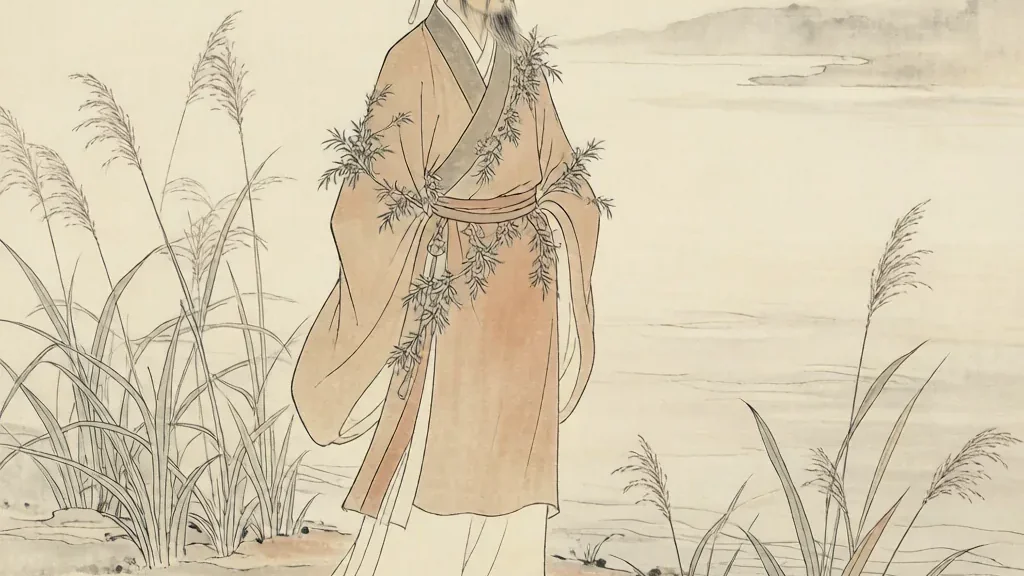
Chu Ci (楚辞), or 'Songs of Chu,' is one of the two foundational anthologies of classical Chinese poetry alongside the Shi Jing (Book of Songs). Compiled during the Western Han dynasty around the 2nd century BCE by Liu Xiang, the collection is primarily attributed to Qu Yuan (c. 340–278 BCE), a nobleman and statesman of the southern state of Chu during the Warring States period. Unlike the restrained, ritualistic verses of the Shi Jing, Chu Ci bursts with wild shamanistic imagery, elaborate floral symbolism, and deeply personal lament — representing a distinctly southern voice in ancient Chinese literature that would echo through millennia.
The Birth of Chu Poetry: A Southern Elegy
The state of Chu, which occupied the middle and lower Yangtze River valley during the Warring States period, was a world apart from the northern states of the Central Plains. Its landscape of mist-shrouded mountains, vast marshlands, and subtropical forests nurtured a culture deeply infused with shamanism, spirit worship, and a rich tradition of ritual song and dance. Unlike the rational, ancestor-focused religion of the northern Zhou states, Chu spirituality was animistic: people worshipped river spirits, mountain deities, and celestial powers, believing that shamans (巫, wu) could travel between the human and divine realms. This cultural environment produced a poetic tradition radically different from the restrained, ritualistic verses of the north. The Chu Ci collects this tradition at its most developed form — poems that are personal, passionate, and filled with supernatural encounters. The collection includes works by several poets, but the overwhelming presence is Qu Yuan, the exiled minister who transformed political despair into some of the most extraordinary poetry in world literature.
Qu Yuan and 'Li Sao': The Poet as Exile and Martyr
Qu Yuan was born into the royal clan of Chu and served King Huai of Chu as a trusted minister, advocating for resistance against the expansionist Qin state to the west. His political career ended catastrophically when rival courtiers, jealous of his influence, slandered him to the king. Qu Yuan was exiled, wandering the banks of the Xiang and Miluo Rivers, composing poetry that fused personal anguish with cosmic vision. His magnum opus, 'Li Sao' (离骚, 'Encountering Sorrow'), is a poem of 373 lines and nearly 2,500 characters — one of the longest poems surviving from the ancient world. In it, the poet embarks on a celestial journey, mounting a phoenix-drawn chariot, commanding the sun god Xihe to slow his course, and seeking a just ruler across heaven and earth. The poem alternates between exaltation and despair, cosmic ambition and bitter disillusionment. Its driving rhythm, built on the characteristic use of the exclamatory particle '兮' (xi) as a caesura, gives the verse a haunting, song-like quality. When Qu Yuan learned in 278 BCE that the Qin general Bai Qi had sacked the Chu capital of Ying, he clasped a heavy stone to his chest and drowned himself in the Miluo River — an act of political protest and spiritual desperation that made him China's first poet-martyr.
The Romantic Imagination: Chu Ci and the Rise of Lyric Individualism
Chu Ci introduced a radically new mode of poetic expression into Chinese literature — what later critics would recognize as the origins of Chinese romanticism. The 'sao' style (骚体), named after Li Sao, broke decisively from the conventions of the Shi Jing: where the earlier anthology used restrained four-character lines and impersonal, ritualistic themes, Chu Ci employed irregular line lengths, emotional intensity, and a first-person voice that spoke directly of the poet's inner experience. The poet presents himself not as a spokesman for his community but as a solitary individual, misunderstood and rejected by a corrupt society. This autobiographical impulse — the poet's self as the center of the poetic universe — was unprecedented in Chinese letters. It opened a space for lyric individualism that later poets from Li Bai to Su Shi would explore and expand. The Tang dynasty poet Li Bai's famous declaration "I was born with talents that must be used" echoes the defiant self-confidence of Qu Yuan's voice. The romantic sensibility of Chu Ci also manifested in its treatment of nature: where the Shi Jing used natural images as conventional symbols (a plum tree for courtship, fish for abundance), Chu Ci described landscapes with a painterly attention to atmosphere and emotion — mist over rivers, autumn orchids in the rain, the melancholy beauty of the southern wilderness.
Fragrant Grasses and Beautiful Women: The Symbolic Language of Virtue
The botanical imagery of Chu Ci represents one of the most elaborate symbolic systems in Chinese poetry. Qu Yuan consistently uses fragrant plants — thoroughwort (芷, zhi), angelica (白芷, baizhi), autumn orchids (秋兰, qiulan), and asarum (细辛, xixin) — to represent virtuous conduct and political integrity, while foul weeds like mugwort (艾蒿, aihao) and cocklebur (苍耳, cang'er) symbolize corrupt courtiers. This "fragrant grass-beautiful woman" tradition (香草美人, xiangcao meiren) established a poetic code in which the failure of rulers to appreciate virtue was figured as a lover's betrayal or a woman's rejection. The poet becomes a spurned lover, the corrupt courtiers become rival concubines, and the neglectful king becomes an inconstant lover. This allegorical framework allowed poets for two millennia to discuss political criticism in the language of romance — a coded discourse that could evade censorship while expressing the most bitter frustrations. Beyond the plant symbolism, Chu Ci draws extensively on mythical geography: the Kunlun Mountains, the Divine Ponds, the Fusang tree where the sun rises, and the realms of the gods. These cosmic journeys represent both the poet's search for an ideal ruler and the shamanic tradition in which the soul travels through celestial realms. The four cardinal directions, the stars, and the seasons all carry symbolic weight, creating a poetic universe in which every natural element is charged with moral and spiritual meaning. This fusion of political allegory, botanical symbolism, and cosmic geography made Chu Ci the most influential single source of imagery in the Chinese literary tradition.
The Nine Songs and the Enduring Legacy of Chu Ci
The 'Jiu Ge' (九歌) or 'Nine Songs,' traditionally attributed to Qu Yuan but likely adapted from Chu folk rituals, are a suite of eleven shamanistic hymns that dramatize encounters between shamans and deities — the Lord of the East, the River Earl, the Mountain Spirit — blending erotic longing with religious awe. The 'Mountain Spirit' poem, describing a goddess waiting in vain for her lover amid bamboo groves and rain, is a scene of sublime melancholy that inspired generations of Chinese painters. These poems are our most precious window into the pre-imperial religious imagination of southern China — a world where humans, spirits, and nature interpenetrate. The influence of Chu Ci on later Chinese literature is immeasurable. The Han dynasty fu (赋) rhapsody is a direct descendant of the sao style. Poets from Cao Zhi to Li Bai drew freely on Chu Ci imagery. Qu Yuan's suicide gave rise to the Dragon Boat Festival (端午节), where boat races reenact the search for his body and zongzi are thrown into the water — a poet so beloved that his death created a 2,300-year-old national holiday, with no parallel in world literature.
Performance and Music in Chu Ritual
The poems of the Chu Ci were not originally silent reading matter. Many, especially the Nine Songs, grew out of the song-and-dance ceremonies of Chu shamanism, in which a human medium invited deities to descend and then sent them away with music, wine, and perfume. The texts preserve traces of this staging: processions, offerings, and the longing of a spirit who arrives and departs. Even Li Sao can be read as a solo shamanic journey, with the poet mounting chariots and summoning dragons. Understanding the Chu Ci as performance helps explain its hypnotic rhythm and its emotional directness, for these are words meant to be chanted, not merely scanned.
Compilation and the Work of Commentators
The Chu Ci we read today is the product of centuries of editing. After Qu Yuan's death the poems circulated separately, some attributed, some anonymous, until the Han scholar Liu Xiang gathered them into a single anthology in the second century BCE and fixed much of the present ordering. The collection might have faded, but the Eastern Han commentator Wang Yi produced the Chu Ci Zhangju, the earliest surviving line-by-line commentary, preserving both the text and its allegorical readings for later readers. From the Tang through the Qing, scholars produced new annotations, editions, and illustrations, each generation finding in the poems what its own age needed.
From Chu Ci to the Han Rhapsody
The Chu Ci did more than inspire lyric poets; it shaped the very form of Han dynasty literature. The fu, or rhapsody, inherited the sao style's love of long descriptive lines, exclamatory particles, and cosmic travel, turning Qu Yuan's solitary flight into the empire-praising spectacle of the Han court. Early fu writers such as Sima Xiangru openly echoed Chu Ci rhythms, and the two forms remained linked for centuries. Even the habit of using natural symbols as moral code passed from the fragrant-grass tradition into later poetry. In this sense the anthology is a parent of two streams of Chinese writing: the intimate lyric of personal feeling and the grand public display of verbal abundance.
❓ Frequently Asked Questions
Key Terms
离骚 / 楚辞 屈原 (Qū Yuán) 九歌 (Jiǔ Gē) 天问 (Tiān Wèn) 招魂 (Zhāo Hún) 香草美人 (Xiāng Cǎo Měi Rén) 巫 (Wū) 骚体 (Sāo Tǐ)Fun Facts
- The 'Tian Wen' (Heavenly Questions) contains 172 questions about mythology, history, and cosmology — all posed without a single answer.
- Qu Yuan is one of the few poets in the world whose death anniversary is observed as a national public holiday (Dragon Boat Festival).
- The Chu Ci was lost for centuries before Wang Yi of the Eastern Han dynasty (2nd century CE) compiled, annotated, and preserved it with his 'Chu Ci Zhangju' commentary.
- The Nine Songs were likely sung and danced as Chu ritual performances long before they were read as literature.
- Qu Yuan's life created the enduring ideal of the wronged but loyal official, a model later scholars invoked when protesting corrupt rulers.
- The anthology's southern, shamanistic imagery set it apart from the restrained northern Book of Songs and gave Chinese poetry a second great fountainhead.