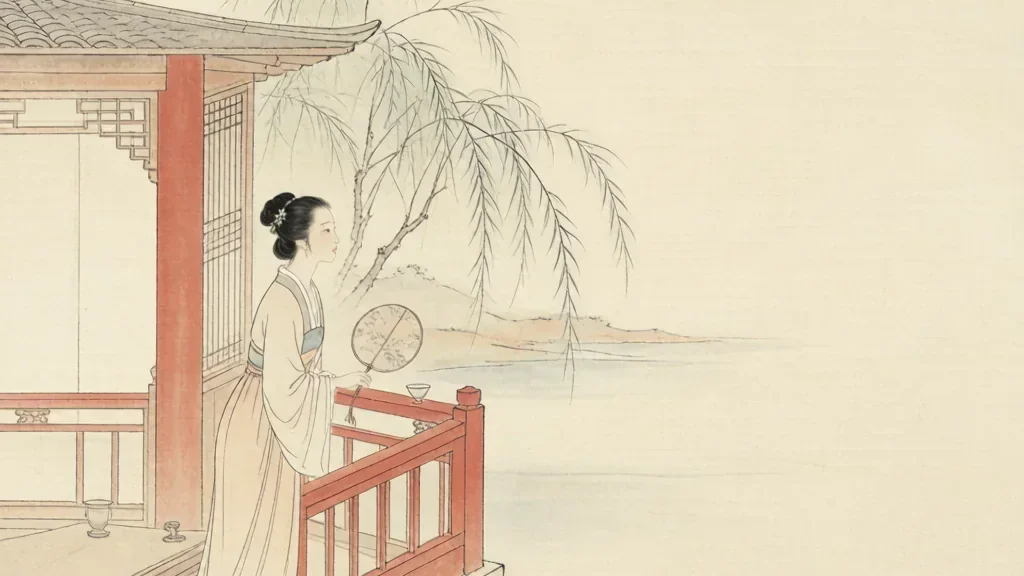
If Tang Dynasty poetry is classical Chinese literature at its most majestic, Song Dynasty ci poetry (宋词) is Chinese literature at its most intimate. Emerging from the entertainment quarters of the Tang and perfected during the Song (960-1279), ci were originally lyrics written to fit existing melodies — the pop songs of their day. Courtesans and singing girls performed them at banquets, accompanied by string and wind instruments. Over time, what began as popular entertainment evolved into one of China's most sophisticated literary forms, capable of expressing the subtlest shades of emotion.
The Song Dynasty represented a dramatic shift from Tang cosmopolitanism. Where the Tang empire had been outward-looking, expansive, and militarily confident, the Song turned inward, cultivating refinement, scholarship, and introspection. The ci form was perfectly suited to this new sensibility — its irregular line lengths and prescribed tonal patterns allowed for a musicality and emotional nuance that the rigid structures of Tang shi poetry could not match.
What Is Ci Poetry? Form and Musical Origins
The word ci (词) simply means "words" or "lyrics," reflecting its origin as text set to music. Each ci poem is written to a specific cipai (词牌), or "tune title," which determines the poem's line lengths, number of lines, and tonal pattern. There were over 800 recognized tune titles, each with its own emotional association. A poet choosing the tune title "Butterflies in Love with Flowers" (蝶恋花) knew they were working within a tradition of romantic longing, while "The River Is Red" (满江红) carried expectations of heroic passion.
This is fundamentally different from writing shi poetry, where the poet creates both form and content. A ci poet fills in the words to a pre-existing musical and prosodic template — a constraint that demanded extraordinary skill. The great ci poets made these constraints invisible, creating the illusion that the words had naturally chosen their own shape.
The musical dimension cannot be overstated. Unfortunately, the original melodies have been lost to history. What remains is the poetry itself — a ghost of music preserved in the rhythm and cadence of the words. When read aloud in the proper tone, a well-crafted ci still sings, even without its original accompaniment.
Su Shi: The Bold and Unconstrained Master
Su Shi (苏轼, 1037-1101), also known by his literary name Su Dongpo, was the Renaissance man of the Song Dynasty — poet, essayist, calligrapher, painter, statesman, and gourmand. His contribution to ci poetry was revolutionary: he broke the convention that ci should only express delicate, feminine emotions and proved that the form could handle any subject, from philosophical meditation to political protest.
Su Shi's life was marked by repeated political exiles. A victim of factional struggles at court, he was banished to increasingly remote regions — Huangzhou, Huizhou, and finally the tropical island of Hainan. Rather than breaking his spirit, exile deepened his art. His most celebrated ci, written to the tune "Charm of a Maiden Singer" (念奴娇), opens with the immortal lines:
"The Great River flows east, its waves sweeping away the heroes of ages past."
These words, written while gazing at the Yangtze River near the site of the ancient Battle of Red Cliffs, compress cosmic time and personal emotion into a single sweeping gesture. The poem moves from the grandeur of history to the poet's own white-haired reflection in the water, ending with a toast to the moon — a characteristically Su Shi blend of heroic melancholy and Daoist acceptance.
Su Shi founded what critics call the haofang (豪放, "bold and unconstrained") school of ci. Before him, ci was considered a "feminine" genre, suitable only for love lyrics and boudoir laments. Su Shi demonstrated that the form could carry the weight of history, philosophy, and masculine emotion, elevating ci to equal status with shi poetry.
Li Qingzhao: The Voice of Delicate Restraint
If Su Shi represents the bold yang of Song ci, Li Qingzhao (李清照, 1084-1155) represents its exquisite yin. Widely regarded as China's greatest female poet, Li Qingzhao perfected the wanyue (婉约, "delicate and restrained") style that had dominated ci before Su Shi's innovations. Her poems are marvels of compression — a few dozen characters can suggest an entire emotional landscape.
Li Qingzhao's life divides sharply into two halves. In her youth, she enjoyed a happy marriage to the scholar Zhao Mingcheng, with whom she shared a passion for art collecting and antiquities. Her early poems celebrate love, beauty, and the pleasures of a cultured life. One famous ci describes her teasing a maidservant after a night of drinking, asking whether the crabapple tree still blooms — a scene of playful intimacy unprecedented in Chinese literature by a woman.
The Jurchen invasion of 1127 destroyed this world. Li Qingzhao fled south with what remained of her collection, her husband died en route, and she spent her remaining years as a refugee widow. Her late poetry transforms personal grief into universal lament. The playful girl who once asked about crabapple blossoms now writes:
"Searching, seeking — cold, clear — miserable, wretched, sad. The season of sudden warmth then cold — hardest to bear."
These opening lines of her most famous ci, to the tune "Slow, Slow Song" (声声慢), use seven pairs of reduplicated characters to create a rhythmic pattern of accumulating sorrow. No translation can fully capture the effect, but the original Chinese feels like rain dripping on a lonely windowsill.
The Bold vs. Delicate Debate
The tension between the haofang (bold) and wanyue (delicate) styles is one of the enduring conversations in Chinese literary criticism. The terms were first applied systematically by the Ming Dynasty critic Zhang Yan, and they have shaped how readers approach ci ever since.
Bold style poets — Su Shi and his follower Xin Qiji — wrote about history, politics, and philosophy. Their language was direct, their imagery drawn from the masculine world of battlefields and great rivers. They expanded the emotional range of ci to include everything that shi poetry could express.
Delicate style poets — Li Qingzhao, Liu Yong, and Qin Guan — focused on love, loss, and the fleeting beauty of the natural world. Their language was allusive and refined, their imagery drawn from the inner chambers, gardens, and seasonal changes. They honored the genre's origins in music and feminine sensibility.
In truth, the greatest poets moved between these modes. Su Shi could write exquisitely tender lyrics, and Li Qingzhao could summon heroic resolve. The bold/delicate dichotomy is best understood not as a rigid classification but as two poles of a spectrum along which individual poems find their place.
The Living Legacy of Song Ci
Song ci continues to resonate in contemporary Chinese culture in ways both obvious and subtle. The poems are standard material in Chinese language textbooks. Calligraphers favor ci for their visual beauty and rhythmic variety. Contemporary Chinese songwriters occasionally set classical ci to modern melodies, creating a bridge across a thousand years of musical tradition.
Beyond China, ci poetry offers Western readers a window into a mode of expression quite different from the Western lyric tradition. The interplay between fixed form and personal emotion, the assumption that poetry should be sung, and the integration of literature with the other arts — poetry, music, calligraphy, painting — all challenge modern assumptions about what poetry can be.
Perhaps the deepest appeal of ci is its intimacy. These are poems written for private moments — a parting, a sleepless night, a glimpse of plum blossoms through a window. Reading them feels like overhearing a conversation meant for someone else, a sensation that the best lyric poetry in any language can produce. Song ci invites us into the inner lives of people who lived a thousand years ago and shows us, in their own words, that they loved and grieved just as we do.
The Tune System and How Ci Were Composed
Every ci is written to a cipai, a tune title that acts as a rigid prosodic mold. The title decides how many lines the poem has, how long each line is, where the tones must rise or fall, and often where a pause falls. A poet choosing Butterflies in Love with Flowers works inside a tradition of longing, while The River Is Red carries heroic expectation. This means composition is a kind of fitting, setting fresh words to an old melody's shape, and skill lies in making the constraint invisible. For readers the tune supplies a mood before a word is read. The system also explains the form's musical intimacy: a ci is, fundamentally, words awaiting a song, a poem that remembers it was once sung.
Ci in the Southern Song and Beyond
After the Jurchen conquest of 1127, ci took on a weight of exile and loss. Li Qingzhao's later poems turn personal grief into national lament, while Xin Qiji, a soldier denied a war to win, poured frustrated heroism into bold, history-haunted lines. The Southern Song thus deepened the form's range, joining public sorrow to private feeling. In later dynasties ci never lost favor: Ming and Qing critics codified the styles, women poets took up the delicate mode, and the Qing produced a late flowering of masters. Through the exam system and the brush, ci stayed a living art for eight centuries. Its survival shows how a song form, once lifted into literature, can keep speaking across changed worlds.
Ci and the Other Arts
Ci was never only literature, because it was born of music and soon joined calligraphy and painting. A fine ci made an ideal subject for a scroll: its uneven lines and rhythmic turns gave the calligrapher room to show breath and pace, and a painted plum branch or lonely river could illustrate its mood. Singers kept the words audible long after the tunes faded, and garden designers named pavilions after famous lines. This integration meant that to know a ci was to enter a whole aesthetic, where sound, stroke, and image reinforced one another. The form's intimacy suited the scholar's studio, where a short lyric could sum up an evening's feeling, and its cross-media life is a large part of why ci still feels so alive on the page.
❓ Frequently Asked Questions
📝 Chinese Vocabulary
- 词 (cí) — Ci poetry; originally "lyrics" written to fit existing melodies
- 词牌 (cí pái) — Tune title; the musical template that determines a ci poem's structure
- 豪放 (háo fàng) — Bold and unconstrained style; associated with Su Shi and heroic themes
- 婉约 (wǎn yuē) — Delicate and restrained style; associated with Li Qingzhao and romantic themes
- 东坡 (Dōng Pō) — "Eastern Slope"; Su Shi's literary name, taken from the farm he cultivated during exile
🎉 Fun Facts
- Su Shi invented a famous dish — Dongpo Pork (东坡肉) — during his exile in Huangzhou. He even wrote a poem about the recipe, making him perhaps the only major poet to also be a culinary innovator.
- Li Qingzhao was also a fierce literary critic. She wrote an essay dismissing virtually all the major male ci poets of her era — including Su Shi — for not properly understanding the musical nature of the form.
- There are over 800 known cipai (tune titles), but many poets created their own. Jiang Kui, a Southern Song poet-musician, was one of the few who composed both lyrics and music — some of his musical notation survives.
- The bold-style master Xin Qiji was also a military leader who fought the Jurchen invaders, and his ci often voice the frustrated heroism of a soldier's life.
- Although ci were written to melodies, almost all the original tunes have been lost; what survives is the lyrics, whose rhythm still hints at the music.
- Ci first flourished in the singing houses of the Tang and Five Dynasties, performed by courtesans before educated men like Su Shi raised it to high literature.