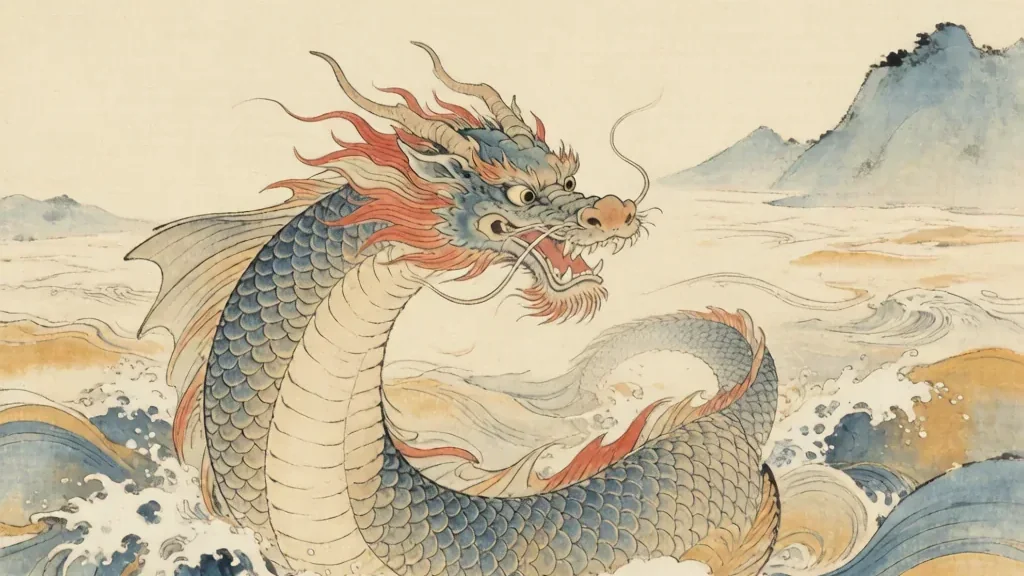
When the great floods threatened to drown the world, a dragon with wings rose from the storm to answer the call. Yinglong, the 应龙 (), is the winged dragon of Chinese myth, the creature who brought the rains that ended the deluge and who aided the heroes who shaped early China. Unlike the hornless Jiaolong of the deep or the coiling river dragons, Yinglong bears wings and stands among the highest of dragon kinds, a servant of heaven and a master of water. This article follows Yinglong from the flood myths to the battlefields of the culture heroes, and shows why a winged dragon became a symbol of timely, life-giving power.
What Kind of Dragon Is Yinglong?
Yinglong is usually translated as the "Responsive Dragon" or the "Winged Dragon." The name suggests a dragon that answers a need, that comes when called. It is counted among the ranks of dragons but is special for its wings, a feature most Chinese dragons lack. In the traditional hierarchy of dragon kinds, the winged Yinglong sits near the top, associated with the sky and with the controlled release of rain, rather than with the untamed depths.
The wings mark Yinglong as a bridge between earth and heaven. Ordinary dragons move through water and cloud, but the winged dragon can rise fully into the upper air, where it meets the commands of the gods. This gives Yinglong a role as a messenger and an agent of celestial will, the dragon most trusted to carry out a task that requires both strength and flight. It is, in short, the dragon that heaven sends when the matter is urgent.
Yinglong and the Great Flood
The most famous deed of Yinglong is its part in the taming of the great flood. In Chinese myth the world was once overwhelmed by rising waters that no dike could hold. The culture hero who took up the task, in some versions Gun and in others his son Yu the Great, needed help from the powers of water and sky. Yinglong answered by using its wings to stir the rains and by showing the way to channel the torrents into the sea.
The winged dragon's role was double: it both commanded the waters and taught their control. By beating the air it could summon or still the rain, and by tracing great furrows with its body it showed where the rivers should run. The flood story thus presents Yinglong as the instrument by which chaos becomes order, the wings that turned a drowning world into a watered and fruitful one. Without it, the heroes could not have finished their work.
Ally of the Yellow Emperor and Yu the Great
Yinglong appears as an ally of the founders of civilization. In the wars that established the Yellow Emperor's rule, the dragon is said to have fought on his side, using wind and water against his enemies. Later, in the labor of Yu the Great to drain the flood, Yinglong guided the digging of channels so that the rivers found their beds. In both cases the winged dragon serves the orderly power against disorder.
This loyal service made Yinglong a model of the helpful celestial being, the creature that does not seize rule for itself but lends its strength to the rightful hero. The dragon's wings carried the will of heaven to the fields of men, and its rain fell where it was needed. Such a figure fit the Chinese belief that nature, properly honored, cooperates with human virtue rather than opposing it.
The Dragon That Made the Rivers
A striking image in the Yinglong lore is that the dragon's body, dragging across the land, carved the courses of the great rivers. The furrow left by its passage became a channel, and the channel became a river that still flows. This myth explains geography as the handwriting of a winged dragon, a poetic way of saying that the land's shape was given by water moving with purpose under heavenly guidance.
The idea also links Yinglong to the practical Chinese concern with irrigation and flood control. A culture that lived or died by its rivers would naturally tell a story in which the perfect river was drawn by a perfect dragon. Yinglong is thus both a wonder and an engineer, the mythical author of the waterways on which farms and cities depended. To honor the dragon was, in a sense, to honor the science of water.
Wings, Rain, and the Sky's Command
The wings of Yinglong connect it to the upper heavens and to the dispatch of rain, which in agricultural China was the gift that meant life or famine. Dragons were long held to be masters of rain, and the winged kind was the one most directly under the sky's orders. When a drought pressed the land, the proper response was to appeal to the dragons, and among them Yinglong was the one who could fly to the cloud and release the needed water.
This role gave the winged dragon a place in ritual as well as story. Communities facing dry fields might perform dances or rites that invoked the dragon of rain, hoping to stir the same power Yinglong represented. The creature stood for the belief that the weather, though mighty, was not random but answerable to a higher order, and that a winged servant of heaven could open the skies when the time was right.
Yinglong's Legacy in Art and Memory
Yinglong survives in murals, on bronze and jade, and in the long tradition of dragon art where a winged form signals a dragon of the highest rank. It appears in the "Classic of Mountains and Seas," where its deeds are recorded among the wonders of the age of heroes. Scholars of myth point to Yinglong as proof that the Chinese dragon was never only a water beast but could be a sky-borne agent of cosmic order.
The lasting appeal of Yinglong is the appeal of power used at the right moment. A winged dragon that ends a flood is a promise that even the worst deluge has a limit, and that help can come from above when virtue calls. To remember Yinglong is to remember that the rains, though they can destroy, were also the first thing that made the valleys green, and that the dragon who once saved the world with its wings is, in the Chinese heart, still on watch.
Yinglong and the Yellow Emperor's Wars
Before the flood, Yinglong earned its place in myth by fighting for the Yellow Emperor in the wars that founded his rule. Legends say the winged dragon summoned wind and water against the emperor's enemies, turning the weather itself into a weapon. In the great contest with the rebel god Chi You, who called up mist and storm, Yinglong's controlled rains helped clear the field and secure victory. This martial service matters because it shows the dragon as an agent of order from the very beginning, not merely a helper of engineers. The same wings that later drained the flood first won the realm for civilization's founder. Read together, the war and the flood present one consistent picture: Yinglong is heaven's instrument whenever chaos must be met with disciplined, timely force.
Yinglong in Ritual and Rain Dances
Because Yinglong was the dragon most directly under the sky's command, communities facing drought turned to it in ritual. Villagers performed dragon dances with cloth and bamboo, whirled poles hung with paper streamers, and beat drums to stir the sleeping rain dragon, hoping to echo Yinglong's power to open the clouds. In some regions a winged dragon figure led the procession, distinct from the ordinary water dragon, to signal that the highest rain-bringer had been invoked. These rites treated weather not as random but as answerable to a higher order, a belief the myth of Yinglong made vivid. Even today, dragon dances at festivals carry a trace of that old appeal: a people asking the winged servant of heaven to remember the world it once saved, and to send the waters that make the valleys green.
❓ Frequently Asked Questions
📝 Chinese Vocabulary
应龙 — : the Winged Dragon, or Responsive Dragon.
黄帝 — : the Yellow Emperor, whom Yinglong aided in battle.
大禹 — : Yu the Great, the hero who tamed the flood with the dragon's help.
洪水 — : the great flood, the disaster Yinglong helped end.
雨 — : rain, the gift the winged dragon was master of.
翼 — : Wing, the feature that sets the sky dragon apart from other dragons.
雷 — : Thunder, the celestial force often paired with rain dragons.
旱 — : Drought, the calamity Yinglong's rain relieves.
🎉 Fun Facts
- Yinglong is unusual among Chinese dragons because it has wings, a trait shared by only a few of the highest dragon kinds.
- One myth says the great rivers were carved by the furrow Yinglong's body left as it dragged across the land.
- The dragon's name can mean "Responsive," suggesting it appears whenever heaven calls it to act.
- Yinglong appears in the "Classic of Mountains and Seas," one of the oldest sources of Chinese myth.
- In some later tales the aging Yinglong, having spent its strength on the flood, was said to have lost its wings and sunk into the rivers, a poetic explanation for why winged dragons became rare.
- Because Yinglong answered the call to end the flood, the dragon became a patron of engineers and irrigation workers, who honored it as the first builder of China's waterways.