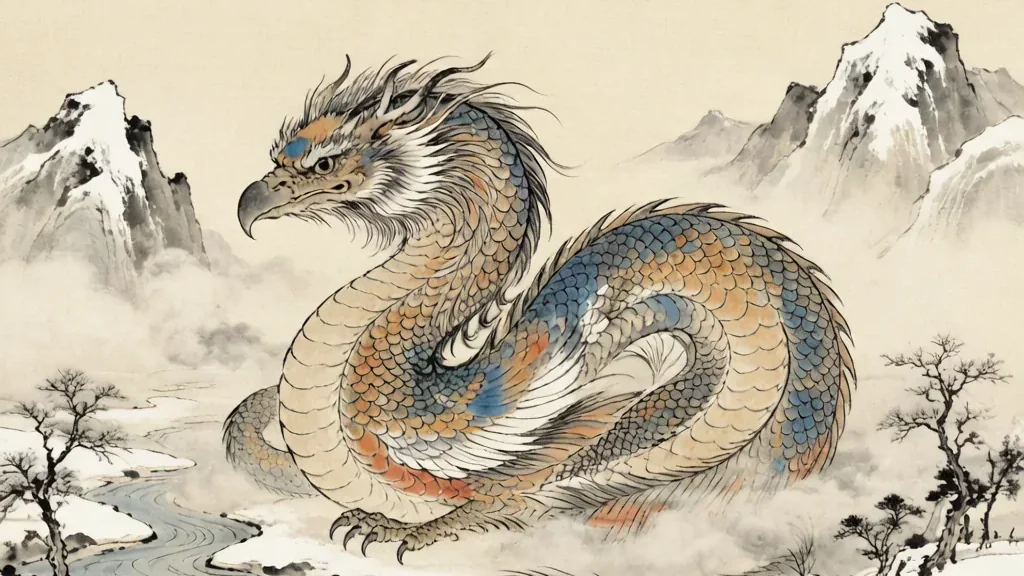
At the cold northern edge of the Chinese cosmos coils a creature older than empires, a black tortoise entwined with a snake, its shell like a mountain and its gaze like deep water. The Black Tortoise, called 玄武 (), is the celestial guardian of the north. Unlike the bright Vermillion Bird of the south or the martial White Tiger of the west, the Black Tortoise is a figure of stillness, endurance, and hidden strength. It rules winter, the element of water, and the long dark that precedes every spring. As one of the Four Symbols it closes the circle of guardians and reminds the world that rest is also a form of power. This article explores the tortoise-snake, its meaning, and its long life in Chinese thought.
The Black Tortoise Among the Four Symbols
The Black Tortoise is the northern guardian of the Four Symbols, the celestial quartet that also includes the Azure Dragon of the east, the Vermillion Bird of the south, and the White Tiger of the west. The north is the direction of water and winter, and the tortoise's dark shell matches the deep, quiet character of that quarter. Its element is water, its season is winter, and its color is black, the color of the night sky and of the unfathomable depths.
As with the other guardians, the Black Tortoise began as a constellation. Ancient star-watchers traced the shape of a snake and tortoise in the northern sky, among the seven northern lodges of the twenty-eight lunar mansions. Over centuries that star-pattern became a living guardian who watched over the northern lands and the dark half of the year. The creature therefore exists both as a map of the heavens and as a spirit of the earth's cold edge.
A Tortoise and a Snake Entwined
What makes the Black Tortoise unusual among the Four Symbols is that it is two creatures at once: a tortoise and a snake wound around it. The pairing may seem strange, but it is rich with meaning. The tortoise is the emblem of long life and steadfastness, slow and certain, carrying its home on its back. The snake is the emblem of renewal, since it sheds its skin and seems to be born again. Together they speak of endurance that is also transformation, a stillness that nonetheless changes.
The snake and tortoise together also balance the wet and the dry, the creeping and the rooted. In art the snake coils around the tortoise's shell or rises from its side, a single guardian made of contrast. This doubling shows the Chinese genius for finding unity in apparent opposites: the creature that does not move and the creature that slides are, in the north, one and the same protector, black, ancient, and unshakable.
Winter, Water, and the Virtue of Stillness
The element of the Black Tortoise is water, and its season is winter. Where the Vermillion Bird's fire blazes and the White Tiger's metal cuts, the tortoise's water gathers and waits. Winter is the time when fields lie fallow and seeds sleep underground, a season that looks like death but is only rest. The Black Tortoise embodies this necessary pause, the wisdom of conserving strength until the moment to act returns.
In a farming society, respecting winter was a matter of survival. The tortoise taught, without words, that not every season is for doing. Its black stillness is a lesson in patience: hold your ground, keep your shell, and let the cold pass. The north in Chinese thought is not a place of evil but a place of retreat and renewal, and the tortoise is its patient king, counting the long nights until the light comes back.
From Star Guardian to a God of the North
Over time the Black Tortoise grew from a constellation into a full deity. In later Daoist and popular religion it became known as the Dark Warrior or the True Warrior of the North, a divine general who subdues demons and protects the faithful. Temples were built in its honor, and stories told of a god who purified himself through trial and earned the right to guard the northern quarter of heaven.
This elevation turned the slow tortoise into a martial saint, a figure of disciplined stillness who could nevertheless strike. The transformation shows how Chinese religion adopted the old sky-beasts and gave them biographies and altars. The farmer's constellation became the worshipper's protector, and the black creature of the north acquired an army of legends about conquest over chaos, all while keeping the shell and the snake that marked it from the start.
The Tortoise in Tombs, Medicine, and Longevity
The tortoise's role as a symbol of long life made it a favorite motif in tombs, gardens, and court art. Stone tortoises were carved to support steles, the tall inscribed pillars that recorded the deeds of emperors, so that memory itself rested on the back of endurance. In medicine and diet the creature's Shell was used in traditional remedies, reflecting the belief that its long life could be shared. To honor the tortoise was to wish for the same slow, steady span of years.
The Black Tortoise also influenced the design of sacred spaces. Northern gates and northern altars might carry its image, and the layout of a temple or a garden could be oriented so that the north was anchored by its dark guardian. Because the north is where the cold and the water gather, placing the tortoise there was a way of saying that even the harshest quarter was known and held. The beast did not fight winter; it simply was winter's calm, watchful heart.
Why the Black Tortoise Endures
The Black Tortoise remains meaningful because it protects a value that busy cultures forget: the value of waiting. In a world that prizes speed and noise, the black guardian of the north insists that some strength is quiet, some wisdom is slow, and some power lies in simply enduring. Its shell is a model of self-containment, and its snake is a model of renewal, two lessons bound into one northern beast.
When people today wear a tortoise charm for luck or plant a garden with a stone tortoise by the pond, they are quoting an idea two thousand years old. The Black Tortoise tells us that the dark half of the year is not the enemy of life but its safeguard, that water is not only a flood but a keeper of balance, and that the north, cold and far, is watched over by a creature who will outlast every storm. That patience is why the tortoise has never been forgotten.
The Wudang Cult
The Ming emperor Yongle rebuilt the Wudang Mountains shrines in Hubei to honor Zhenwu, making the Black Tortoise's human form the focus of a major state cult. Pilgrims still climb to the Golden Hall on Tianzhu Peak, where a gilded Zhenwu statue sits with a snake and tortoise at his feet, and annual festivals reenact his subjugation of demons. This living worship keeps the ancient northern symbol present in contemporary religious life rather than merely as a constellation. Yongle claimed that Zhenwu had aided him in a military uprising, so he spent vast sums enlarging the mountain's temples and funded thousands of bronze and gilded images. The result was a sacred landscape where the tortoise-snake emblem appears on banners, roofs, and ritual bronze, binding a stellar omen to the authority of the throne and to the daily devotion of ordinary worshippers.
In Architecture and Almanacs
As one of the Four Symbols, the Black Tortoise governs the north and is paired with winter, black, and water in the traditional correlative system. Builders placed northern roof tiles and foundation stones under its protection, while almanacs list the tortoise-snake days as favorable for rest and storage. In feng shui the north belongs to the Black Tortoise, so a garden's rear wall or hill is called its 'black tortoise' support, balancing the vermilion bird at the front. Tomb planners likewise set a low northern mound behind the grave to act as the tortoise's shell, sheltering the dead from the cold. Seasonal rites thanked the northern guardian at the winter solstice, when the sun turns north again. Through these practices the constellation shaped not only cosmology but the practical layout of homes, graves, and the agricultural calendar.
❓ Frequently Asked Questions
📝 Chinese Vocabulary
玄武 — : the Black Tortoise, guardian of the north.
四象 — : the Four Symbols, the four celestial guardians.
北方 — : the north, the direction ruled by the Black Tortoise.
龟 — : tortoise, a symbol of long life and steadfastness.
真武 — : the True Warrior of the North, the deified form of Xuanwu.
龟蛇 — : the intertwined tortoise and snake form of the Black Tortoise
北宫 — : the Northern Palace constellation group
七宿 — : the seven lunar mansions of the northern sky
🎉 Fun Facts
- The Black Tortoise corresponds to the seven northern lodges of the twenty-eight lunar mansions, a constellation pattern read as a snake and tortoise.
- Stone tortoises were commonly carved to bear imperial steles, so that the record of a ruler's deeds rested on the back of endurance.
- The Black Tortoise later became a martial deity who conquers demons, showing how a slow constellation could turn into a divine general.
- Tortoiseshell was traditionally used in Chinese medicine because people believed the creature's long life could be passed along.
- In later folk religion the Black Tortoise was personified as the god Zhenwu, who is almost always shown with a snake coiled around a tortoise at his feet.
- Because the north is associated with water and cold, the Black Tortoise was invoked by builders to protect structures from fire, and small tortoise-snake tiles were placed on northern roofs.