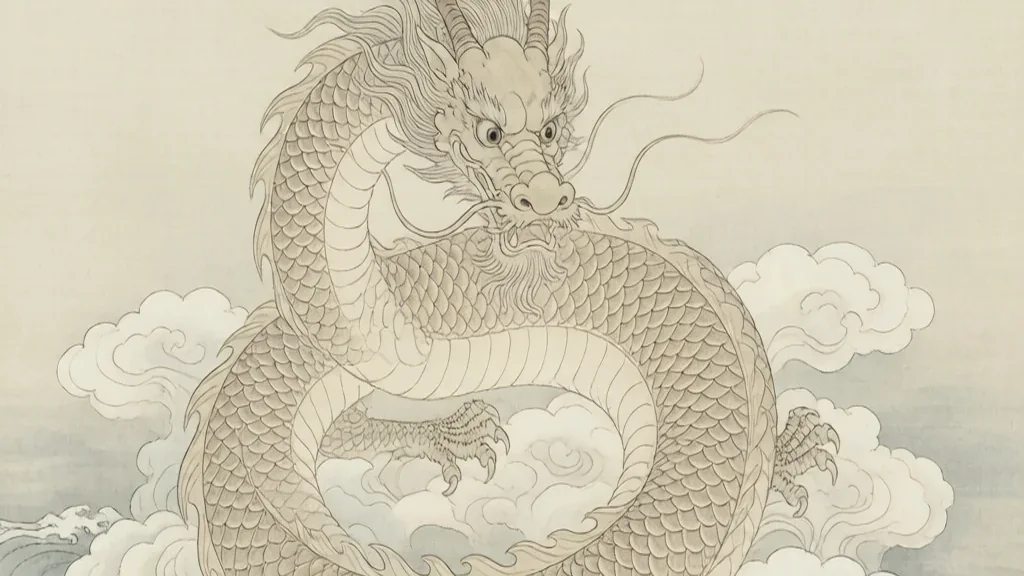
Panlong (蟠龙, pán lóng) is the coiled dragon — a dragon shown curled in a tight spiral, still earthbound and not yet risen to the heavens. The very word pan means "to coil or wind," and the image captures a dragon in potent reserve: all its energy gathered inward, a guardian of springs and lakes and a symbol of power held in waiting rather than power displayed.
What "Coiled" Means
The character 蟠 (pán) carries the sense of something wound round and held close — a snake coiled on a branch, a root twisted underground. Applied to the dragon, it marks a specific stage of the creature's life. The great lexicographer Xu Shen, in his Explaining Graphs and Analyzing Characters (说文解字, Shuowen Jiezi), describes the dragon as a being that "ascends to heaven at the spring equinox and hides in the deep at the autumn equinox" (春分而登天,秋分而潜渊). The panlong is the dragon in its hidden, coiled, watery phase — latent rather than active.
This makes the coiled dragon the opposite of the soaring dragon of ambition and the heavens. It is the dragon of foundations, of still water, and of the patient concentration of force before it is released.
The Coiled Dragon in the Dragon Family
Chinese tradition sorts dragons by stage and habitat, and the panlong sits in the middle of that ladder. Near the bottom is the jiaolong (蛟龙, flood dragon) of marshes and floods; the qiulong (虬龙) is a young dragon, often shown hornless and coiling; the panlong is the coiled dragon not yet ascended; above it the yinglong (应龙, winged dragon) has earned its wings and risen; and the canglong / qinglong (苍龙 / 青龙, Azure Dragon) rules the east as a cosmic constellation. The contrast most often drawn is between the panlong and the shenglong (升龙, ascending dragon): one carves downward in a coil, the other rears upward toward the sky.
In art these two are frequently paired — a coiling dragon and an ascending dragon on facing walls or beams — to express the whole arc of dragonly power from earth to heaven.
Coiled Dragons in Neolithic Jade
The coiled form is the oldest dragon shape preserved in Chinese art. The Hongshan culture (红山文化, c. 4700–2900 BCE) of the Liao River basin carved small jade dragons in a C-shape: a rounded, head-like knob at one end, a long body curved into a near circle, and a prominent snout. These "C-shaped dragons" (玉龙, yù lóng) are among the earliest dragon images anywhere in China, and their closed loop is exactly the panlong posture.
The same culture produced the "pig-dragon" (玉猪龙, yù zhū lóng), a squat, ring-like jade with a blunt snout, again a coiled creature grasped in the hand as a pendant. From the very beginning, then, the Chinese dragon was as likely to be shown curled as stretched — a portable emblem of contained power.
Bronze Age Spirals: The Coiled Dragon Motif
On Shang and Zhou dynasty bronzes (c. 1600–256 BCE), the coiled dragon becomes a repeating decorative grammar. Vessels bear panlongwen (蟠龙纹, "coiled dragon patterns") in which a single dragon bites or nearly bites its own tail within a medallion, and later panhuiwen (蟠虺纹, "coiled serpent patterns") of densely interlaced miniature dragons covering the surface like scales. These designs are not merely pretty: the coiling serpent-dragon was a protective, water-associated motif thought to shield the vessel and its owner.
The spiral itself echoed the whorls of water and thunder, linking the coiled dragon to rain and to the generative force of the storms that bronze-age farmers depended upon.
Guardian of Waters and Wells
Because the coiled dragon is the unrisen, watery form, folklore places it in wells, ponds, and the still centers of lakes — the places where a dragon might sleep unseen. A panlong lurking in a deep pool is a classic figure of local legend: the water is alive, and the dragon within it governs the rainfall and the fortune of the neighborhood. To "draw a coiled dragon from a dry well" became a metaphor for summoning hidden talent or unexpected help.
In this role the panlong overlaps with the dormant dragon (蛰龙, zhé lóng) of winter, the creature that sleeps through the cold until the thunder of spring wakes it — a seasonal rhythm the Shuowen description captures exactly.
Coiled Dragons in Architecture
The coiled dragon is a workhorse of Chinese building ornament. Stone columns wrapped by a carved dragon — panlongzhu (蟠龙柱) — rise in temple courtyards and palace halls, the dragon's body spiraling up the shaft as if climbing toward the roof. The ceilings of important rooms carry a panlong caisson (蟠龙藻井), a coffered dome with a coiled dragon at its center staring down from the heavens. On imperial robes of the Ming and Qing, the tuanlong (团龙, "round dragon") is a dragon coiled into a circular medallion, the standard emblem of the emperor's authority.
From a Neolithic jade pendant to an emperor's chest, the coil recurs: a way of showing the dragon complete, self-contained, and forever ready to uncoil into action.
The Coiled Dragon as a Symbol of Latent Power
Beyond decoration, the panlong became a metaphor for the worthy person lying low. The strategist Zhuge Liang was famously nicknamed "Crouching Dragon" (卧龙, wò lóng), a cousin idea to the coiled dragon: greatness held in reserve until the right moment. To call someone a panlong was to say their ability was real but not yet displayed — a compliment of patience and depth.
In this sense the coiled dragon teaches a distinctly Chinese lesson about power: that the highest force is not the one loudly unleashed, but the one calmly gathered, like water in a well, like a dragon curled at the bottom of the world, waiting for the season to rise.
The Coiled Dragon and the Seasons
The panlong's hidden phase is tied to the turning of the year. The early character dictionary says the dragon climbs to heaven at the spring equinox and hides in the deep at the autumn equinox, a rhythm that makes the coiled form the dragon's winter self. When the first thunder of spring sounded, people believed the sleeping dragon woke and began its ascent, a moment marked by the solar term that honors the awakening of insects. The coiled dragon thus stands for the pause before action, the season when power gathers underground and in the water rather than showing itself in the clouds. This seasonal reading gave the spiral a deeper calm: it was not a dragon trapped, but a dragon keeping time, waiting for the thunder that calls it back to the sky.
❓ Frequently Asked Questions
📝 Chinese Vocabulary
蟠龙 — : Coiled dragon; a dragon curled in reserve, not yet ascended.
龙 — : Dragon; the supreme scaly creature of Chinese myth.
应龙 — : Winged dragon; the ascended, winged stage above the coiled dragon.
升龙 — : Ascending dragon; the dragon rearing up to heaven, contrasted with the coiled form.
虬龙 — : A young, often hornless coiling dragon, a close kin of the panlong in the ladder of dragon kinds.
红山文化 — : The Hongshan culture of the Liao River basin, source of the oldest coiled jade dragons in China.
蟠龙纹 — : The coiled dragon pattern, a repeating bronze-age design of a dragon biting its own tail.
藻井 — : The coffered ceiling dome with a coiled dragon at its center, found in important rooms.
🎉 Fun Facts
- Hongshan-culture jade "C-shaped dragons" (c. 4700–2900 BCE) are among the oldest dragon images in China, and they are already coiled.
- The coiled dragon (蟠龙) is the hidden, watery stage; the ascending dragon (升龙) is its skyward opposite, and the two are often carved as a pair.
- The round "tuanlong" (团龙) medallion on Ming and Qing imperial robes is a coiled dragon in a circle — the emperor's emblem.
- The coiled dragon's spiral on bronzes echoes the whorls of water and thunder, linking it to rain.
- The pig-dragon jade of the Hongshan culture is a squat, ring-like coiled creature, showing the dragon was imagined curled up long before it was drawn stretching across the sky.
- The famous strategist's nickname Crouching Dragon is a cousin idea to the panlong: greatness held in reserve until the right moment to act.