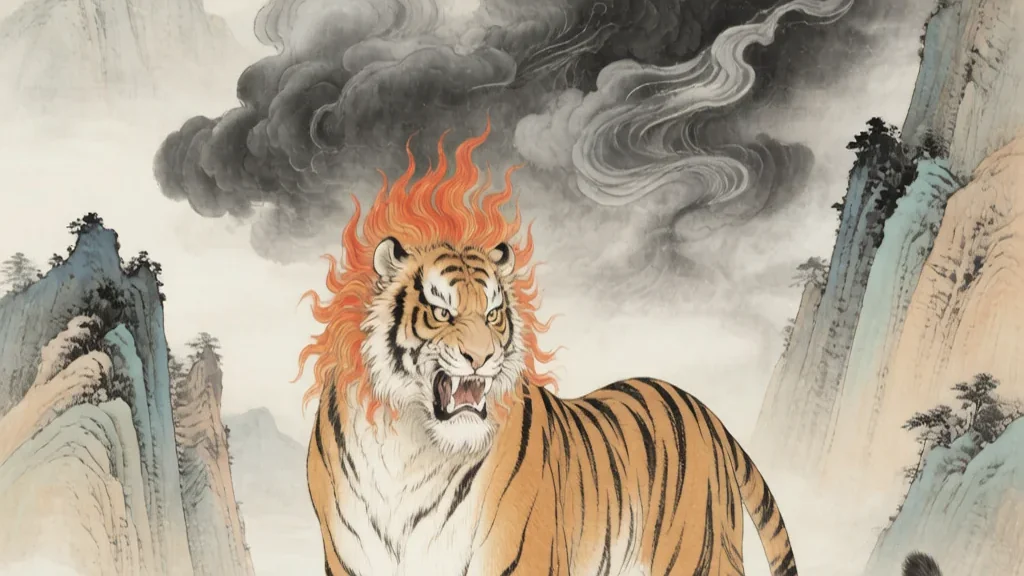
Jiangliang, written with characters meaning "strong" and "good" and pronounced as a firm two-syllable name, is one of the stranger divine figures recorded in the Shan Hai Jing, the Classic of Mountains and Seas. He is described as a god with the body of a tiger, the face of a human, and horns like those of an ox, who holds snakes in his mouth and in his hands, a composite of predatory, human, and serpentine power. Listed among the gods of the far northern wilderness in the mythic geography, Jiangliang belongs to the tradition of hybrid deities who govern the strange margins of the known world. To encounter him in the text is to enter a cosmology in which the boundaries between beast, person, and spirit are fluid, and in which the north is ruled by beings of imposing and unsettling form.
Source in the Classic of Mountains and Seas
The Shan Hai Jing is the sole major source for Jiangliang, preserving his description within the sections that catalogue the gods and wonders of the directional wildernesses, especially the north. The text places him among a company of northern deities, each with a hybrid body that signals a particular relationship to the natural and spirit worlds. As with much of the Shan Hai Jing, the passage blends geographical lore, shamanic observation, and imaginative invention, and its compilers were less interested in doctrinal consistency than in mapping a world thick with significant beings. Jiangliang's entry therefore reads as both a wonder-tale and a piece of symbolic geography, marking the north as a realm of tiger strength and serpent mystery.
Because the classic accumulated over centuries, the figure of Jiangliang reached later readers already encrusted with the authority of antiquity. He was quoted by commentators and illustrators who treated the Shan Hai Jing as a serious, if marvelous, account of the world's edges, and his hybrid form became a fixed item in the Chinese bestiary of gods rather than a passing curiosity.
Hybrid Physical Description
Jiangliang's body is that of a tiger, granting him the strength, speed, and awe of the king of beasts, while his face is human, marking him as a person among the powers rather than a mere animal. From his head rise horns like those of an ox, a feature that adds a note of agrarian and earthy power to his feral frame, and in his mouth and in his hands he holds snakes, creatures long associated in Chinese thought with water, renewal, and the chthonic depths. The total impression is of a being who commands the terrestrial predators, the domesticated strength of the ox, and the serpentine forces of the earth and water at once.
Artists illustrating the Shan Hai Jing have rendered Jiangliang with varying emphasis, some stressing the tiger's stripes and ferocity, others the uncanny sight of a human-faced god calmly gripping snakes. What remains constant is the message of compounded authority: this is no simple spirit but a constructed synthesis of several natural powers, each reinforcing the others to produce a formidable northern deity.
Role Among the Northern Gods
In the spatial scheme of the Shan Hai Jing, the far north is a realm of cold, darkness, and the mysterious, governed by a roster of hybrid gods who personify its qualities. Jiangliang is counted among these northern deities, and his tiger body and serpent grip suit a landscape conceived as both threatening and fertile, where the powers of earth and water lie close to the surface. To be a god of the north was to rule a margin of the cosmos, a place where the human order thinned and the primal forces held sway, and Jiangliang's form announces exactly that primal charge.
The company of northern gods in the classic includes several figures who, like Jiangliang, mix beast and human traits, suggesting a coherent mythic geography in which each direction is staffed by beings suited to its character. The north thus receives guardians of tiger strength and serpent cunning, while other quarters are served by other composites, and the whole system expresses a vision of the world as alive with differentiated divine power.
Symbolism of the Snake and the Tiger
The tiger and the snake are both creatures of deep symbolic weight in Chinese culture. The tiger commands the land as king of beasts and suppresses evil, while the snake moves between earth and water and carries connotations of transformation, healing, and the hidden currents of life. By holding snakes in mouth and hand, Jiangliang demonstrates mastery over these chthonic forces, as though he could speak with and grasp the energies of the underworld at will. The ox horns add a further layer, linking him to the patient strength of the farmer's chief animal and to the earth itself.
Read as a symbolic construct, Jiangliang embodies the idea that the northern wilderness is governed by a power that unites the ferocious, the human, and the serpentine. His human face ensures that he is a personified will rather than blind nature, while his beast and serpent parts ensure that he is a will embedded in the living world. The synthesis is characteristic of the Shan Hai Jing's genius for packing meaning into monstrous form.
Comparison With Other Shan Hai Jing Deities
The Shan Hai Jing is rich in hybrid gods, and Jiangliang stands among those who combine animal bodies with human faces and additional emblematic features. Near him in the bestiary one finds figures such as Yingzhao with horse body and bird wings, Lu Wu with tiger body and nine tails, and various snake-handling or bird-bearing spirits of the directional wilds. What distinguishes Jiangliang is the specific trio of tiger, ox horn, and snake, a combination that anchors him firmly in the northern, earthly, and watery registers of the mythic map.
These parallels show that the classic's deities were not isolated inventions but members of a coherent visual language, in which the choice of body parts encoded a creature's domain and temperament. Jiangliang's particular assembly marks him as a northern master of terrestrial and serpentine power, a role he shares in spirit with other guardians while keeping his own unmistakable silhouette.
Place in the Mythic Geography of the North
The north in Chinese cosmology is associated with water, with the color black, and with the season of winter, a time of retreat and hidden growth. A god stationed there naturally partakes of these qualities, and Jiangliang's serpent grip aligns him with the watery and the subterranean, while his tiger body aligns him with the wild strength proper to a cold and forbidding quarter. His posting thus fits the logic by which the Shan Hai Jing assigned each direction its own appropriate divinities, building a cosmos in which no region lacked a guardian suited to its nature.
This directional staffing also reflects a worldview in which geography is moral and spiritual before it is merely physical. To travel north in the classic is to enter the jurisdiction of Jiangliang and his companions, and the traveler's safety depends on respecting the powers who rule there. Myth here functions as a map of peril and protection alike.
Modern Scholarship and Illustration
In the modern era, Jiangliang is studied by scholars of the Shan Hai Jing as evidence of early Chinese shamanic and geographical thought, and he appears in illustrated editions of the classic aimed at general and scholarly readers. His tiger-and-snake form makes him a natural subject for artists exploring the bestiary, and digital reconstructions have brought him to new audiences curious about the stranger corners of Chinese myth. Though he lacks the fame of the great directional symbols, Jiangliang attracts interest for what he reveals about the compositional logic of the ancient deities.
Researchers read figures like Jiangliang to reconstruct how the compilers of the Shan Hai Jing conceived the margins of the world and the powers that inhabited them. His continuing presence in art and commentary keeps alive a vision of the north as a realm watched over by a tiger-faced god who holds the snakes of the earth in his steady hands, a reminder that the Chinese cosmos was imagined as teeming with hybrid and purposeful spirits.
Jiangliang in Ritual and Memory
Although Jiangliang was not the focus of a major cult with temples and priests, his place in the Shan Hai Jing ensured that he survived in the memory of the learned and the imagination of artists as a type of the northern wilderness god. Commentators who annotated the classic preserved his description across the centuries, and illustrators kept his tiger-and-snake form before readers, so that he functioned as a stable reference point for the idea of the directional deity. In this quiet way he participated in the ritual of textual transmission that kept the mythic geography alive.
The act of copying and illustrating such figures was itself a kind of homage, a recognition that the margins of the world deserved to be known and named. Jiangliang's endurance thus depends less on worship than on scholarship, a guardian of the north preserved by the very human habit of studying and picturing the strange, which is its own form of respect.
❓ Frequently Asked Questions
What is Jiangliang?
Jiangliang is a northern god in the Shan Hai Jing with a tiger body, human face, ox horns, and snakes in mouth and hands.
Where is Jiangliang described?
He appears in the Classic of Mountains and Seas among the deities of the far northern wilderness.
What do the snakes signify?
Holding snakes shows his mastery over chthonic, watery, and renewing forces of the earth.
Why does he have a tiger body?
The tiger grants him the strength and awe of the king of beasts suited to a northern wilderness god.
Is Jiangliang a threat or a guardian?
He is a personified divine power of the north, governing that quarter rather than threatening humanity at large.
How is Jiangliang shown today?
Illustrated editions of the Shan Hai Jing depict him as a tiger-faced, snake-handling northern deity.