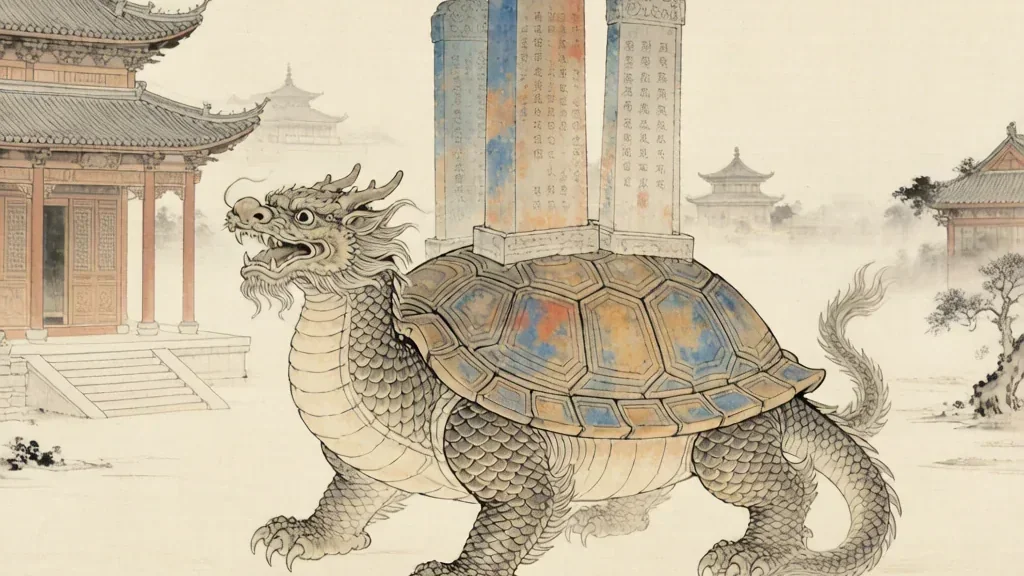
Across the temple courtyards, imperial tombs, and ancient academies of China, a remarkable sight greets visitors: massive stone tortoises, their shells intricately carved with scales, laboring under the weight of towering stone steles inscribed with calligraphy. These are not ordinary tortoises but Bixi (赑屃), one of the legendary Nine Sons of the Dragon in Chinese mythology. According to the Ming Dynasty encyclopedia Sancai Tuhui (1607 CE), the dragon had nine sons, each with a distinct personality and role. The Bixi, the sixth son, was born with the body of a turtle and the head of a dragon, possessing such prodigious strength that it delighted in carrying heavy loads. This mythological origin story explains why, for over a thousand years, Chinese stonemasons have carved Bixi as the foundation for commemorative steles.
Mythological Origins and the Dragon's Nine Sons
The legend of the Dragon's Nine Sons emerged during the Ming Dynasty as a way to explain the diverse dragon-like creatures found in Chinese decorative arts. The earliest complete list appears in the Sheng'an Ji by the scholar Yang Shen (1488-1559), who compiled folk traditions about the nine dragon offspring. According to this taxonomy, each son had a unique nature: Qiuniu loved music, Yazi loved combat, Chaofeng loved adventure, Pulao loved roaring, Suanni loved sitting, Bixi loved carrying heavy loads, Bi'an loved litigation, Fuxi loved literature, and Chiwen loved swallowing. The Bixi's distinctive love of weight-bearing made it the natural choice for supporting steles, a role it has fulfilled since at least the Han Dynasty.
The system of the Nine Sons was deeply embedded in Chinese architectural and decorative traditions. Each son's placement served both aesthetic and protective functions. Qiuniu, who loved music, was depicted on musical instruments — his image can still be seen on the headstocks of antique Chinese zithers and violins. Yazi, the bloodthirsty second son, adorned weaponry, his fierce face carved into sword pommels and axe handles to instill fear in enemies. Chaofeng, the adventurous third son, was placed on palace roof corners as a guardian against evil spirits. Pulao, who loved roaring, decorated the tops of bronze bells, his open mouth amplifying the bell's resonance. Suanni, resembling a lion, sat upon incense burners in Buddhist temples. After Bixi, Bi'an guarded prison gates, Fuxi wrapped around stone stele crowns, and Chiwen protected palace roofs from fire. This comprehensive system transformed ordinary architecture into a living mythological encyclopedia, with each building element carrying the spiritual power of its dragon guardian.
The taxonomy of the Nine Sons also reflected the Confucian emphasis on hierarchy and specialized roles within a unified cosmic order. Just as the imperial court assigned distinct functions to different officials, the dragon father assigned each son a specific domain of influence. This parallel between celestial and earthly governance made the Nine Sons system particularly appealing to Ming Dynasty scholar-officials, who saw in it a mirror of their own bureaucratic ideal. The system was so culturally resonant that it persisted through the Qing Dynasty and continues to be referenced in Chinese decorative arts today.
The Other Eight Dragon Sons: A Comparative View
Understanding the Bixi's place within the dragon family requires examining its eight siblings, each of whom manifested in distinct architectural and artistic contexts. The eldest, Qiuniu (囚牛), was a music lover whose image appears on the headstocks of ancient Chinese zithers. Yazi (睚眦), the second son, was bloodthirsty and adorned sword hilts and battle axes. Chaofeng (嘲风), the third, had a penchant for adventure and perches on palace roof corners as an architectural guardian. Pulao (蒲牢), the fourth, was a natural roarer whose image decorates bell tops. Suanni (狻猊), the fifth, resembles a lion and sits upon incense burners. After Bixi, Bi'an (狴犴) loved litigation and appears on prison gates. Fuxi (负屃) delighted in literature and wraps around stele crowns, while Chiwen (螭吻) loves swallowing and guards roof ridges against fire. This rich taxonomy reveals how Ming Dynasty scholars systematized folk beliefs into a coherent mythological framework.
The classification of the nine sons was not merely a scholarly exercise but had practical implications for traditional Chinese architecture and material culture. Craftsmen and architects consulted these mythological archetypes when designing buildings, weapons, musical instruments, and legal institutions. Each son's distinctive trait dictated its appropriate placement and function. For instance, placing Chiwen on roof ridges was believed to prevent fires through spiritual protection, while positioning Bi'an on prison gates served as a psychological deterrent to both prisoners and corrupt officials. The Bixi's assignment to stele-bearing was thus part of a comprehensive system in which every architectural element carried mythological meaning, transforming the built environment into a three-dimensional encyclopedia of Chinese cosmological beliefs.
The Bixi in Imperial Memorial Architecture
The most famous Bixi steles in China are found at the Ming Tombs north of Beijing, the burial site of thirteen Ming emperors. Each emperor's spirit way is marked by a massive Bixi — some weighing over 50 tons — supporting a stele inscribed with the deceased ruler's achievements and virtues. The largest of these, at the Changling tomb of the Yongle Emperor (reigned 1402-1424), measures 7.9 meters in height and rests on a Bixi carved from a single block of marble weighing approximately 70 metric tons. At the Temple of Confucius in Qufu, Shandong Province, a Bixi carries a stele erected in 1686 by the Kangxi Emperor. The construction of these monuments required extraordinary engineering skill: historical records describe the use of ice roads during winter months to transport massive Bixi stones from quarries.
Beyond the Ming Tombs, the Xi'an Forest of Steles (Beilin), established in 1087 CE during the Northern Song Dynasty, houses one of the most remarkable collections of Bixi-carried steles in the world. This museum, located within the former Confucian Temple of Xi'an, contains over 3,000 stone steles, many resting on finely carved Bixi bases. Among the most famous is the "Classic of Filial Piety" stele, erected in 745 CE during the Tang Dynasty, inscribed with the text of the Xiaojing in the elegant calligraphy of Emperor Xuanzong himself. The stele stands atop a particularly large and expressive Bixi, its dragon head turned slightly to one side in a naturalistic pose unusual for the period. Another notable Beilin Bixi carries the "Kaicheng Stone Classics," a set of twelve Confucian classics carved in 837 CE, comprising over 650,000 characters spread across 114 steles. The Bixi bases in the Forest of Steles display remarkable variation in carving style, from the austere simplicity of Tang Dynasty examples to the elaborate ornamentation of Qing Dynasty replacements, providing a visual chronology of Chinese stone carving techniques spanning over a millennium.
Bixi Beyond the Imperial Court: Temples and Academies
While the most spectacular Bixi steles belong to imperial mausoleums, the creature also played a vital role in religious and educational architecture across China. At the Temple of the Six Banyan Trees in Guangzhou, a Tang Dynasty pagoda is accompanied by a Bixi stele dating from 1096 CE that records the temple's history. Buddhist monasteries throughout China employed Bixi steles to safeguard sutras and commemorate the construction of new halls, combining religious devotion with practical record-keeping. The Confucian academies of the Song Dynasty, such as the White Deer Grotto Academy and the Yuelu Academy, erected Bixi steles inscribed with educational principles and examination results. These steles served a dual purpose: they immortalized scholarly achievement and reminded students of the weighty responsibility that knowledge carries.
The Bixi also featured prominently in the design of spirit ways leading to elite tombs. A spirit way, or shendao, is a ceremonial path lined with stone statues of officials, animals, and mythical creatures that guides the deceased's soul to the afterlife. Bixi steles typically stood at the entrance of these spirit ways, their inscriptions proclaiming the achievements of the tomb's occupant to both earthly visitors and wandering spirits. The Nanjing Ming Xiaoling Mausoleum, built for the Hongwu Emperor (reigned 1368-1398), features a particularly elaborate spirit way with a Bixi stele weighing an estimated 100 metric tons. The inscriptions on these steles, composed by the most celebrated calligraphers of each dynasty, represent the pinnacle of Chinese monumental calligraphy and have been studied by scholars for centuries as primary historical sources.
Artistic Conventions and Regional Variations
The Bixi's artistic representation follows conventions that crystallized during the Tang Dynasty (618-907 CE) and persisted through the Qing Dynasty (1644-1912). The typical Bixi features a dragon's head with prominent fangs, a pair of backward-sweeping horns or ears, a serrated ridge along its spine, and a turtle-like carapace decorated with hexagonal scale patterns. Unlike natural turtles, the Bixi is always depicted with visible claws on its four feet — an important detail that distinguishes it from ordinary tortoises and emphasizes its draconic lineage. Regional variations are notable: the Bixi of southern China, particularly in Fujian and Guangdong provinces, tend to have more expressive faces with bulging eyes and flared nostrils, reflecting the influence of southern Chinese woodcarving traditions.
Symbolic Significance: Bixi, Turtle, and Dragon
The Bixi occupies a distinctive symbolic space between the turtle and the dragon, inheriting traits from both while transcending each. In traditional Chinese cosmology, the turtle represents longevity and stability — its domed shell echoes the vault of heaven, and its flat underside represents the earth. The Black Tortoise, one of the Four Celestial Symbols, governs the northern quadrant of the universe and embodies endurance. The dragon, by contrast, symbolizes imperial authority, cosmic power, and transformation. By combining these two archetypes, the Bixi becomes a bridge between the earthly and the celestial, its turtle body anchoring it to the material world while its dragon head reaches toward spiritual realms. This liminal quality made the Bixi the perfect symbol for steles that connected the living with the dead and the present with history.
The distinction between Bixi and ordinary turtles was well understood in traditional Chinese culture and reinforced through deliberate visual and anatomical differences. Unlike the smooth, unadorned shell of a natural turtle, the Bixi's carapace is always carved with scale patterns that mimic dragon hide, often arranged in hexagonal formations that echo the Bagua (Eight Trigrams) cosmological diagram. Its tail is typically thicker and more ornate than a turtle's, often terminating in a tuft like that of a dragon rather than the simple pointed tip of an actual turtle. Most significantly, the Bixi's four feet are equipped with five claws each — a number reserved for imperial dragons in Chinese sumptuary laws dating back to the Zhou Dynasty. Commoners' turtles, even in mythological contexts, would never be depicted with five claws. The positioning of the Bixi's head also differs: while real turtles typically have heads that retract horizontally, the Bixi's dragon head is always held upright and forward, teeth bared, giving it a vigilant and powerful expression. These iconographic cues served as a visual language that communicated the Bixi's hybrid nature to all viewers, regardless of literacy.
The Bixi's fusion of turtle and dragon traits also reflects a deeper philosophical concept in Chinese thought — the integration of yin and yang. The turtle, associated with the earth, water, and the receptive yin principle, represents stillness and endurance. The dragon, associated with heaven, sky, and the active yang principle, represents movement and transformation. The Bixi, as a dragon-turtle hybrid, embodies the harmonious union of these opposing forces. This symbolic resonance made the Bixi particularly suitable for steles commemorating significant transitions — imperial successions, military victories, and the founding of institutions — moments when the balance between stability and change was most keenly felt. In this sense, every Bixi stele is not merely a historical record but a philosophical statement about the nature of cosmic order itself.
Cultural Significance and Modern Preservation
The Bixi's cultural significance extends beyond its architectural function. In Chinese folk belief, rubbing the head of a Bixi brings good luck and academic success, a superstition that has worn smooth the heads of countless Bixi statues at temples and universities. The creature's association with scholarship stems from its role in carrying steles that record examination results, imperial decrees, and literary achievements. In 1961, the Chinese government designated many Bixi steles as Major Historical and Cultural Sites Protected at the National Level, initiating systematic preservation efforts. The Palace Museum in Beijing launched a comprehensive Bixi conservation project in 2015, using 3D laser scanning to document the precise condition of over 200 Bixi steles in its collection.