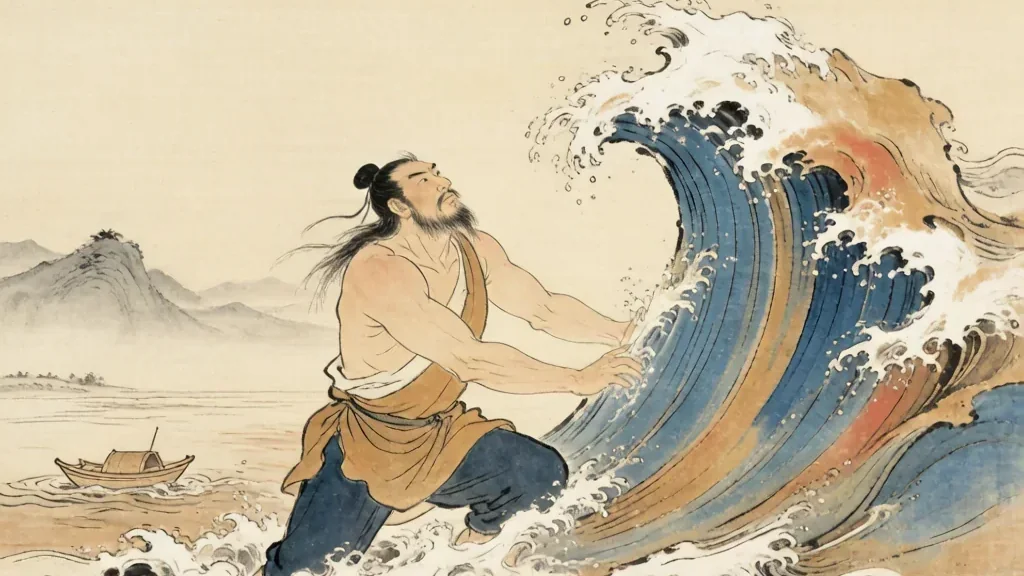
Every civilization has its flood myth — a great deluge that nearly destroys humanity and the hero who rises to save it. In ancient China, that hero was Yu the Great, a man whose dedication to his mission was so absolute that he became the very definition of selflessness. His story is not just about controlling water — it is about the birth of Chinese civilization itself, the founding of a dynasty, and a model of leadership that would influence Chinese governance for thousands of years.
The tale of Yu the Great (大禹) bridges the gap between mythology and history. While scholars debate whether he was a real historical figure or a legendary construct, his impact on Chinese culture is undeniable. The values he embodied — perseverance, humility, and placing duty above personal desire — remain core ideals in Chinese society to this day.
A World Drowning
The story begins not with Yu, but with his father, Gun. In the reign of Emperor Yao, catastrophic floods swept across the land. The Yellow River, China's lifeblood and its greatest natural threat, burst its banks repeatedly. Vast regions of farmland were submerged, villages were washed away, and the people huddled on shrinking islands of high ground, watching their world disappear beneath the rising waters.
Emperor Yao was desperate. He summoned his council and asked who could control the floods. The council recommended Gun, a nobleman with some claim to divine heritage. Gun accepted the monumental task and immediately set to work. His strategy was straightforward: build bigger and stronger dikes and dams to block the water. He even stole "swelling soil" (xirang) from the heavens — a magical substance that expanded endlessly when exposed to water — to reinforce his barriers.
But Gun's approach was fundamentally flawed. Water, when blocked, does not disappear — it accumulates pressure until it finds or creates another path. For nine years, Gun built his walls, and for nine years, the water found ways around them. The floods grew worse, not better. The stolen xirang was discovered by the gods, and Gun was executed for his failure and his theft. His body was left on a mountainside, but something strange happened — it did not decompose. After three years, Yu emerged from his father's corpse, born with a mission already inscribed in his destiny.
A New Approach: From Blocking to Guiding
Yu understood immediately what his father had failed to grasp: you cannot defeat water by fighting it head-on. Water is not an enemy to be vanquished — it is a force of nature that must be understood, respected, and redirected. Where Gun had tried to block, Yu would learn to guide. Where Gun had built walls, Yu would dig channels. It was a complete philosophical reversal, and it would change everything.
Yu began his work by studying the land itself. He walked the length and breadth of China — from the source of the Yellow River in the western highlands to its mouth at the eastern sea. He mapped the terrain, identified natural drainage patterns, and designed an elaborate system of canals, spillways, and river channels that would carry the floodwaters safely to the ocean. This was not merely engineering — it was a comprehensive reimagining of humanity's relationship with nature.
Legends say that Yu had the help of supernatural allies in his work. A yellow dragon used its tail to carve channels through the earth, while a giant black turtle carried soil on its back to build embankments. Yinglong, a winged dragon, showed Yu where the rivers should flow. But supernatural aid alone could not accomplish the task — it required Yu's tireless personal effort and an almost superhuman level of dedication.
Thirteen Years, Three Passes
The most famous and heartbreaking detail of Yu's story is the "three passes at the door." After beginning his flood control work, Yu married a woman named Tushan-shi. Just four days after their wedding, he left to continue his mission. His wife later gave birth to a son, Qi, whom Yu had never met. Over the course of thirteen long years, Yu's work brought him past his own home on three separate occasions. Each time, he could hear his wife weeping inside and his son crying for a father he had never known. Each time, Yu forced himself to walk on, refusing to enter the house.
Why? Because every moment he spent in personal comfort was a moment stolen from the millions of people suffering from the floods. Because if he allowed himself even the brief respite of his family's embrace, he might not have the strength to leave again. Because the mission was greater than the man. This episode — known as "three passes without entering" (三过家门而不入) — has become one of the most enduring moral exemplars in Chinese culture, taught to children for millennia as the ultimate expression of dedication to duty.
Yu's physical transformation over these thirteen years was dramatic. He worked alongside the common people, wading through mud and water, carrying stones, digging channels. His hands became calloused beyond recognition. His legs were worn hairless from constant immersion in water. He developed a distinctive limping gait from the strain on his body — a walk that would later be known as "Yu's step" and was even incorporated into Daoist ritual dances.
The Taming of the Waters
Yu's system was brilliant in its conception and monumental in its execution. He divided the known world into nine provinces and tackled the flood control problem systematically. He dredged riverbeds to increase their capacity, dug canals to divert excess water into natural basins, and cleared obstructions that caused dangerous backups. Perhaps most importantly, he recognized that the rivers needed outlets — he carved passages through mountain ranges to allow the water to reach the sea.
One of the most dramatic episodes involves the Dragon Gate (Longmen) on the Yellow River. At this point, the river was blocked by a massive mountain, creating a bottleneck that caused catastrophic flooding upstream. Yu personally led the effort to split the mountain open, creating a passage for the river to flow through. According to legend, the carp that managed to swim up through this newly created torrent would transform into dragons — giving rise to the famous Chinese idiom "the carp leaps over the Dragon Gate" (鲤鱼跳龙门), a metaphor for dramatic success through perseverance.
After thirteen years of ceaseless labor, the floods were finally controlled. The Yellow River flowed along a stable course to the sea. The nine provinces were connected by a network of waterways that would serve as both flood control and transportation arteries. The people could return to their fields, rebuild their homes, and live without the constant fear of watery death. Yu had succeeded where his father had failed, and in doing so, he had fundamentally reshaped the Chinese landscape.
The Birth of the Xia Dynasty
Yu's reward for his monumental achievement was nothing less than the mandate to rule. Emperor Shun, who had succeeded Yao, was so impressed by Yu's character and capability that he abdicated the throne to him. Yu became the founder of the Xia Dynasty — traditionally regarded as China's first dynasty, marking the transition from the age of myth to the age of history. His son Qi would succeed him, establishing the principle of hereditary rule that would define Chinese governance for the next four thousand years.
But Yu never forgot his origins. He remained a humble ruler, focused on the welfare of his people rather than the trappings of power. He is said to have cast nine bronze tripods representing the nine provinces he had saved, each decorated with maps and symbols of the natural features of each region. These tripods became the symbol of legitimate rule — to possess them was to possess the Mandate of Heaven.
Yu the Great represents something profound in Chinese culture: the idea that true leadership is earned through service, not seized through force. He did not become emperor because he wanted power — he became emperor because he had already proven, through thirteen years of selfless labor, that he would use power wisely and for the benefit of all. It is a model of leadership that continues to resonate, and a reminder that the greatest heroes are often those who simply refuse to stop until the work is done.
Yu's Nine Provinces and the First Map
A striking claim about Yu is that he divided the flood-tamed world into nine provinces and toured them to chart rivers, soils, and tribute. This act turns a rescue story into the founding of geography: the hero who moved water also drew the first administrative map of China. Later texts credited him with recording which lands grew which grains and where the nine rivers met the sea, turning the chaos of flood into an ordered catalogue of place. Whether or not the provinces were his literal invention, the motif established a lasting idea that good government begins with knowing the land. The nine tripod cauldrons he cast, each marked with a province's mountains and beasts, became the physical emblem of that order, so that to hold the tripods was to hold a mapped and settled realm.
The Legacy of Yu in Chinese Rule
Yu's story shaped Chinese ideas of leadership for millennia. Unlike rulers who seize power, he earned it through service, and he gave it up not to a son at first but to the worthy Shun, modeling a merit-based ideal even as his own line later turned hereditary. The title Great itself became shorthand for the official who toils among the people rather than above them, and flood control remained a prime test of any dynasty's mandate. Emperors staged sacrifices to Yu at his tomb, and engineers invoked him when taming rivers. His limping gait, the Pace of Yu, entered ritual dance as a living memory of his labor. In short, Yu supplied the template for the benevolent worker-ruler, the leader whose authority rests on having done the hardest job for the common good.
Yu and the World's Flood Myths
Yu belongs to a global family of flood heroes, yet his differs in key ways. Where many traditions show a deluge sent as punishment and a sole saved family, Yu's flood is a natural disaster met by engineering and persistence rather than by ark or prayer alone. His method, guiding water instead of damming it, became a Chinese proverb for wise governance and a willingness to work with nature. The parallel with Mesopotamia's Atrahasis or the biblical Noah lies in the shared terror of water and the hope of a fresh start, but Yu's emphasis on canals and provinces roots the myth in statecraft. Reading him beside other flood heroes shows how each culture encoded its own answer to catastrophe: for China, the answer was organization, diligence, and a leader who would not go home until the land was dry.
❓ Frequently Asked Questions
📝 Chinese Vocabulary
大禹 — : Yu the Great, the legendary flood-controller and founder of the Xia Dynasty.
治水 — : "Control water" — the term for flood management that Yu pioneered through his system of channels and diversions.
黄河 — : The Yellow River, China's second-longest river and the focus of Yu's flood control efforts, known as "China's Sorrow" for its devastating floods.
三过家门而不入 — : "Three passes at the door without entering" — the famous idiom describing Yu's selfless dedication.
夏朝 — : The Xia Dynasty, traditionally China's first dynasty, founded by Yu the Great.
鲧 — : Gun, Yu's father, who failed to control the flood by building dams and was punished by the gods.
息壤 — : Swelling soil, the self-expanding magic earth Gun stole from heaven to build his failed barriers.
启 — : Qi, Yu's son, who succeeded him and began the hereditary rule of the Xia Dynasty.
🎉 Fun Facts
- The Xia Dynasty founded by Yu was long considered purely mythical by Western historians, but archaeological discoveries at Erlitou in the 20th century have provided evidence that a complex Bronze Age civilization did exist in the region and period described by the legends.
- Yu's distinctive limping walk was considered so remarkable that it was preserved as a ritual dance by Daoist priests, known as the "Pace of Yu" (禹步), believed to have protective and exorcistic powers.
- The "Dragon Gate" that Yu supposedly carved through the mountain is a real geographical feature on the Yellow River, located at the border of modern-day Shanxi and Shaanxi provinces, and remains an important cultural landmark.
- Yu is said to have laid out the first system of distances by measuring the land with his own stride and body.
- The nine bronze tripods he cast became the supreme symbol of royal power for later dynasties.
- Some versions say a giant tortoise carried earth on its back to help Yu build his embankments.