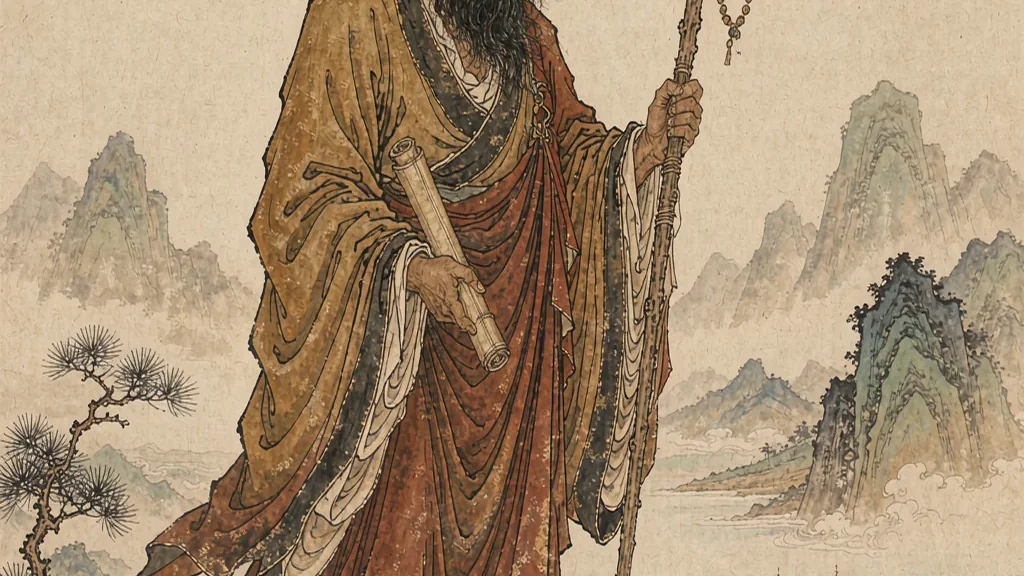
Chinese Buddhist history is filled with gentle scholars and meticulous translators, but the man who supposedly founded Chan Buddhism was none of these — he was a fierce, bearded foreigner who refused to flatter emperors, crossed the Yangtze River on a single reed, and spent nine years staring at a cave wall until his legs fell off. Whether fact or legend, Bodhidharma (菩提达摩, pú tí dá mó) remains the most iconic figure in Chan Buddhism, a symbol of relentless determination and uncompromising directness who seems to have stepped out of a martial arts novel rather than a monastery.
The Indian Prince Who Became a Monk
According to traditional accounts, Bodhidharma was born a prince in the kingdom of Pallava in South India, the third son of King Simhavarman. He converted to Buddhism at a young age and studied under the master Prajnatara, who instructed him to travel to China to transmit the true dharma. The name "Bodhidharma" means "Enlightenment Doctrine" in Sanskrit, a name he lived up to through a life of uncompromising practice.
Scholars debate the historical details of Bodhidharma's life. The earliest biography, written by Daoxuan in the seventh century, says he arrived in China around 470 CE during the Liu Song dynasty, not the later Liang dynasty as popular legend claims. What is clear is that he was a South Indian monk who brought a distinctive meditation tradition to China, one that emphasized direct realization over textual study. The historical Bodhidharma was likely less dramatic than the legend, but his impact on Chinese Buddhism was no less profound.
The Encounter with Emperor Wu
Perhaps the most famous story about Bodhidharma concerns his meeting with Emperor Wu of Liang (also known as Liang Wudi), a devout Buddhist ruler who built temples, supported monasteries, and sponsored translations. When Bodhidharma was summoned to the court, the emperor asked, "I have built many temples, copied many sutras, and supported countless monks. How much merit have I earned?"
Bodhidharma replied bluntly: "No merit at all." Stunned, the emperor asked, "What, then, is the holy truth?" Bodhidharma answered: "Vast emptiness, nothing holy." The emperor, now confused, demanded: "Who are you, then, to speak to me like this?" Bodhidharma replied: "I do not know." With that, he left the court and crossed the Yangtze River — in some versions, on a single reed — heading north to the Shaolin Temple.
Nine Years Facing the Wall
Arriving at the Shaolin Temple on Mount Song in Henan Province, Bodhidharma was reportedly refused entry by the resident monks, who found his foreign appearance and abrupt manner off-putting rather than inspiring. Undeterred, he settled in a nearby cave and began to meditate facing the wall. According to the legend, he remained in this position for nine years, without moving, without speaking, without sleeping. The intense concentration of his meditation is said to have bored a hole in the cave wall opposite his face.
Some accounts add that during these nine years, Bodhidharma fell asleep once and, in frustration at his weakness, cut off his own eyelids. Where they fell to the ground, tea plants grew — providing monks with a caffeinated beverage to keep them awake during meditation. This charming etiological myth links Bodhidharma not only to the origins of Chan but also to the Chinese tea tradition, though historians note that tea drinking in China predates Bodhidharma by many centuries.
Teaching and Transmission
Bodhidharma's teachings, as preserved in texts attributed to him such as the Two Entrances and Four Practices and the Bloodstream Sermon, are remarkably straightforward. He taught two "entrances" to the dharma: the entrance through principle (realizing the essential nature of mind) and the entrance through practice (cultivating virtues like patience and non-attachment). His four practices were: accepting suffering without complaint, adapting to circumstances, seeking nothing, and acting in accordance with the dharma.
The text of the Bloodstream Sermon contains some of Chan's most radical statements: "Your mind is the Buddha. The Buddha is the mind. The mind is the Buddha. The Buddha is the mind." For Bodhidharma, enlightenment was not something to be achieved by studying texts or performing rituals; it was the immediate recognition of what one already is. This direct, no-nonsense approach became the defining characteristic of Chan Buddhism.
The Legend and Its Meaning
Bodhidharma is traditionally considered the twenty-eighth Indian patriarch of Buddhism and the first Chinese patriarch of Chan. His transmission of the "mind-seal" to his successor Huike — a transmission that supposedly occurred without words — established the Chan lineage that continues to this day. Whether the historical Bodhidharma actually transmitted a formal lineage is uncertain, but the legend served a crucial institutional purpose: it gave Chan a direct connection to the Buddha, bypassing the Indian schools and establishing an independent Chinese tradition.
In East Asian popular culture, Bodhidharma — affectionately called "Daruma" in Japan — is an enduring symbol of perseverance. The traditional Daruma doll, a rounded figure that always returns to an upright position when pushed, represents Bodhidharma's indomitable spirit. The message is simple: fall down seven times, get up eight. In a world that values speed and convenience, the image of the fierce monk staring at a wall for nine years remains a powerful reminder that some achievements require absolute, unwavering commitment.
The Chan Lineage After Bodhidharma
Bodhidharma is remembered as the first patriarch of Chinese Chan, but the school's continuity depended on those who received his transmission. According to Chan hagiography, he passed his robe and bowl to Huike, who became the second patriarch, and the line continued through Sengcan, Daoxin, and Hongren, eventually flowering in the mature Chan of the Tang dynasty. This carefully constructed genealogy gave Chan a sense of unbroken authority reaching back through Bodhidharma to the Buddha himself. Later masters such as Huineng would reinterpret the teaching, but the founding myth of a rough foreign meditator who transmitted a special transmission outside the scriptures remained central. The patriarchs' stories were recorded in the Chan lineage histories, which blended fact and legend to show how a single silent man planted a tree that would shade East Asian Buddhism for fifteen centuries.
The Two Entrances and Four Practices
The shortest text attributed to Bodhidharma is the Erru Sixing lun, or Two Entrances and Four Practices, a concise outline of the Buddhist path. The first entrance is by reason: through study and insight one realizes that all beings share the same true nature, which is calm and unborn, and so one turns from delusion to awakening. The second entrance is by practice: four forms of conduct that train the body and mind, accepting adversity without resentment, adapting to circumstances, seeking nothing, and acting in accord with the Dharma. Together they balance understanding and action, showing that meditation is not escape but the steady reorientation of an entire life. Though scholars debate how much Bodhidharma himself wrote, the treatise became a foundational charter for Chan, distilling his demanding, introspective style into memorable form.
Bodhidharma in Art and Memory
Few Buddhist figures are as instantly recognizable as Bodhidharma. Chinese and Japanese art almost always show him as a scowling, heavy-browed foreign monk with a thick beard, sometimes seated cross-legged or sailing on a reed. In Japan this image hardened into the red Daruma doll, a limbless, round-bodied figure whose blank eyes worshippers fill in as they make and keep vows. Folk theater, woodblock prints, and modern cartoons keep his stern face before the public, while Shaolin temples honor him as the wellspring of their martial and meditative heritage. The historical man is nearly lost beneath these layers of story, yet that very mythologizing shows his power: Bodhidharma became a symbol of stubborn, solitary determination, the master who needed no words to transmit the truth that words cannot hold.
❓ Frequently Asked Questions
📝 Chinese Vocabulary
菩提达摩 — : Bodhidharma; the founder of Chan Buddhism in China.
少林寺 — : Shaolin Temple; the monastery associated with Bodhidharma.
面壁 — : wall-gazing; the meditation practice Bodhidharma is said to have performed for nine years.
传法 — : transmission of the dharma; the passing of the Chan lineage from master to disciple.
慧可 — : Huike, the monk who became Bodhidharma's successor after standing in the snow and cutting off his arm to prove his sincerity.
禅宗 — : The Chan school, the Chinese meditation lineage that traces its founding to Bodhidharma and later became Zen in Japan.
二入四行 — : The Two Entrances and Four Practices, a short teaching attributed to Bodhidharma outlining the path of meditation and conduct.
壁观 — : Wall-contemplation, Bodhidharma's method of facing a wall to settle the mind in silent awareness.
🎉 Fun Facts
- Japanese Daruma dolls, modeled on Bodhidharma, are used as good-luck charms and goal-setting tools — you color in one eye when you set a goal and the other when you achieve it.
- When Bodhidharma's tomb was reportedly opened, it contained only a single sandal. The monk himself was said to have been seen walking back toward India, carrying the other sandal.
- The phrase "Bodhidharma has no beard" is a famous Chan koan — despite the fact that every image of Bodhidharma shows him with a full beard. The koan points to the gap between appearance and reality.
- Legend says Bodhidharma crossed the wide Yangtze River standing on a single floating reed, a feat celebrated in many Chinese and Japanese paintings.
- The tale of Huike cutting off his own arm to demonstrate his sincerity before Bodhidharma is one of the best-known stories in Chan literature.
- Bodhidharma is honored as the first Chinese patriarch of Chan, yet the school's deeper lineage is traced back to India to the Buddha's disciple Mahakasyapa, said to have received the wordless transmission.