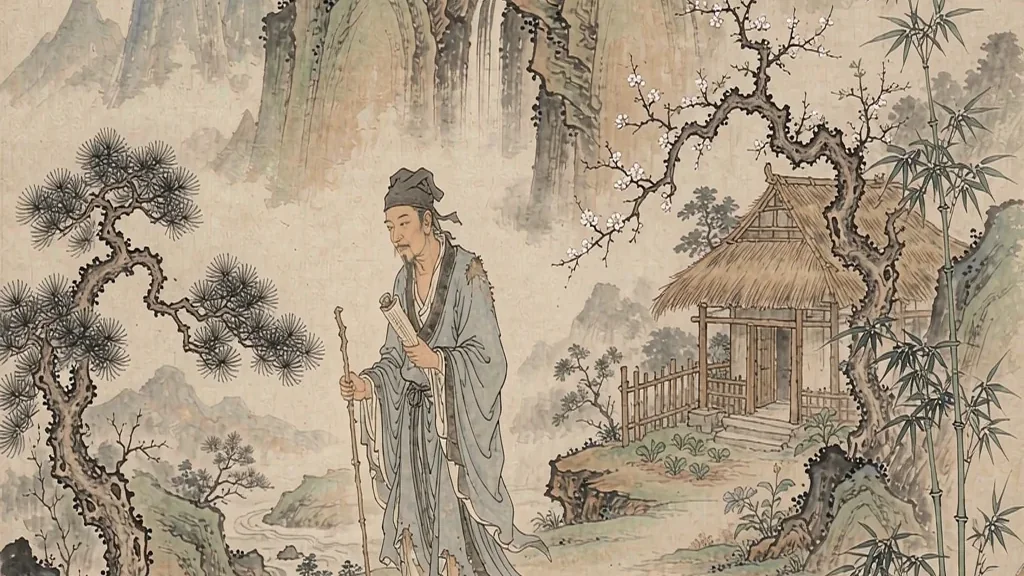
To walk through a Chinese bookstore and pick up a volume of classical poetry, you expect the serious elegance of Du Fu, the wine-soaked brilliance of Li Bai, or the refined melancholy of Wang Wei. But tucked among these giants is a voice like no other: rough, unpolished, coarse, and utterly unforgettable — the voice of a wild man who lived in a cave on Cold Mountain and wrote poems on rocks, trees, and temple walls. Hanshan (寒山, hán shān) — "Cold Mountain" — is one of the most beloved and most mysterious figures in Chinese literature, a Chan Buddhist hermit whose poems speak across fourteen centuries with startling freshness.
Who Was Hanshan? The Mystery of Cold Mountain
No one knows exactly who Hanshan was. He left no biographical record, no dates of birth or death, no official history. What we know comes from a preface to his collected poems, written by a Tang official named Luqiu Yin (闾丘胤), who claimed to have encountered the poet during his tenure as the magistrate of Tiantai County. According to this account, Hanshan was a wild-looking man who lived at the Guoqing Temple on Mount Tiantai but refused to enter the monastery — he stayed in a nearby cave, eating leftovers from the temple kitchen and writing poems everywhere.
The dates of Hanshan's life are uncertain, but most scholars place him in the Tang dynasty, roughly between the seventh and ninth centuries CE. He may have been a failed scholar-official who abandoned the civil service examinations and retreated to the mountains. He may have been a Chan monk who rejected institutional Buddhism. He may have been a figment of the collective imagination, a literary persona rather than a single historical person. The uncertainty itself has become part of his charm.
The Poetry of Cold Mountain
Hanshan's surviving corpus consists of about 300 poems, written in a deliberately simple style that contrasts sharply with the elaborate conventions of Tang poetry. His language is colloquial, his subjects are ordinary, and his tone ranges from bawdy humor to profound spiritual insight. He writes about poverty, cold, hunger, and loneliness — not as things to be pitied but as conditions that strip away illusion and reveal reality.
Many of his poems are explicitly Chan Buddhist teachings. He writes about the futility of seeking enlightenment outside oneself, the danger of attachment to words and doctrines, and the peace that comes from letting go. Other poems describe the natural beauty of Cold Mountain — the mist, the pines, the moon, the streams — with a clarity that seems effortless. His most famous poem begins: "People ask the way to Cold Mountain / but Cold Mountain is not a road you follow." The poem itself is a pointer to the inexpressible.
The Friendship with Shide
Hanshan's inseparable companion was Shide (拾得, "Foundling"), a eccentric monk who worked in the kitchens of the Guoqing Temple. According to legend, Shide had been found as an abandoned baby by Master Fenggan (丰干), a mysterious monk who rode a tiger. Shide grew up at the temple, working as a kitchen helper, and became friends with Hanshan when the hermit came down from the mountain to scrounge for food.
The two are inseparable in Chinese iconography: Hanshan holding a scroll, Shide leaning on a broom, both laughing uproariously at something invisible to ordinary eyes. They represent the Chan ideal of spontaneous freedom — the laughter of those who have seen through the world's pretenses and found themselves awake. Their friendship reminds us that the spiritual path, even in its most solitary forms, is never truly walked alone.
Hanshan in East Asian and Western Literature
Hanshan's influence in China was modest during his own time — his rustic style did not appeal to the literary establishment. But his reputation grew over the centuries, and he became a favorite subject of Chan painters and calligraphers. In Japan, where he is known as Kanzan, he became a central figure in Zen art, often depicted alongside his friend Jittoku (Shide) in ink paintings that capture their wild, ecstatic energy.
The most remarkable chapter in Hanshan's reception came in the twentieth century, when his poems were translated into English by Gary Snyder and others, and they became a touchstone of the Beat Generation. Jack Kerouac dedicated his novel The Dharma Bums to Hanshan, seeing in the ragged mountain hermit a precursor to the free-spirited seekers of 1950s America. In the West, Hanshan became the archetypal "wilderness poet," a voice for those who find their truth not in temples or libraries but in the raw encounter with mountains and sky.
The Enduring Appeal of the Hermit
Why does Hanshan still speak to readers today? Perhaps because his poems capture a universal human longing: the desire to escape the noise of society and find something real in silence. Hanshan never preaches; he simply shows us his life on the mountain — the cold that bites through his rags, the moonlight on the empty peaks, the laugh he shares with his kitchen-sweeping friend. His poems do not argue for Buddhism; they embody it.
In an age of digital distraction and constant connectivity, the image of a man writing poems on rocks in a mountain cave is irresistibly attractive. Hanshan reminds us that the deepest truths are not found in the noise but in the stillness, not in the crowd but in the solitary heart. His Cold Mountain is not a place on the map — it is a place in the mind, a refuge that anyone can find by letting go of everything that is not essential.
Cold Mountain as a Symbol
Over time 'Cold Mountain' (寒山) became less a biography than a symbol of reclusive freedom. Chinese painters depicted a ragged figure laughing among cliffs as an emblem of the unworldly sage, and Chan monks invoked him as proof that awakening needs no robe or degree. The name itself came to stand for any place of withdrawal from court and crowd. In this way Hanshan outgrew the historical poet to become a recurring character in the Chinese imagination of the hermit who sees through society's pretensions. The phrase 'Cold Mountain' could be invoked by any later recluse as a way of claiming spiritual independence, so that the poet's own biography mattered less than the freedom his name had come to name.
Language and Style
Hanshan wrote in a direct, colloquial register that broke with the refined diction expected of Tang poetry. His lines mix folk sayings, blunt advice, and sudden leaps of image, sometimes deliberately rough. This 'vernacular' quality is precisely what later readers valued: the poems feel spoken rather than composed, as if overheard from a cliff. The style also made them easy to memorize and copy, helping them survive and spread across East Asia long before they reached the West. By refusing the polished craft of the academy, Hanshan turned his apparent artlessness into a signature, and that refusal is itself the point his admirers most admired. By refusing polished craft, Hanshan turned artlessness itself into the point his admirers most prized.
Hanshan in Modern China
In modern China Hanshan has been claimed by several movements. Early twentieth-century reformers admired his plain language as a model for a new vernacular literature, while later readers interpreted his attacks on greed and corrupt officials as social critique. Tourists now visit Mount Tiantai's Guoqing Temple to see the sites linked to him and Shide. The poet's shift from obscure hermit to cultural icon shows how a figure outside the establishment can be repeatedly reinvented to fit each era's idea of authenticity. Whether read as sage, satirist, or free spirit, Hanshan keeps answering a persistent Chinese longing for a life lived beyond the reach of rank and routine. Whether sage, satirist, or free spirit, Hanshan answers a lasting Chinese longing for untrammeled life.
❓ Frequently Asked Questions
📝 Chinese Vocabulary
寒山 — : Hanshan; literally "Cold Mountain," the poet's name.
拾得 — : Shide; Hanshan's companion, the laughing kitchen monk.
寒山诗 — : Hanshan's poems; the collected verses of Cold Mountain.
丰干 — : Fenggan; the tiger-riding monk who brought them together.
白话诗 — : vernacular poetry
天台山 — : Mount Tiantai, the poets' home
国清寺 — : Guoqing Temple on Mount Tiantai
禅诗 — : Chan (Zen) poetry
🎉 Fun Facts
- Hanshan's poems were found carved on rocks, trees, and temple walls — he never bothered to write them on paper or compile them himself.
- The American poet Gary Snyder based his translation of Hanshan's poems on a Japanese edition, and his versions became the basis for Jack Kerouac's novel The Dharma Bums.
- In Chinese folk tradition, Hanshan and Shide are considered the gods of marital harmony and are sometimes depicted at weddings.
- Hanshan's poems were carved, by his own account, on rocks, bamboo, and the walls of trees around Mount Tiantai, not written in books.
- The Japanese Zen master Dogen quoted Hanshan, and the novelist Gary Snyder's translations made him a hero of the 1960s American counterculture.
- Hanshan and Shide were later honored as the twin gods of harmony (和合二仙) in Chinese folk art, often shown laughing with a lotus and a box.