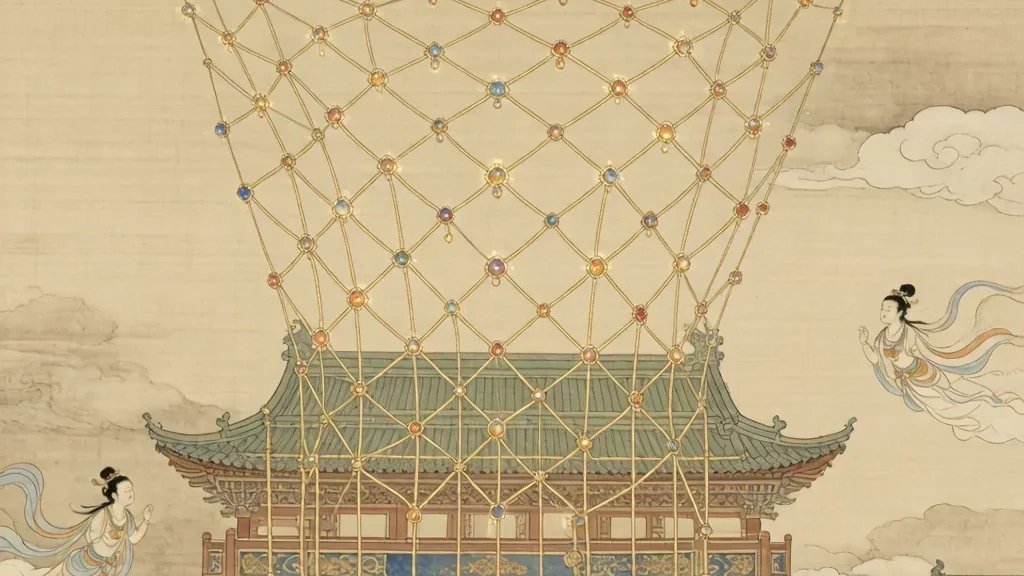
Imagine a vast net hung across the heavens, each knot tied with a luminous jewel, and every jewel reflecting every other jewel, so that in a single pearl you see the entire cosmos and all its companions. This is the image at the center of 华严宗 (Huá Yán Zōng), the Huayan or "Flower Garland" school, one of the most dazzling achievements of Chinese Buddhist thought. Built upon the immense Avatamsaka Sutra, Huayan teaches that reality is a seamless web of mutual interpenetration in which the part contains the whole and the whole pervades the part. This article explores how Huayan turned a bewildering scripture into a vision of total harmony that still captivates philosophers, artists, and meditators alike.
The Avatamsaka Sutra and the School's Birth
Huayan takes its name from the Avatamsaka Sutra, known in Chinese as the 华严经 (Huáyán Jīng), the "Flower Garland Sutra." This enormous scripture, probably assembled from many earlier texts, opens with the Buddha seemingly immersed in a state of cosmic enlightenment, radiating light and teaching not in ordinary language but through signs, worlds, and bodhisattvas. Its geography spans countless buddha-lands and its mathematics delights in vast numbers, evoking a reality too rich for ordinary concepts.
The school was systematized in the Tang dynasty, with Dushun traditionally counted as the first patriarch, followed by Zhiyan, and above all Fazang, who expounded Huayan to the Empress Wu Zetian and is considered its great architect. Fazang's lucid explanations turned an abstruse scripture into a coherent philosophy. Later masters such as Chengguan and Zongmi refined it further, Zongmi notably bridging Huayan with Chan. The school flourished briefly at the Tang court before being absorbed into the broader current of Chinese Buddhism.
The Realm of Indra's Net
The signature symbol of Huayan is Indra's net, a cosmic lattice in which every junction holds a polished jewel that reflects all the others. Because each reflection contains reflections of all the rest, the whole universe is present, infinitely mirrored, in every single point. This image expresses the principle of "mutual containment and mutual identity" (xiangru xiangji), in which no phenomenon exists in isolation; each is woven into the being of all others.
From this follows the famous dictum that "the many are contained in the one, and the one is contained in the many." A droplet of water reflects the ocean; a single thought encompasses the ten directions. Huayan thereby dissolves the ordinary opposition between the particular and the universal, the momentary and the eternal. For the believer, this means that the enlightenment of one buddha is the enlightenment of all, and that the slightest virtuous act resounds throughout the entire web of existence.
The Ten Mysterious Gates
To explain this interpenetration, Huayan masters devised the "Ten Mysterious Gates" (十玄门, shí xuán mén), a set of perspectives through which one may contemplate how reality simultaneously differs and unifies. These include such principles as "simultaneous corresponding illumination," "the freedom of the pure and the impure," and "the manifestation of the minor within the major." Together they are pedagogical lenses, not separate truths, meant to train the mind to see the same reality from multiple harmonious angles.
A closely related framework is the doctrine of the "four dharmadhatu" (四法界, sì fǎjiè): the realm of phenomena, the realm of emptiness, the realm of the non-obstruction of phenomena and emptiness, and the realm of the non-obstruction of phenomenon with phenomenon. The last and highest realm is pure Huayan vision, in which each thing both is empty and yet perfectly appears, and in which all things interpenetrate without confusion. To realize this is to taste the "ocean-seal samadhi," a meditative state in which the mind mirrors reality as calmly and completely as a still sea reflects the stars.
Huayan and the Practice of the Bodhisattva
Huayan is not only abstract metaphysics but a path of compassionate action. Its scriptural heart is the career of the bodhisattva Sudhana, who in the "Gaṇḍavyūha" chapter journeys through fifty-three spiritual friends (kalyanamitra), learning from kings, merchants, monks, goddesses, and even a young boy and girl. This pilgrimage illustrates that wisdom is found everywhere and that the bodhisattva vow to liberate all beings unfolds through endless relation and service.
The school also inspired a distinctive ethic of vow and dedication. The universal vows of Samantabhadra, the "ten great vows" to pay homage, make offerings, repent, rejoice, and transfer merit, became a cornerstone of East Asian devotional life and are chanted daily in many monasteries. Huayan thus teaches that the interpenetration of reality is not a reason to withdraw but an impetus to engage the world, since every act touches all beings and every being is a manifestation of the one truth.
Influence on Art, Chan, and East Asia
Huayan's vision left a visible mark on culture. The "Flower Garland" cosmology inspired monumental cave sculptures, such as the luminous statues at the Yungang and Longmen grottoes, and the narrative wall paintings of Sudhana's pilgrimage in Dunhuang. The school's emphasis on the universal buddha-nature fed directly into Chan, whose masters spoke of "seeing your original face" and who found in Huayan a philosophical language for sudden awakening.
Though as an independent order Huayan declined after the Tang, its thought survived by permeating everything. The great Chan master Zongmi was himself a Huayan patriarch, and the Shingon and Tendai traditions of Japan absorbed Huayan ideas. In Tibet, the Avatamsaka Sutra is revered as a foundational text. Today, the image of Indra's net has even migrated into science and literature as a metaphor for ecological interdependence and the connectedness of all things, a quiet testament to a Chinese school's enduring power to picture the unity of the world.
The Patriarchs of Huayan
Although the Avatamsaka Sutra is ancient, the Huayan school was built by a line of Chinese masters who turned its vast imagery into a system. Dushun is honored as the first patriarch for organizing its key insights, followed by Zhiyan, who deepened the doctrine of interpenetration. The true architect was Fazang, who lectured at the Tang court and explained the teaching to Empress Wu Zetian with the help of mirrors and a golden statue, making the abstract concrete. Later Chengguan and Zongmi refined the philosophy and, in Zongmi's case, bridged it with Chan. This chain of teachers shows Huayan was less a single revelation than a careful intellectual construction, a Chinese reordering of an Indian scripture that reached its height under imperial patronage before dissolving into the broader Buddhist mainstream.
Huayan Meditation and the Ocean-Seal Samadhi
Huayan is not only philosophy but a method of seeing. Its masters taught contemplations such as the Ten Mysterious Gates, lenses for viewing how reality both differs and unifies, and the four dharmadhatu, steps from mere phenomena to the highest realm where all things interpenetrate without confusion. The culmination of practice is described as the ocean-seal samadhi, a meditative state in which the mind becomes like a calm, vast sea that reflects every star and wave exactly as it is. In this state the practitioner directly tastes the mutual containment of all things rather than merely reasoning about it. Such meditation aims to dissolve the habit of splitting the world into isolated objects, replacing analysis with a clear, inclusive awareness in which the part is seen shining within the whole.
Huayan's Legacy in East Asia
As an independent order Huayan declined after the Tang persecutions, yet its thought survived by spreading into nearly everything around it. In China it fed Chan, whose masters borrowed its language of non-dual awakening, and it enriched the ritual and art of later Buddhism. In Japan the Tendai and Shingon schools made Huayan cosmology a foundation of their grand systems, and in Tibet the Avatamsaka Sutra is treasured as a root text. The school's signature image, Indra's net, has even traveled beyond religion into modern ecology and systems theory as a metaphor for interdependence. Few schools so abstract have left so broad a trace; Huayan's picture of a universe where every part holds the whole remains one of Chinese Buddhism's most enduring contributions to how the world is imagined.
❓ Frequently Asked Questions
📝 Chinese Vocabulary
华严宗 — : The Huayan (Flower Garland) school of Buddhism.
华严经 — : The Avatamsaka or Flower Garland Sutra.
十玄门 — : The Ten Mysterious Gates of Huayan contemplation.
法界 — : The dharmadhatu, the realm or suchness of reality.
帝释网 — : Indra's net, the symbol of universal interpenetration.
法藏 — : Fazang, the Tang-dynasty master who systematized Huayan philosophy and taught it to Empress Wu Zetian.
杜顺 — : Dushun, the monk traditionally counted as the first patriarch of the Huayan school.
善财童子 — : Sudhana, the youthful pilgrim who visits fifty-three spiritual friends in the Gaṇḍavyūha chapter.
🎉 Fun Facts
- The Avatamsaka Sutra describes worlds as numerous as the atoms in a billion universes, delighting in astronomically large numbers.
- Fazang is said to have used a golden statue surrounded by mirrors to demonstrate Indra's net to Empress Wu Zetian.
- The pilgrimage of Sudhana through fifty-three spiritual friends is one of the longest character journeys in world literature.
- Modern systems thinkers and ecologists often cite Indra's net as an ancient metaphor for interdependence.
- Huayan thought deeply shaped Japanese Buddhism, where the Tendai and Shingon schools absorbed its vision of the cosmos as a perfectly interpenetrating whole.
- The ocean-seal samadhi is a Huayan meditative state in which the mind becomes like a still sea that calmly mirrors all things without distortion.