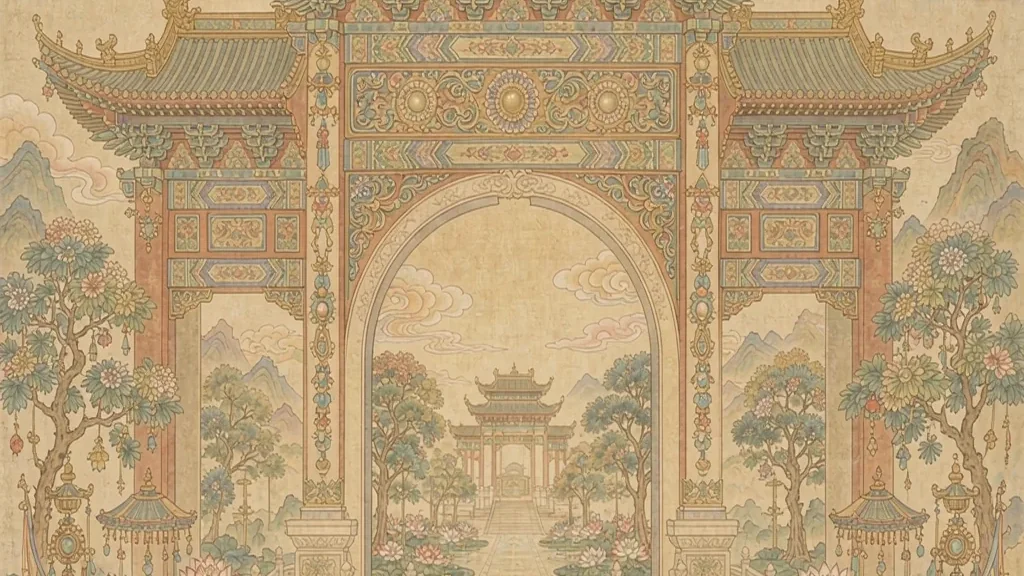
A fisherman with a criminal record, exhausted by a life of wrong choices, hears a wandering monk chant the name of Amitabha Buddha. He repeats it once, dies, and is reborn in a paradise of golden light where lotuses bloom in jeweled ponds and the air vibrates with dharma music. This is not a fairy tale but a foundational narrative of Pure Land Buddhism (净土宗, jìng tǔ zōng), a tradition that argued — against the entire monastic establishment — that ordinary people, mired in desire and ignorance, could achieve liberation not through their own efforts but through the compassionate power of a Buddha's vow.
The Western Paradise and Amitabha's Vows
According to the Larger Sukhavati-vyuha Sutra, eons ago a monk named Dharmakara made forty-eight vows before the Buddha Lokeshvararaja. The eighteenth vow was the most crucial: if, after attaining Buddhahood, any being who sincerely wished to be reborn in his pure land and called his name ten times should fail to be born there, Dharmakara vowed he would not attain full enlightenment. He did attain Buddhahood, becoming Amitabha (无量光, Infinite Light), and his pure land — Sukhavati, the Land of Bliss — became accessible to all who had faith.
Pure Land cosmology describes Sukhavati as a realm located in the western direction, billions of Buddha-fields away. It is not a heaven in the ordinary sense — it is a Buddha-field (fó tǔ), a purified world created by a Buddha's vows where the conditions for enlightenment are optimal. There is no suffering, no hell, no hunger, no greed. The ground is made of gold, the trees are adorned with jewels, and the birds sing the dharma. Rebirth there does not mean final nirvana, but it guarantees it: once in Sukhavati, liberation is inevitable.
Tanluan, Daochuo, and Shandao: The Chinese Patriarchs
The Pure Land school in China traces its lineage through a series of remarkable patriarchs. Tanluan (昙鸾, 476–542 CE) was originally a Taoist alchemist who sought immortality before converting to Buddhism. He argued that the "easy path" of reliance on Amitabha's power (tā lì, other-power) was vastly superior to the "difficult path" of self-power (zì lì), which required monastic discipline and advanced meditation.
Daochuo (道绰, 562–645 CE) popularized chanting as the primary practice and established the framework of "five practices" for Pure Land cultivation: reciting the sutra, contemplating Amitabha, worshipping, reciting the name, and dedicating merit. His disciple Shandao (善导, 613–681 CE), however, became the most influential figure. Shandao simplified Pure Land practice to its essential core: the exclusive and continuous recitation of Amitabha's name (niànfó, 念佛), trusting entirely in the vow for salvation. His writings, particularly the Commentary on the Contemplation Sutra, remain authoritative in Pure Land circles today.
The Nianfo: One Phrase, Infinite Power
The central practice of Pure Land Buddhism is niànfó — the recitation of the phrase "Namo Amituofo" (南无阿弥陀佛), meaning "Homage to Amitabha Buddha." This practice can be performed aloud or silently, individually or in groups, for five minutes or five hours. There is no specialized knowledge required. The efficacy of the nianfo is said to derive not from the practitioner's mental concentration but from the power of the Buddha's vow, which responds to sincere faith like a magnet drawing iron.
Chinese Pure Land developed two approaches to nianfo. One emphasizes single-minded recitation with counted beads or a meditation wheel, aiming for "mindfulness of Buddha" (niànfó sān mèi) as a meditative state. The other emphasizes faith alone, holding that even ten recitations at the moment of death, if uttered with genuine trust, are sufficient for rebirth in the Pure Land. This latter interpretation made Pure Land accessible to the dying, the illiterate, and those who lacked leisure for extended practice.
Pure Land and Other Schools: Cooperation and Tension
Throughout Chinese history, Pure Land coexisted with Chan and other schools in a relationship that was both cooperative and competitive. Many Chan monasteries incorporated nianfo into their daily liturgy, and masters from both traditions debated whether self-power or other-power was the ultimate path. The Ming dynasty monk Yunqi Zhuhong (云栖祩宏) advocated for the integration of Chan and Pure Land, arguing that the two methods were complementary rather than contradictory.
This integration was institutionalized in the common Chinese monastic schedule: monks would meditate in the Chan hall and also chant the Buddha's name in the memorial hall. Laypeople, especially women and the elderly, were particularly drawn to Pure Land because it required no renunciation of family life. By the Ming and Qing dynasties, Pure Land had become the de facto Buddhism of the Chinese people, the tradition that ordinary people turned to in times of crisis and at the bedside of the dying.
Pure Land in the Modern World
Today, Pure Land is arguably the most widely practiced form of Buddhism in East Asia. In China, Vietnam, Korea, and Japan, millions of lay Buddhists recite Amitabha's name daily. The Japanese Jodo Shinshu (True Pure Land) school, founded by Shinran, radicalized Shandao's teachings by claiming that faith itself is a gift from Amitabha, not an act of human will — a doctrine that resembles Protestant Christian ideas of grace.
In the modern Chinese diaspora, Pure Land temples are among the most visible Buddhist institutions, offering weekly chanting sessions, funeral services, and临终关怀 (hospice care) for the dying. The simplicity of the practice — one phrase, repeated with faith — has proven remarkably resilient in an age of migration and cultural change. For millions, "Namo Amituofo" remains the first Buddhist phrase they learn and the last they utter.
The Three Progenitors
Chinese Pure Land honors a line of patriarchs who systematized the path. Tanluan (476–542) turned from Daoist longevity to Amitabha's vow and wrote the foundational commentary on the 'Ten Recollections.' Daochuo (562–645) stressed that the degenerate age made nianfo the sure path. Shandao (613–681) taught that even one sincere invocation could secure rebirth, and his emphasis on oral practice reached laypeople directly. Together these figures shifted Pure Land from a learned option to a mass movement grounded in simple, repeatable faith. Their writings gave later devotees a clear, step-by-step assurance that the vow of a single buddha could outweigh a lifetime of ordinary failing. Their writings gave later devotees clear assurance that one buddha's vow could outweigh a lifetime of failing.
Faith, Vow, and Practice
Pure Land practice rests on three supports: faith in Amitabha's vow, the vow to be reborn in the Pure Land, and the practice of name-recitation. The tradition insists this works by the Buddha's 'other power' rather than the practitioner's own merit, a consoling message in an age believed to be spiritually declined. Visualizing the Pure Land's golden ponds and jeweled trees also aids devotion. The balance of trust and repetition made the school emotionally accessible and philosophically modest compared with scholastic paths. For the sick, the dying, and the unlearned, the promise that a few heartfelt syllables could open the gate of the Pure Land removed the despair that stricter paths sometimes bred. For the dying and the unlearned, a few heartfelt syllables could open the gate that stricter paths kept shut.
Pure Land and Popular Culture
Beyond the monastery, Pure Land shaped Chinese death rituals, funeral chanting, and the imagery of Amitabha descending to welcome the dying. Its scenes of the Western Paradise fed literature, operas, and vernacular tales of rebirth. In the modern period the school revived through reform monks who promoted nianfo societies and publishing, carrying the practice to diaspora communities. Its marriage with Chan produced the living mainstream of Chinese Buddhism, in which quiet sitting and loud invocation are two voices of the same salvation. The picture of the Buddha's hand reaching down to the dying bed is among the most enduring images in Chinese religious life, a daily comfort across a thousand years. The image of the Buddha's hand reaching down to the bedside is among the most enduring in Chinese life.
❓ Frequently Asked Questions
📝 Chinese Vocabulary
净土宗 — : Pure Land School; the tradition of Amitabha devotion.
念佛 — : recitation of the Buddha's name; the core Pure Land practice.
阿弥陀佛 — : Amitabha Buddha; the Buddha of Infinite Light.
他力 — : other-power; the salvific power of Amitabha's vow.
往生 — : rebirth in the Pure Land; the goal of Pure Land practice.
西方极乐世界 — : the Western Pure Land of Ultimate Bliss
弥陀 — : Amitabha, the buddha of boundless light
称名 — : the practice of invoking the buddha's name
🎉 Fun Facts
- The phrase "Namo Amituofo" is so widely used in Chinese culture that it appears in everything from temple murals to martial arts films as an all-purpose Buddhist exclamation.
- Shandao is said to have recited the nianfo so fervently that each utterance produced a visible light from his mouth — earning him the title "Shandao of the Light."
- Pure Land Buddhism inspired the development of "nembutsu" dance traditions in Japan, where chanting is accompanied by ecstatic movement.
- The Pure Land promise — rebirth in Amitabha's paradise by faith and the simple repetition of his name — made Buddhism accessible to ordinary people.
- The school's great advocate Shandao taught that even a single sincere invocation could secure rebirth, lowering the bar for salvation.
- In later China, Pure Land practice fused with Chan so thoroughly that most monasteries combined meditation by day with nianfo by night.