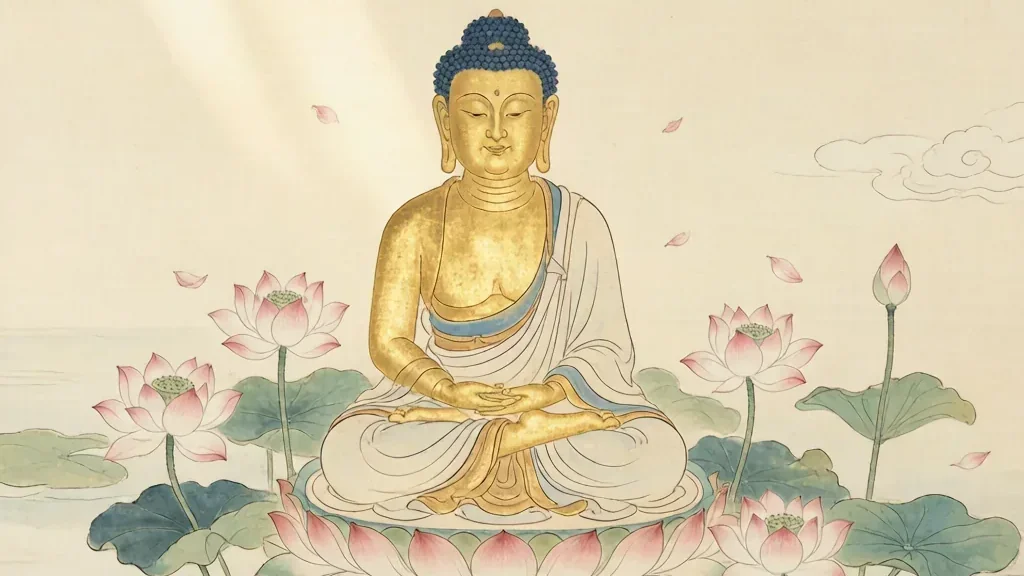
What if salvation required not years of silent meditation or scholarly mastery, but a single heartfelt cry of faith? For hundreds of millions of Buddhists across East Asia, the answer lies in 净土宗 (Jìng Tǔ Zōng), the Pure Land school. Rooted in the promise that sincere devotion to Amitabha Buddha opens the gate to a Western Paradise free from suffering, Pure Land became the most widely practiced form of Buddhism in China, Korea, and Japan. Its appeal is democratic and consoling: enlightenment is not reserved for monks alone but offered to anyone who calls upon the Buddha's name. This article explores how a simple practice of recitation grew into a spiritual lifeline that shaped the daily faith of ordinary people for over a millennium.
Origins and the Promise of the Western Paradise
Pure Land teaching traces its scriptural foundation to the Longer Amitabha Sutra, the Shorter Amitabha Sutra, and especially the Contemplation Sutra, together known as the "Three Pure Land Sutras." These texts describe how, countless eons ago, a monk named Dharmakara made forty-eight great vows before a buddha, the most important being that any being who calls upon his name with faith and aspiration would be reborn in his pure land. After boundless eons of cultivation, Dharmakara fulfilled those vows and became Amitabha, the Buddha of Infinite Light and Infinite Life, whose realm is called Sukhavati, the Land of Bliss.
Unlike our world, where greed, anger, and ignorance make spiritual progress painfully slow, the Pure Land is a transformed buddha-field where no one experiences hunger, sickness, old age, or death, and where every sound and sight turns the mind toward awakening. The central promise is that a faithful devotee, at the moment of death, is welcomed by Amitabha and his attendant bodhisattvas and reborn there in a lotus flower, never again to fall back into the lower realms. This assurance answered a deep anxiety in later Indian and Chinese Buddhism about practicing in a "degenerate age" when the Buddha's teaching is in decline and personal effort alone seems insufficient.
The Founders of the Chinese School
In China, Pure Land practice began as an adjunct to meditation and was promoted by masters such as Huiyuan, who in 402 CE gathered a community at Mount Lushan and vowed before an image of Amitabha to be reborn in the Western Paradise. Huiyuan is often honored as a patriarch, though the school was not yet formally distinct. The decisive systematizer was Tanluan, who turned from Daoist longevity techniques to Buddhist teaching after meeting the monk Bodhiruci, and who wrote a pivotal commentary explaining how faith transfers the merit of Amitabha to the practitioner.
The lineage is usually traced through a series of patriarchs. Daochuo emphasized that the present age is the "Age of the End of the Dharma," when only the easy path of recitation works. Shandao, perhaps the most influential, taught that even ten recitations of the name, performed with genuine sincerity, guarantee rebirth, and that visualization and recitation are both valid. Later masters such as Cimin Huiri and the Tiantai monk Zhili further integrated Pure Land with other schools. By the Tang dynasty, Pure Land had become a virtually universal devotional layer within Chinese Buddhism, practiced alongside Chan, Huayan, and esoteric rites.
The Practice of Nianfo: Calling the Name
The heart of Pure Land is nianfo, usually rendered as "recitation of the Buddha's name." The most common form is the verbal repetition of "Namo Amituofo" (Homage to Amitabha Buddha), sometimes counted on a string of prayer beads to structure the practice. Practitioners may recite aloud, whisper, or mentally invoke the name, alone or in groups, at a temple or at a sickbed. The goal is not mechanical repetition but the unification of mind and heart in trust, until the name and the reciter are no longer separate.
Beyond simple recitation, the Contemplation Sutra outlines sixteen visualization exercises, from imagining the setting sun to constructing the full splendor of Amitabha's pure land in the mind's eye. Shandao taught that for ordinary people the oral nianfo is the most reliable method. In daily life, Pure Land faith expresses itself in regular sutra chanting, making offerings before a Buddha image, dedicating merit to departed relatives, and facing death with composure, confident in the promise of rebirth. The practice's portability made it especially beloved among laypeople, the elderly, and the ill.
Pure Land and the Other Buddhist Schools
A persistent misunderstanding is that Pure Land and Chan (Zen) are rivals. In fact, Chinese Buddhism wove them together. The phrase "Chan for the mind, Pure Land for the afterlife" captures a common synthesis, and many Chan masters encouraged nianfo as a koan-like practice in which the question "Who is reciting?" dissolves the boundary between self and Buddha. The great reformer Yungu and later the lay scholar-official Yunqi Zhuhong promoted a combined path of precepts, recitation, and repentance.
Pure Land also absorbed elements of Huayan cosmology and esoteric ritual. In the late imperial period, the "dual cultivation of Chan and Pure Land" became standard in monastic training, and today most Chinese Buddhist temples maintain a Hall of Amitabha alongside the Hall of Shakyamuni. The school's genius was inclusivity: it asked no one to abandon their other practices, only to add a refuge of faith that promised a safe passage through the most frightening transition of all, the moment of death.
Spread Across East Asia
Pure Land traveled from China to Korea, where it became a major current of practice, and to Vietnam, where it remains central to lay Buddhism. In Japan, the teaching was transformed by Honen, who founded the Jodo (Pure Land) school on exclusive nianfo, and by Shinran, whose Jodo Shinshu taught that salvation is entirely a gift of grace received by faith, not by any effort of one's own. These movements made Pure Land the faith of the masses in medieval Japan, and today Shin Buddhism counts tens of millions of adherents.
The visual culture of Pure Land also shaped art across the region: monumental paintings of Amitabha descending on a cloud to welcome the dying, serene sculptures of the standing savior with hands in the gesture of welcome, and illustrated "deathbed scenes" that guided families in their final rites. From a Chinese village chapel to a Kyoto temple, the image of the compassionate Buddha reaching down to receive the believer became one of the most beloved icons of Asian religion, a symbol that no one need face death alone.
Why Pure Land Still Matters
In an age of anxiety about mortality, meaning, and isolation, Pure Land offers a remarkably accessible spirituality. It affirms that the deepest human longing for safety and belonging can be met not by striving alone but by trust and connection, by calling on a compassion greater than oneself. The practice requires no special status, no wealth, and no philosophical training — only sincerity repeated, breath by breath.
Modern practitioners continue to find in nianfo a portable refuge: a way to steady the mind in traffic, in grief, or beside a dying parent. Scholar-monks and laypeople alike observe that the school's emphasis on dedicating merit to others reflects a profoundly altruistic ethic. Whether understood literally as rebirth in a celestial buddha-field or symbolically as the awakening of the pure mind within, Pure Land Buddhism remains a living stream that has carried the hopes of ordinary believers across fifteen hundred years and shows no sign of running dry.
Deathbed Rites and the Passing Hour
Because Pure Land promises rebirth in Sukhavati at the moment of death, the final hours of life became a focus of devoted care. Family members and fellow practitioners gather at the bedside to chant the Buddha's name in unison, creating an atmosphere of calm and faith intended to steady the dying person's mind. A small image of Amitabha is often placed where the person can see it, and the name is whispered again and again so that the last thought may be of the Buddha. This tradition reflects a core belief: the state of mind at death shapes the next rebirth. Rather than mourning, the assembly offers reassurance, sometimes reading the sutras or transferring the merit of their chanting to the departed. In this way, dying is treated not as a lonely ending but as a protected crossing, surrounded by the voices of the community and the promise of welcome.
Pure Land in Everyday Devotion
Beyond the crisis of death, Pure Land shaped the texture of ordinary Buddhist life. Monasteries and households kept a daily rhythm of morning and evening chanting, with the assembly reciting the Buddha's name before an image of Amitabha. Lay devotees joined periodic recitation retreats, sitting for hours with beads in hand, and many inscribed the name on rotating wheels or hanging scrolls. The ideal of the Lotus Society, first formed by Huiyuan's circle, inspired centuries of lay associations dedicated to collective practice and the vow to meet again in the pure land. In modern China, Taiwan, and overseas communities, Pure Land remains the most common form of home Buddhism: a shrine, a string of beads, and a few minutes of nianfo woven into the day. Its genius is precisely this portability, turning commute, chores, and grief into occasions of remembrance.
❓ Frequently Asked Questions
📝 Chinese Vocabulary
净土宗 — : Pure Land school of Buddhism.
阿弥陀佛 — : Amitabha Buddha, the Buddha of Infinite Light.
念佛 — : Recitation of the Buddha's name.
往生 — : Rebirth or passage into the pure land.
极乐世界 — : The Land of Ultimate Bliss, Sukhavati.
四十八愿 — : The Forty-eight Vows made by the monk Dharmakara before he became Amitabha, the foundation of the Pure Land promise.
善导 — : Shandao, the Tang-dynasty Pure Land master who taught that even ten sincere recitations can secure rebirth.
十六观 — : The sixteen visualization practices taught in the Contemplation Sutra as a path to the pure land.
🎉 Fun Facts
- The Chinese name for the prayer beads used in recitation, 佛珠 (fózhū), can number 108, symbolizing the clearing away of 108 defilements.
- Pure Land is sometimes called the "easy path" (易行道, yìxíng dào) compared with the "difficult path" of self-powered cultivation.
- The JapaneseJodo Shinshu, founded by Shinran, allowed its priests to marry, shaping a distinctive married clergy tradition.
- The welcoming descent of Amitabha at death is one of the most frequently painted subjects in all of East Asian Buddhist art.
- The phrase Namo Amituofo functions both as a devotional recitation and as a customary greeting of peace among monastics and lay devotees.
- The Contemplation Sutra begins its sixteen meditations with visualizing the setting sun, training the mind to turn from the fading world toward the western paradise.