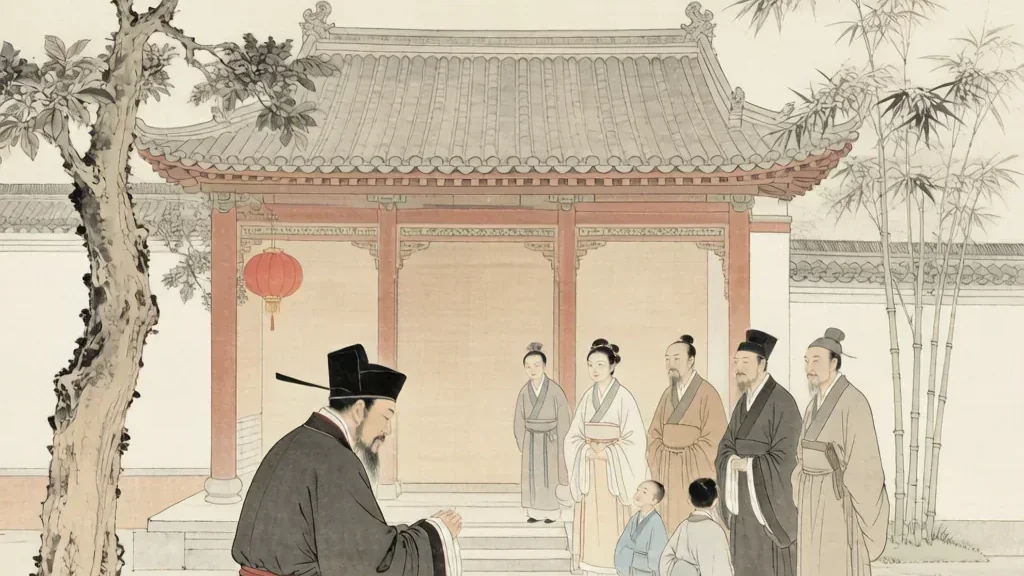
Imagine a civilization that measured the health of its society not by armies or wealth, but by the quality of its human relationships. For over two millennia, the st, China was shaped by exactly such a vision, and the name behind it is 儒家 (Rújiā) — Confucianism. Born from the teachings of a troubled teacher who lived in an age of chaos, this school of thought became the ethical backbone of imperial China and, in many ways, of Chinese family life to this day. To understand Confucianism is to understand how a quarter of humanity learned to think about respect, responsibility, and the proper ordering of the world.
Origins in a Time of Chaos
Confucianism began with a man known in the West as Confucius and in Chinese as 孔子 (Kǒngzǐ), "Master Kong." He lived from roughly 551 to 479 BCE, during the later part of the Zhou dynasty, an era historians call the "Spring and Autumn" period. It was a time of fracturing authority, when regional lords fought one another and the old rituals that had held society together were collapsing. Confucius looked at this disorder and concluded that the problem was not a lack of laws or wealth, but a loss of moral character among those who governed and those who were governed.
Rather than invent a new religion, Confucius pointed backward. He admired the semi-legendary sage-kings and the early Zhou rulers, and he believed that the best way to heal society was to recover the virtue (德, dé) of the ancients and to live by the rituals (礼, lǐ) that expressed it. He gathered disciples, traveled from court to court seeking a ruler who would listen, and left behind a body of sayings later compiled as the 论语 (Lúnyǔ), the Analects. He never saw his ideas adopted in his lifetime, yet within a few centuries they would become the official doctrine of the Chinese state.
The Core Idea: Ren and the Cultivation of the Person
At the heart of Confucian ethics lies the concept of 仁 (rén), often translated as "humaneness" or "benevolence." Ren is the quality of a person who genuinely wishes well for others and acts on that wish. Confucius said that ren is to "love people," and he described it as the inward spirit that gives life to every outward form of good conduct. A person of ren does not need constant supervision, because virtue has become part of who they are.
But ren does not appear by accident. For Confucius, it is cultivated through learning, reflection, and daily practice — especially through the performance of ritual. The Chinese word 礼 (lǐ) covers ceremonies, manners, and the whole set of customary behaviors that bind people together. By treating others with proper ceremony, one trains the heart to feel proper respect. In this sense Confucianism is less a system of beliefs than a discipline of becoming a better human being, one relationship at a time.
The Five Relationships and Social Order
Confucius taught that society is a web of relationships, and that harmony depends on each person playing their role well. He named five key relationships: ruler and subject, father and son, husband and wife, elder brother and younger brother, and friend and friend. In four of these, one party naturally guides and the other follows; in the fifth, between friends, the two are equal. The striking feature of this scheme is that obligation runs in both directions. A father should be kind and a son reverent; a ruler should be just and a subject loyal.
This reciprocal model meant that Confucianism was never simply a tool for obedience. A bad ruler, Confucius argued, forfeits the right to be followed, and the mandate to govern can be lost. The emphasis on mutual duty helped make the family — not the individual and not the state alone — the central unit of Chinese life. What one owed to parents, siblings, and ancestors shaped behavior more powerfully than any law, and this explains why family loyalty remains so strong in Chinese culture today.
Education, Merit, and the Scholar-Official
One of Confucianism's most lasting contributions was its faith in education as the road to virtue and to office. Confucius famously taught that one should "learn without flagging," and he welcomed students regardless of their social birth. This radical idea — that ability, not ancestry, should determine who governs — eventually produced the imperial examination system. For more than a thousand years, young men across China studied the Confucian classics to compete for posts in the bureaucracy.
The result was a class of scholar-officials who ran the empire at the local level, bridging villagers and the throne. Because promotion depended on mastering the same texts, a rough cultural unity stretched from the capital to the countryside. The examinations also meant that, at least in theory, a poor but brilliant boy could rise to the highest office. This meritocratic ideal, borrowed and adapted around the world, is one of Confucianism's quiet legacies to modern government.
Ritual, Music, and the Gentle Path
Confucius believed that law and punishment could keep people in line, but only ritual and music could make them good. 乐 (yuè), music, held a special place in his thought, because he saw harmony in sound as a mirror of harmony in society. The properly ordered court, like a properly ordered piece of music, allowed every part to contribute without overwhelming the others. This is why the Confucian gentleman (君子, jūnzǐ) was expected to be cultured — versed in poetry, history, ritual, and music — and not merely clever or strong.
The gentleman, or "superior person," became the moral ideal of the tradition. Unlike the petty person who thinks only of personal gain, the gentleman acts from principle and cares for the welfare of the whole. To become such a person is a lifelong task, but it is open to anyone willing to learn. In this gentle, self-transforming path, Confucianism offered not salvation from the world but a way to improve the world one relationship at a time.
Why Confucianism Still Matters
Confucianism was criticized and even suppressed at moments in Chinese history, most violently in the early twentieth century, when reformers blamed it for China's weakness. Yet its habits of filial devotion, respect for teachers, emphasis on education, and faith in social harmony have proved remarkably durable. Today, across East Asia, versions of Confucian values shape family life, business ethics, and attitudes toward authority and learning. Leaders in several countries openly invoke "Asian values" rooted in this tradition.
More than a philosophy, Confucianism is a posture toward life: that we are defined by our relationships, that character can be trained, and that a good society begins with good people in right relation to one another. Whether or not one accepts its answers, the questions it asks — how should we live together? what does it mean to be a virtuous person? — remain as pressing now as they were when Master Kong walked the roads of a divided land.
Governance Through Virtue
Confucius argued that a state is best led not by harsh punishment but by the moral example of its rulers. If those in power are upright, he taught, the people will be upright of their own accord, much as grass bends when the wind blows. A good official governs through de, or virtuous influence, earning trust so that laws need only be a backstop. This idea reshaped Chinese government for two millennia, supplying the ideal of the benevolent administrator and the censoring official who spoke truth to the throne. It also linked ethics to politics: to rule well was to cultivate oneself well. Critics note the model could excuse weak enforcement, yet the aspiration endured, from imperial edicts to the civil service ideal. The phrase 'lead by virtue' still surfaces in discussions of leadership, a reminder that Confucius saw public life as a continuation of personal character.
The Cultivated Gentleman
The junzi, often translated as gentleman or noble person, is Confucius's model of the mature moral self. Unlike the petty person who chases private gain, the gentleman acts from duty and rectitude even when no one is watching. Becoming one is a lifelong discipline of study, reflection, and practice: learning the classics, mastering ritual, and repeatedly examining one's own faults. Confucius insisted that anyone, not only the well born, could walk this path, a strikingly open claim for his age. The gentleman is courteous yet principled, firm yet not harsh, able to work with others without losing independence. This ideal gave Chinese culture a shared picture of what a good person looks like in family, school, and office. It also set self-cultivation above status, suggesting that character, not rank, is the true mark of nobility.
❓ Frequently Asked Questions
📝 Chinese Vocabulary
儒家 — : The Confucian school of thought.
仁 — : Humaneness or benevolence, the central Confucian virtue.
礼 — : Ritual propriety, ceremony, and customary good conduct.
君子 — : The gentleman or "superior person" of moral cultivation.
论语 — : The Analects, the collected sayings of Confucius.
孝 — : Filial piety, the respect, care, and reverence owed to parents and ancestors.
中庸 — : The doctrine of the mean, the pursuit of balanced, timely conduct that avoids excess and deficiency.
天命 — : The mandate or ordinance of heaven, the higher destiny and moral order governing human affairs.
孝 — : Filial piety, the respect, care, and reverence owed to parents and ancestors.
中庸 — : The doctrine of the mean, the pursuit of balanced, timely conduct that avoids excess and deficiency.
天命 — : The mandate or ordinance of heaven, the higher destiny and moral order governing human affairs.
🎉 Fun Facts
- Confucius is traditionally said to have had three thousand disciples, of whom seventy-two mastered his teachings completely.
- The imperial examination based on Confucian classics lasted in various forms for more than 1,300 years, ending only in 1905.
- Confucius was honored with the title "Supreme Sage and Foremost Teacher," and temples in his honor (文庙) still stand across East Asia.
- The Analects were not written by Confucius himself but compiled by his disciples and later followers over generations after his death.
- Korea, Vietnam, and Japan each absorbed Confucian ideals, shaping their civil exams, family rites, and schools for centuries.
- The Confucius family mansion, cemetery, and temple in Qufu have been maintained and expanded by his descendants for more than two thousand years.
- The Analects were not written by Confucius himself but compiled by his disciples and later followers over generations after his death.
- Korea, Vietnam, and Japan each absorbed Confucian ideals, shaping their civil exams, family rites, and schools for centuries.
- The Confucius family mansion, cemetery, and temple in Qufu have been maintained and expanded by his descendants for more than two thousand years.