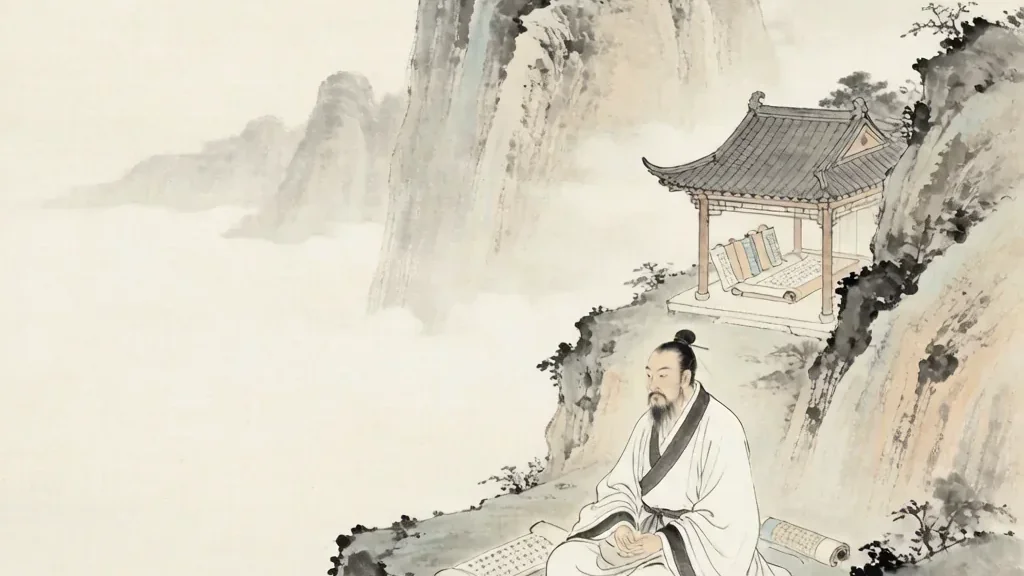
Neo-Confucianism is the broad term for the revival and reconstruction of Confucian thought that began in the Tang and Song dynasties and dominated Chinese philosophy, education, and government for nearly a thousand years. Facing the challenge of Buddhism and Daoism, Neo-Confucian scholars reworked the classical heritage into a comprehensive metaphysical, ethical, and political system. Their synthesis gave China—and later Korea, Japan, and Vietnam—a rigorous framework for self-cultivation and statecraft that remained authoritative until the modern era.
Historical Background
After the collapse of the Han dynasty, Confucianism lost its monopoly over elite culture. Buddhism, arriving from India, and native Daoism offered compelling answers about suffering, death, and the nature of mind that early Confucianism had left undeveloped. By the Tang dynasty, educated Chinese might be Confucian in public office yet Buddhist or Daoist in private contemplation.
A turning point came with Tang reformers such as Han Yu, who attacked Buddhism as foreign and called for returning to the Confucian Way. But a merely defensive return was insufficient; what emerged instead was a creative reconstruction that borrowed Buddhist and Daoist depth—especially meditation and cosmology—while reaffirming Confucian this-worldly ethics.
The real flowering occurred in the Song dynasty, when thinkers like Zhou Dunyi, Zhang Zai, Cheng Hao, and Cheng Yi built a new system. It was later codified by Zhu Xi and opposed by the Wang Yangming school, the two great streams of the tradition.
The Search for a Confucian Metaphysics
Neo-Confucians wanted to explain not only how to live but why the cosmos is ordered so that living well aligns with reality. They turned to the Yijing, the Doctrine of the Mean, and the Great Learning, reading them as revelations of a unified cosmic principle. The result was a philosophy that joined ethics to the structure of the universe.
Central to this was the claim that the same principle (li) ordering heaven and earth also orders the human heart. Self-cultivation was therefore not arbitrary moralism but the realization of one's own deepest nature, which is continuous with the world. This gave Confucian ethics a metaphysical grounding it had previously lacked.
The tradition also absorbed a sense of quiet contemplation. Under Buddhist influence, Neo-Confucians practiced "quiet sitting" to settle the mind, though they insisted such calm must issue in active moral service, not withdrawal from the world.
Principal Concepts: Li and Qi
The cornerstone pair is li (principle, pattern, coherence) and qi (vital material force). Li is the intelligible order that makes a thing what it is—the "being-a-table" pattern of a table. Qi is the stuff that embodies it. Every existing thing is a compound of li and qi; nothing exists without both.
For Zhu Xi, li in the abstract is one and universal (the Great Ultimate, Taiji), yet it is manifested distinctly in each thing. A tree and a person share the same underlying principle in its cosmic dimension, while each exhibits it according to its kind. Knowledge is therefore the discernment of li in particular things.
This framework resolved older puzzles about how the many relate to the one. The world's diversity is the differentiation of qi under the guidance of a single, shared li—a vision both pluralistic in appearance and monistic in ground.
Zhu Xi and the Cheng-Zhu School
Zhu Xi (1130–1200) is the systematic giant of Neo-Confucianism. He edited the Four Books—Analects, Mencius, Great Learning, Doctrine of the Mean—and wrote commentaries that became the standard curriculum for the civil-service examinations for centuries. His synthesis is called the Cheng-Zhu school, after the Cheng brothers whom he followed.
Zhu's method emphasized "investigating things" (gewu) to exhaust their li. One begins with the concrete: reading, observing, and reasoning, gradually extending understanding until the mind grasps principle as a whole. Moral cultivation and intellectual inquiry were two sides of one path.
His ethics stressed that human nature, though good in its li, is clouded by the turbidity of qi; education and effort clarify it. The ideal was a calm, serious, well-ordered life in which knowledge and action reinforced each other.
Wang Yangming and the School of Mind
Wang Yangming (1472–1529) offered a rival interpretation that became the tradition's second great school. He is famous for the doctrine that "the mind is principle" (xin ji shi li): there is no li outside the mind, so the search for principle in external things is misdirected. What is needed is to clarify the originally good knowing (liangzhi) within.
Wang's turning point came when, after years of following Zhu Xi's investigative method without success, he concluded that principle must be sought in the heart. He taught "the unity of knowing and acting": genuine knowledge necessarily expresses itself in action, and a failure to act reveals that knowledge was not yet real.
His followers practiced "inquiring into the mind" and trusting innate moral intuition. The Wang school's emphasis on spontaneous, heartfelt action influenced later reformers and, through Japanese adherents, modern political activists who valued its activist confidence.
Self-Cultivation and Practice
Neo-Confucian life was disciplined and studious. The day might open with quiet sitting, continue with reading the classics and recording reflections in a journal, and include care for family and public duties. The aim was constant watchfulness over one's thoughts before they hardened into action.
The Great Learning supplied a ladder: investigate things, extend knowledge, make the will sincere, rectify the heart, cultivate the person, regulate the family, govern the state, and pacify the world. Personal perfection and cosmic order were linked rung by rung.
Communities of scholars also formed "community compacts" (xiangyue) to encourage mutual correction in local villages, blending self-cultivation with grassroots moral governance. Neo-Confucianism was thus not only a philosophy but a social movement.
Neo-Confucianism and Society
As state orthodoxy, Neo-Confucianism shaped law, education, and family life. Its emphasis on ritual, hierarchy, and filial piety reinforced a stable, patriarchal social order. Examinations tested mastery of Zhu Xi's commentaries, so the tradition literally formed the minds of the ruling class.
This authority had a conservative edge. The same teachings that promoted learning and responsibility also upheld strict gender roles and suppression of unorthodox thought. The neo-Confucian "rectification of the heart" could harden into social conformity and the policing of behavior.
Yet the tradition also inspired remarkable scholarship, public service, and local charity. Many Neo-Confucian officials saw themselves as moral shepherds, and the ideal of the scholar-official as both learned and virtuous owes much to this synthesis.
Spread Across East Asia
Neo-Confucianism traveled far beyond China. In Korea, the Joseon dynasty made Zhu Xi's Cheng-Zhu learning the state creed, producing intense scholastic debate. In Japan, both Zhu Xi and Wang Yangming schools took root, the latter influencing samurai reformers such as those of the Meiji Restoration.
In Vietnam, Neo-Confucian examination and administrative models shaped the state for centuries. Each culture adapted the system to its own needs, but all shared the core conviction that cosmic principle and human virtue are one.
This regional spread makes Neo-Confucianism one of the great shared philosophies of East Asia, comparable to the role of Aristotelian-Scholastic thought in parts of Europe, binding diverse societies through a common intellectual language.
Legacy and Modern Reappraisal
The early twentieth century saw Neo-Confucianism attacked as an obstacle to modernization, blamed for China's weakness in the face of Western power. The May Fourth movement dismissed it as "feudal." Yet it never fully disappeared, and from the late twentieth century a scholarly revival reassessed its resources.
Contemporary "New Confucians" argue that the tradition offers valuable alternatives to unbridled individualism and instrumentalism—emphasizing relation, cultivation, and the unity of knowledge and action. Its ecological resonance, reading humanity as part of a cosmic order, has also drawn interest.
Whether as living guide or historical force, Neo-Confucianism remains essential to understanding East Asian civilization. Its questions—how to know the world, how to form character, how the personal and cosmic connect—are as urgent now as when Zhu Xi and Wang Yangming debated them.
❓ Frequently Asked Questions
What is Neo-Confucianism?
It is the medieval revival and reconstruction of Confucianism that added a metaphysical system using li (principle) and qi (vital force), dominating East Asian thought for nearly a thousand years.
How did Neo-Confucianism differ from early Confucianism?
It absorbed Buddhist and Daoist depth—cosmology and meditation—while keeping this-worldly ethics, giving Confucian morality a metaphysical grounding it previously lacked.
What is the difference between Zhu Xi and Wang Yangming?
Zhu Xi taught investigating things to find external principle; Wang taught that the mind itself is principle and stressed innate knowing and the unity of knowing and acting.
What are li and qi?
Li is the intelligible pattern ordering a thing; qi is the vital stuff embodying it. Every thing is their compound, uniting cosmic order with material life.
Why was Neo-Confucianism important socially?
As exam orthodoxy it shaped the ruling class's mind, reinforced ritual and family order, and inspired scholarship and public service across East Asia.
Is Neo-Confucianism still relevant?
Yes. Modern New Confucians draw on its emphasis on relation, cultivation, and knowledge-action unity, and its ecological resonance attracts fresh interest today.