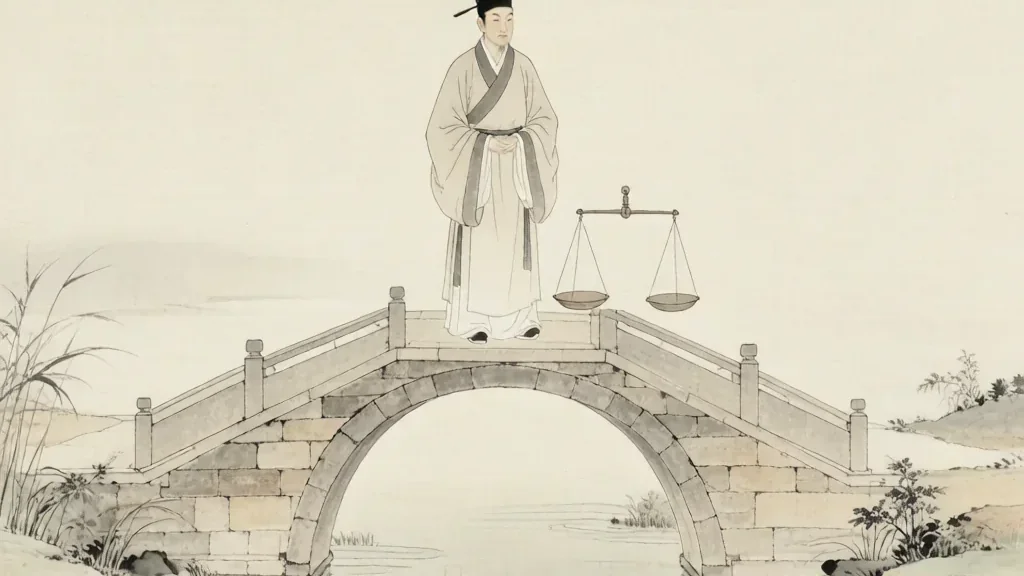
The Doctrine of the Mean, known in Chinese as Zhongyong (中庸), is a central Confucian text that teaches the value of balance, equilibrium, and unwavering correctness in human conduct and character. As one of the Four Books of later imperial education, it shaped how generations of Chinese scholars understood the perfected person and the ordered society. The "mean" here is not mediocrity or compromise but a steady Middle Path—neither excess nor deficiency—rooted in an innate moral nature and expressed as composure under all circumstances.
What "Zhongyong" Means
The title combines zhong, "center" or "middle," and yong, "constant" or "use." Together they suggest the constant, undeviating middle—conduct that never tilts to extremes. The text itself defines zhong as "the state before joy, anger, sorrow, and pleasure have been aroused," and yong as "the way that is practiced everywhere without fail." The mean is thus both an inner equilibrium and an outer steadiness.
Crucially, the Zhongyong is not about being average. To hit the exact right point between too much and too little, in constantly changing situations, is exceedingly difficult and demands the finest moral discernment. The easy path of compromise is not what is praised; rather, it is the precise, principled balance that few attain.
The text presents this balance as rooted in human nature itself. When feelings are properly expressed and nothing is excessive, the result is harmony (he), and the world is thereby set right. The mean is the human expression of the cosmic order.
Place Among the Confucian Classics
The Zhongyong began as one chapter of the Record of Rites (Liji). It was later extracted and elevated by the Neo-Confucian Zhu Xi, who made it the second of the Four Books—alongside the Analects, Mencius, and the Great Learning—that became the core of civil-service examination study from the Song dynasty onward.
Tradition ascribes the original writing to Zisi, the grandson of Confucius, though modern scholars date the text's formation to the centuries after Confucius, with layers of Daoist and Yijing-influenced language. Regardless of authorship, its placement in the curriculum made it one of the most memorized and examined texts in Chinese history.
Its elevation reflected a shift in emphasis: from the outward rules of ritual toward the inner cultivation of a balanced, sincere character. The Zhongyong became the bridge between ethical action and metaphysical cosmology in later Confucianism.
The Argument of the Text
The opening passage is famous: "What Heaven imparts to man is called human nature. To follow our nature is called the Way. Cultivating the Way is called education." From the start, the text ties moral life to a heaven-given nature, making virtue the realization of what we already are.
It then stresses sincerity (cheng). The sincere person is one whose inner and outer life coincide, who needs no effort to be good because his nature flows correctly. The highest sage achieves "sincerity without effort," acting perfectly because his character is fully realized.
The text also describes the gradual path: study, inquiry, reflection, discrimination, and practice. It honors both the learned pursuit of understanding and the quiet embodiment of virtue, offering a roadmap from ordinary effort to effortless sageliness.
Equilibrium and Harmony
A pivotal passage distinguishes the "state of equilibrium" (zhong) before feelings arise from the "state of harmony" (he) when feelings are rightly expressed. When equilibrium and harmony are fully realized, "heaven and earth will attain their proper order and all things will be nourished." The individual's inner balance is thus cosmically significant.
This linkage shows the Confucian confidence that personal cultivation is not private but world-making. A person who governs his own passions helps govern the world, because the microcosm of the self mirrors the macrocosm of the cosmos. The mean is where ethics meets cosmology.
The passage also explains why the mean is rare. Most people, the text says, "eat and drink without knowing the flavor," drifting through life without discernment. To live the mean requires awake attention to every choice—a demanding, lifelong discipline rather than a settled achievement.
The Exemplar and the Sage
The Zhongyong contrasts the sage, who embodies the mean effortlessly, with the worthy person, who must "grasp the two ends and use the middle" deliberately. The worthy studies extremes—rashness and timidity, for instance—and then steers between them with counsel and reflection.
Confucius is quoted as saying that the mean is the highest excellence yet has long been rare among the people. He praises those who, "though they know the mean, swerve from it," acknowledging how hard steady balance is in practice. The text is realistic about human weakness even while it holds up the ideal.
The virtuous person is also described as "firm yet mild, gentle yet upright." Such paired qualities show that the mean is not bland but a dynamic holding-together of strengths that ordinarily pull apart. The ideal character is both resolute and yielding, both serious and warm.
Sincerity and the Way of Heaven
The later chapters deepen the theme of cheng, sincerity. "Sincerity is the way of Heaven; the attainment of sincerity is the way of man." To be sincere is to be wholly real, without falseness or division, so that thought, word, and deed are one.
From sincerity flows the power to "assist the transforming and nourishing powers of Heaven and Earth." The fully sincere sage does not merely conform to the cosmos; he participates in its creative order. This is why the text can move, in its final chapters, from personal ethics to the sage's almost cosmic authority.
The teaching also gives hope to ordinary learners: "He who tries to be sincere chooses the good and holds fast to it." Even gradual, effortful sincerity connects the student to the same heavenly principle realized completely in the sage. The gap between learner and sage is one of degree, not kind.
The Mean and Other Traditions
The Zhongyong shares family resemblances with the Aristotelian "golden mean," the Buddhist Middle Way, and the Daoist teaching of wuwei. All caution against extremes and prize a balanced, natural course. Yet the Confucian version is distinctive in grounding the mean in a social, relational ethic rather than in withdrawal or contemplation alone.
Its language also overlaps with the Yijing (Classic of Changes), speaking of the unseen and the transforming. Some scholars detect Daoist coloring in its cosmic passages, evidence of the cross-fertilization among Warring States and Han thinkers that the text absorbed over time.
What remains distinctly Confucian is the conviction that balance must be lived among parents, friends, and rulers. The mean is not a private tranquility but a public competence—the capacity to act rightly with others in the messy particularity of daily life.
Influence and Legacy
As a core examination text for nearly a millennium, the Zhongyong molded the self-understanding of China's literate elite. Its vocabulary—sincerity, equilibrium, the mean—permeated essays, official speeches, and family instructions. To be called a person of "zhongyong" was high praise.
Neo-Confucians from Zhu Xi to Wang Yangming debated how exactly to realize the innate nature the text describes, and those debates shaped schools of thought across East Asia. Korean and Japanese Confucians likewise studied it as a key to sagehood.
Today the Doctrine of the Mean speaks to anyone interested in balanced living and integrated character. Its warning against both excess and deficiency, and its call for sincerity between inner and outer life, remains a humane and demanding ideal in a world of polarization and performance.
❓ Frequently Asked Questions
What is the Doctrine of the Mean?
The Zhongyong is a Confucian text teaching balance, equilibrium, and sincerity. The "mean" is a steady Middle Path between excess and deficiency, rooted in innate moral nature.
Is the mean the same as mediocrity?
No. It means hitting the exact right point in changing situations, which demands great discernment. Compromise or averageness is not what the text praises.
Who wrote the Doctrine of the Mean?
Tradition names Zisi, Confucius's grandson, but scholars date its formation to later centuries, with layers of Daoist and Yijing-influenced language.
What is the role of sincerity in the text?
Sincerity (cheng) is the unity of inner and outer life. The fully sincere sage participates in the cosmos's creative order; learners approach it through effortful practice.
How did the Zhongyong influence China?
As a Four Books exam text for nearly a millennium, it shaped the elite's self-image and seeded Neo-Confucian debates across China, Korea, and Japan.
How does it relate to harmony?
Equilibrium (zhong) before feeling and harmony (he) in expression together set heaven and earth in order; personal balance is cosmically significant.