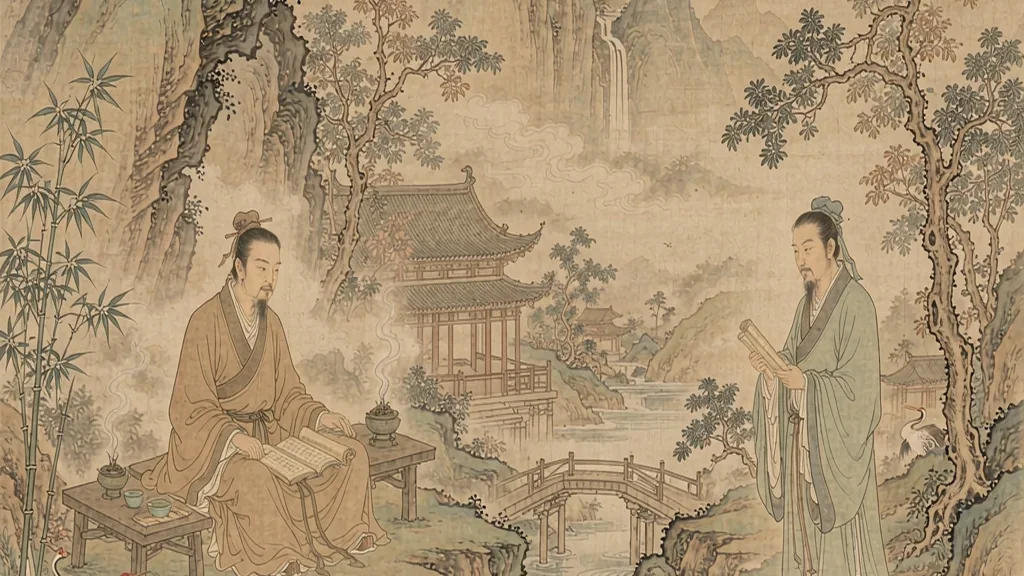
The Lu-Wang school (Lu-Wang xue) names the "heart-mind" (xin) line of Neo-Confucianism founded by Lu Jiuyuan (Lu Xiangshan) and culmination in Wang Yangming. Against the rationalist emphasis of Zhu Xi, who located principle in the orderly investigation of things, the Lu-Wang masters taught that principle resides in the mind itself: "the mind is principle" (xin ji li). Wang's further doctrines of "innate knowing" (liangzhi) and the "unity of knowing and acting" (zhi xing he yi) made the school the most idealist and activist current in later Confucianism, with a profound later influence in Japan and Korea.
Lu Jiuyuan, the Founder
Lu Jiuyuan, styled Xiangshan, was a Southern Song thinker who broke from the dominant Zhu Xi approach. He famously declared that the universe is within the mind, and that searching outward for principle in things was a detour.
In a celebrated debate at the "Goose Lake" gathering with Zhu Xi's followers, Lu stressed sudden comprehension and inward assurance, contrasting with Zhu's patient, book-by-book accumulation. The two temperaments—intuitive versus cumulative—defined the split.
Wang Yangming's Life
Wang Shouren, known by his studio name Yangming, was a Ming statesman, general, and thinker who arrived at the heart-mind doctrine through personal crisis and practice. His military and administrative career gave his philosophy a hard, worldly edge.
After a period of unsuccessful Zhu-Xi-style investigation, Wang experienced a breakthrough, concluding that the principle he sought was not outside but present in his own mind. His teachings then spread through lively lecture gatherings.
"The Mind Is Principle"
The school's cardinal claim is that the mind and principle are not two. Moral truth is not discovered by piecing together external facts but recognised within. This is idealism in the sense that the order of things is inseparable from the knowing mind.
Such a view risks appearing to dissolve the world, so Wang carefully insisted the mind's principle is the very same principle ordering heaven and earth—not a private whim but the shared structure of reality.
Innate Knowing (Liangzhi)
Wang's signature concept is liangzhi, the "innate knowing" of good and bad that every person possesses without instruction. It is both a moral compass and, in a sense, the mind's luminous activity itself.
To cultivate is not to add knowledge but to remove obfuscation, letting innate knowing shine. Wang likened it to the sun behind clouds: always present, needing only clearing.
Unity of Knowing and Acting
Wang's most famous doctrine is zhi xing he yi: knowing and acting are one. To truly know the good is already to begin acting on it; a "knowledge" that does not move the will is, he argued, not yet real knowledge.
This attacked the common excuse of knowing-but-not-doing. For Wang, hesitation and inaction revealed that knowing was merely verbal. Genuine understanding necessarily expresses itself in conduct.
Criticism From Orthodoxy
Zhu Xi's heirs accused the Lu-Wang school of "vacuous" subjectivism that could license antinomianism—if the mind is principle, why study the classics? The charge of "wild" Chan-Buddhist influence dogged the school.
Defenders replied that innate knowing demands the strictest sincerity and concrete action, as Wang's own career proved. The debate reflected a permanent tension between confidence in intuition and respect for tradition.
Influence in Japan and Korea
The school travelled abroad powerfully. In Japan, Wang's thought inspired reformers and warriors, notably figures of the Meiji restoration who read "unity of knowing and acting" as a call to decisive public action.
In Korea, the debate between Zhu Xi orthodoxy and Wang-style intuition shaped scholarly life for centuries. The school's activist tone proved especially resonant where Confucianism met state-building.
Why the School Matters
Lu-Wang offers a Confucianism of confidence and courage: it locates moral authority within the person rather than in texts or institutions, which can be liberating and dangerous alike.
Its insistence that real knowing must become action remains a living challenge to mere talk—a message that crosses cultures and eras.
Reading the Heart-Mind School
Begin with Wang's "Instruction for Practical Living" (Chuanxi lu), a collection of sayings and letters that is strikingly conversational. Lu's shorter writings convey the intuitive temperament at its purest.
Read them alongside Zhu Xi to feel the contrast; the disagreement is less about facts than about where moral transformation begins—outside in the book, or inside in the heart.
The Lu-Wang School and Education
The school's emphasis on the mind made teaching intensely personal. Wang Yangming gathered disciples in informal lecture societies (jianghui) where the aim was not rote recitation but a spontaneous turning of the heart toward innate knowing. He urged students to question themselves in daily affairs rather than hide in books, and his conversational "Instructions for Practical Living" became a model of accessible moral instruction.
These societies spread the school rapidly among merchants, local elites, and even women, troubling orthodox officials who preferred controlled, text-based study. The movement thus democratised Confucian learning in practice, even as its theory located authority squarely in the individual's own mind.
Later Chinese Followers and the Taizhou School
After Wang's death, his teachings branched, most strikingly in the Taizhou school of Wang Gen and his successors, who pushed the implications of innate knowing toward a radical affirmation of ordinary life and feeling. Some Taizhou figures taught that even the farmer or peddler shared the sage's fundamental knowing, blurring the line between sage and commoner.
Such boldness drew fierce repression; the state eventually banned several Lu-Wang offshoots as heterodox. Yet the underlying conviction—that moral truth is near at hand in every person—kept resurfacing in Chinese reform and dissent, a perennial reminder that the heart-mind school's confidence could be liberating as well as destabilising.
The heart-mind emphasis also shaped grassroots moral reform. Local gentry used Lu-Wang ideas to organise community compacts and lecture meetings aimed at improving conduct village by village, trusting that awakened conscience needed only reminding. In this practical register the school's idealism became a tool of social order as well as personal liberation, showing how a philosophy of inner freedom could also serve quietist governance.
❓ Frequently Asked Questions
What is the Lu-Wang school?
It is the "heart-mind" branch of Neo-Confucianism founded by Lu Jiuyuan and perfected by Wang Yangming, teaching that principle lies in the mind.
What does "the mind is principle" mean?
It means moral truth is not found by investigating external things but recognised within the knowing mind, which shares the order of reality.
What is innate knowing (liangzhi)?
It is the native moral awareness of right and wrong present in everyone, needing only to be cleared of obscuration rather than added to.
What is the unity of knowing and acting?
It is Wang's claim that genuine knowing necessarily issues in action; "knowing" that does not move the will is not yet true knowledge.
How did it differ from Zhu Xi?
Zhu emphasised gradual investigation of things and texts; Lu-Wang emphasised inward realisation and the mind as the seat of principle.
Why was it influential in Japan?
Its activist tone—real knowing must become action—inspired Japanese reformers and warriors seeking decisive public commitment.