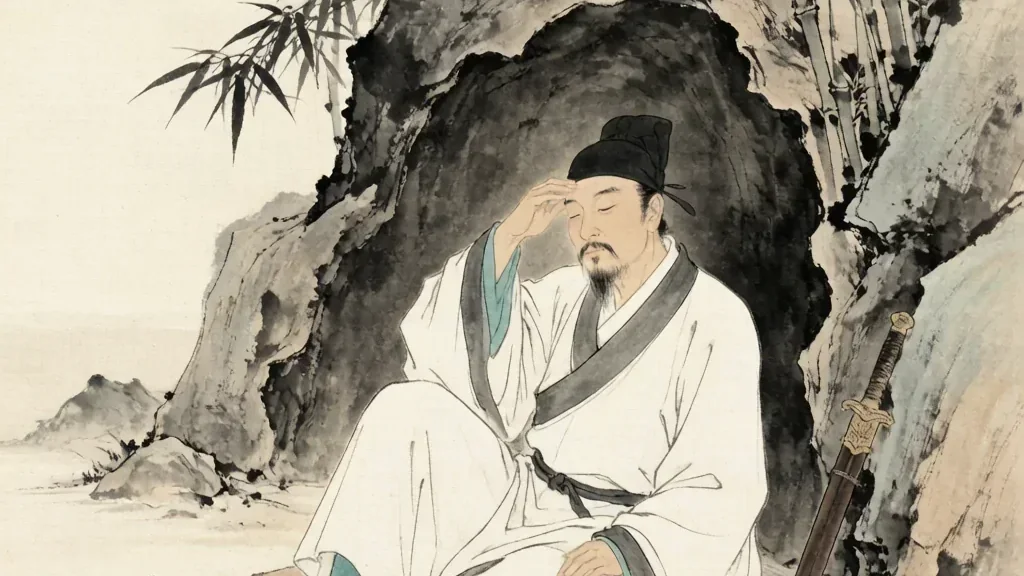
Wang Yangming (1472–1529), originally named Wang Shouren, was a Chinese philosopher, general, and statesman of the Ming dynasty whose reinterpretation of Confucianism became one of the most influential schools of Neo-Confucian thought. He taught that the mind itself is the source of moral principle and that innate knowing (liangzhi) is sufficient for right action when sincerely followed. His emphasis on the unity of knowledge and action made Confucianism not merely a scholarly discipline but a lived, transformative practice, and his ideas shaped reformers across East Asia for centuries.
Life and Career
Wang was born into a scholarly family in Zhejiang and, like many of his class, prepared for the civil-service examinations. As a youth he showed restless breadth—studying archery, military strategy, and Buddhism and Daoism before settling on Confucianism. He passed the jinshi degree and entered official life, where his career was marked by both brilliance and political peril.
His turning point came with a brush with the powerful eunuch Liu Jin, whose faction had Wang punished and exiled to a remote post in Guizhou. In that hardship, living among unfamiliar peoples, he is said to have had a breakthrough realization about the mind and principle, later called his "enlightenment in Longchang."
Wang later distinguished himself militarily, suppressing a major rebellion in Jiangxi with speed and strategy, and serving as a provincial administrator. He remains unusual as both a contemplative sage and a capable field commander—a union of thought and deed he himself preached.
The Crisis of the Zhu Xi Method
Wang's thought began as a problem with the standard Cheng-Zhu method. Following Zhu Xi, he tried to "investigate things" (gewu) outwardly—reportedly by staring at bamboo for days to find its principle—but fell ill and found no principle outside. This failure convinced him that the search for li in external objects was misdirected.
The deeper issue was the split the Cheng-Zhu approach seemed to create between the mind and principle. If principle lay in things and had to be pursued piecemeal, how could ordinary people ever achieve sagehood? Wang came to feel that the unity of the person was being fractured by an over-intellectual method.
His alternative placed principle within the mind from the start. The breakthrough at Longchang was the insight that "the mind is principle" (xin ji shi li)—there is no li outside the mind, only the mind's own clarity to be recovered.
The Mind Is Principle
Wang's central doctrine, "the mind is principle," reverses the Zhu Xi ordering. For Zhu Xi, principle exists objectively in the world and the mind must conform to it; for Wang, the moral order is present in the heart, and to know it is to turn inward with sincerity.
This did not mean reality is a mere projection. Wang held that the mind in its true, unbiased nature is identical with the cosmic principle; a selfish, clouded mind distorts, but the original mind knows. The task is therefore not to acquire principle but to remove what obscures the mind's own light.
The claim elevated human moral agency. If principle is in the heart, then sainthood is potentially immediate, available to any sincere person, not reserved for the erudite. This democratic implication helped make his school popular and passionate.
Innate Knowing (Liangzhi)
Wang's most celebrated concept is liangzhi, usually translated "innate knowing" or "pure knowing." It is the mind's spontaneous, preoperative ability to distinguish good from bad the moment a situation arises—before calculation or desire intervenes.
Everyone possesses liangzhi, Wang insisted; even a villain has it, though it is buried under habit. A child naturally feels pity at a cry; that immediate, untaught response is liangzhi at work. Moral life is the continual extension and trust of this native discernment.
Crucially, liangzhi is not just intellectual. It is the mind's original, luminous knowing that is also a tendency to act rightly. To recognize the good and fail to do it is, for Wang, proof that the knowing was not yet fully realized—which leads directly to his doctrine of the unity of knowing and acting.
The Unity of Knowing and Acting
Wang's most provocative teaching is zhi xing he yi, the unity of knowledge and action. He argued that mere "knowing" that is not acted upon is not true knowing at all. If you truly know a thing is good, you will do it; a failure to act reveals that knowledge was only verbal, not real.
This collapses the common separation between understanding and practice. We often say "I know I should exercise" while not doing it; Wang would say the knowledge is not yet actual. Real knowledge necessarily flows into action, just as a bitter taste is known only by reacting to it.
The practical upshot is that self-cultivation is not first study then practice, but that study and practice are one. One extends liangzhi in the very act of responding to the present moment, so that there is no gap between insight and life.
Self-Cultivation in Practice
Wang's method was deceptively simple: in every affair, examine your intention and align it with liangzhi. Rather than amassing external facts, one "extends innate knowing" (zhi liangzhi) by acting on the good one already discerns, here and now.
He valued quiet sitting to settle the mind but warned against clinging to stillness for its own sake. The real test was action among people—governing, teaching, serving—where the mind meets resistance and reveals its hidden selfishness.
His letters and instructional records (the Chuanxi lu) show a teacher concerned less with doctrine than with the student's genuine transformation. He met each disciple where they were, urging sincerity over sophistication, a style that won devoted followers.
Differences from Zhu Xi
The Wang school and the Cheng-Zhu school agreed on the goal—sagehood through the realization of principle—but diverged on path. Zhu Xi emphasized graduated, outward investigation and quiet seriousness; Wang emphasized inward trust of the heart and immediate practice.
Critics, including later orthodox Neo-Confucians, feared Wang's approach could license antinomianism—if the mind is principle, might one follow impulse? Wang answered that genuine liangzhi is never selfish; only a clouded mind errs. But the worry persisted and shaped official suspicion.
Despite opposition, the Wang school flourished, especially in the south, and produced vigorous debates about whether "the mind is principle" risked dissolving the objective order. The disagreement energized Ming intellectual life and echoed in later Japanese Confucianism.
Influence in China and Abroad
In China, Wang's followers formed numerous academies and a reform-minded current that stressed personal conviction over rote examination success. Some late-Ming thinkers radicalized his individualism, while others channeled it into public service and local reform.
In Japan, the Wang school (Ōyōmei-gaku) attracted samurai reformers who prized its activist confidence. Figures associated with the Meiji Restoration drew on its teaching that knowing and acting are one, using it to justify decisive political action against the shogunate.
In Korea and Vietnam, too, his ideas circulated among those who favored heart-centered, practice-oriented Confucianism. Few Chinese philosophers have had so direct an effect on political actors beyond their own borders.
Legacy and Modern Relevance
Wang Yangming was long contested within official Neo-Confucianism, yet his reputation rose in the modern era. Reformers such as Liang Qichao and revolutionaries found in his unity of knowledge and action a native philosophy of committed practice suited to national renewal.
Contemporary scholars present him as a philosopher of moral psychology and agency: his claim that everyone can access rightness through sincere reflection speaks to debates about moral education and the gap between knowing and doing that still troubles ethics today.
For the general reader, Wang Yangming offers a bracing message—that wisdom is not reserved for the learned, that the heart already knows the good, and that the only real knowledge is the knowledge we live. It is a Confucianism warmed from a doctrine into a way of being.
❓ Frequently Asked Questions
Who was Wang Yangming?
He was a Ming dynasty Neo-Confucian philosopher, statesman, and general (1472–1529) whose teaching that the mind is principle and that knowledge and action are one became a major school.
What does "the mind is principle" mean?
It means moral principle is present in the heart rather than only in external things; the task is to clear the mind's native light, not to acquire principle from outside.
What is innate knowing (liangzhi)?
It is the mind's spontaneous ability to tell good from bad the instant a situation arises. Everyone has it; cultivation means extending and trusting it in action.
What is the unity of knowledge and action?
Wang held that real knowing necessarily issues in action; a failure to act shows the knowing was only verbal. Study and practice are therefore one, not sequential.
How did Wang differ from Zhu Xi?
Zhu Xi stressed outward investigation of things; Wang stressed inward trust of the heart and immediate practice. Both sought sagehood but by opposite paths.
Why is Wang Yangming still influential?
His message that wisdom is available to any sincere heart, and that real knowledge is lived, inspired East Asian reformers and still speaks to ethics and moral education today.