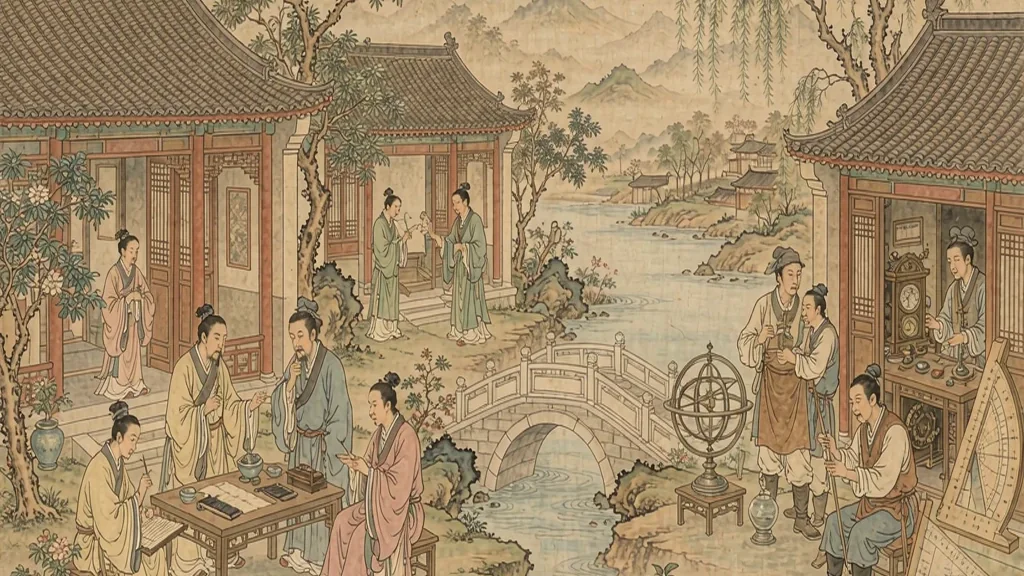
The pairing ti-yong (substance and function) is one of the most durable conceptual couples in Chinese metaphysics, used since the Han to analyse how a deeper reality (ti, "body" or "root") expresses itself in activity (yong, "use" or "function"). In the late nineteenth century the pair was thrust into politics when reformers coined the slogan "Chinese learning for substance, Western learning for function" (Zhongxue wei ti, Xixue wei yong) to justify adopting Western technology while preserving Chinese values. The formula became the motto of the Self-Strengthening Movement and a battleground for debates on how China should meet the modern world.
The Metaphysical Pair
In classical usage, ti denotes the underlying substance or locus, while yong denotes its operation or manifestation. A thing and its working are not two separate entities but one reality seen from two angles.
Neo-Confucians employed ti-yong to discuss human nature and feeling, or principle (li) and its concrete events. The pair let them insist that the eternal and the changing were inseparably one.
Early Uses in Buddhism and Confucianism
The couple was already central in Chinese Buddhist philosophy, where it expressed how the unchanging Buddha-nature appears in varied phenomena. Daoist and Confucian thinkers then borrowed the language to articulate their own non-dualities.
By the Song and Ming, ti-yong was a standard tool for explaining why study and action, or stillness and activity, belonged to a single cultivation. It was less a doctrine than a grammar of explanation.
The Late-Qing Slogan
Facing military defeat by Western powers, some Qing officials argued China must learn enemy strengths without losing its civilisational core. The phrase "Chinese substance, Western function" captured that compromise: keep Confucian values, import Western ships, guns, and factories.
Usually associated with the Self-Strengthening Movement and popularised in Zhang Zhidong's Quanxue Pian (Exhortation to Learning), the formula aimed to quiet conservatives alarmed by reform.
Substance and Function in Practice
In practice the slogan authorised railways, arsenals, and foreign-language schools while leaving the exam system and ritual order largely intact. It was a theory of selective modernisation filtered through cultural confidence.
Supporters saw it as pragmatic patriotism; critics, both conservative and radical, found it incoherent—could one really bolt a Western "function" onto a Chinese "substance" without the substance changing too?
Critiques of the Formula
Radical reformers such as Yan Fu argued that institutions and values cannot be so cleanly split: a steam engine comes with a whole social and intellectual ecology. To take the function, he implied, is to disturb the substance.
Later revolutionaries dismissed ti-yong as a halfway measure that delayed real transformation. Yet the very debate shows how powerfully the pair structured Chinese thinking about change.
Zhang Zhidong's Exhortation
Zhang Zhidong's treatise carefully distinguished what to learn from the West (applied technique, certain sciences) from what to guard at home (moral teaching, social hierarchy). The ti-yong frame gave his moderation a philosophical patina.
The book was widely circulated and translated, becoming the most articulate statement of the moderate reform position in the face of both reactionary refusal and wholesale Westernisation.
Beyond the Qing
After the empire fell, ti-yong language persisted in new forms—"national essence with Western utility," or later debates about "socialism with Chinese characteristics." The habit of balancing identity and adoption outlived the original slogan.
Even critics who rejected the specific Qing formula kept reaching for ti-yong imagery, a sign of how deeply the couple is wired into Chinese conceptual habits.
Why the Pair Endures
Ti-yong endures because it names a genuine problem: how to absorb the foreign without ceasing to be oneself. Every culture meeting another confronts some version of substance and function.
It also models a non-dualistic habit of mind—refusing to pit "tradition" against "modernity" as absolutes, even when the proposed resolution proves messy in practice.
Reading Ti-Yong
Readers can approach the pair on two levels: as a quiet metaphysical tool in Neo-Confucian texts, and as a loud political slogan in late-Qing reform literature. Both reveal a culture thinking through continuity and change.
The lesson is not that the Qing formula succeeded, but that the question it posed—what is essential, and what may be borrowed?—remains live wherever traditions collide.
Ti-Yong in Neo-Confucian Metaphysics
Before its political career, ti-yong did heavy lifting in Song and Ming metaphysics. Zhu Xi used the pair to relate "original human nature" (benti) to its manifest feelings, and to explain how the one principle (li) appears in the many events. The stillness of the mind was substance; its responses were function. This let Neo-Confucians hold that the eternal and the changing were aspects of a single reality rather than rivals.
Wang Yangming and his followers likewise deployed ti-yong, often to stress that the mind's substance and its knowing activity are never truly separate. The pair thus served every side of the later Confucian debates, a versatile vocabulary for saying that depth and surface, root and branch, belong to one living whole.
Critics on the Left and the Right
The Qing slogan drew fire from both flanks. Conservative officials feared that importing Western function would corrode Chinese substance through the habits, sciences, and ultimately ideas that rode in with the technology. Radical reformers, conversely, felt the formula did too little—that genuine strength required remaking the substance itself, including the examination system and the monarchy.
Caught between these critics, ti-yong nevertheless organised the moderate centre of late-Qing thought and gave hesitant reformers a defensible language. Its failure as a settled doctrine matters less than its role as a hinge: a concept old enough to comfort tradition yet flexible enough to admit the new.
Ti-Yong and Modern Chinese Thought
In the twentieth century the pair kept resurfacing whenever Chinese thinkers weighed tradition against modernity. Advocates of "national essence" proposed a Chinese substance shielded by useful Western methods, while critics argued that substance and function were inseparable and that selective borrowing was an illusion. The vocabulary proved stubbornly useful precisely because it named a real dilemma every society faces when importing another culture's achievements.
Even today, phrases echoing ti-yong appear in discussions of how to absorb science, democracy, or management technique without abandoning a distinctive identity. The Qing formula may have been unstable, but the question it framed—what in a civilisation is indispensable, and what may be borrowed—remains central to debates about Chinese modernity and its place in the world.
❓ Frequently Asked Questions
What does ti-yong mean?
It means "substance and function": the underlying reality (ti) and its active expression (yong), treated as two aspects of one thing.
How was it used politically?
Late-Qing reformers used "Chinese substance, Western function" to argue for adopting Western technology while keeping Chinese values.
Who promoted the slogan?
It is associated with the Self-Strengthening Movement and was popularised by Zhang Zhidong in his Exhortation to Learning.
What were the critiques?
Critics said values and institutions cannot be cleanly separated; taking Western function would inevitably alter the Chinese substance.
Was the formula successful?
It authorised useful reforms but proved conceptually unstable, and was later seen as a half-measure that delayed deeper change.
Does ti-yong still matter?
Yes, as a recurring framework for debates about preserving identity while borrowing from other cultures, well beyond the Qing.