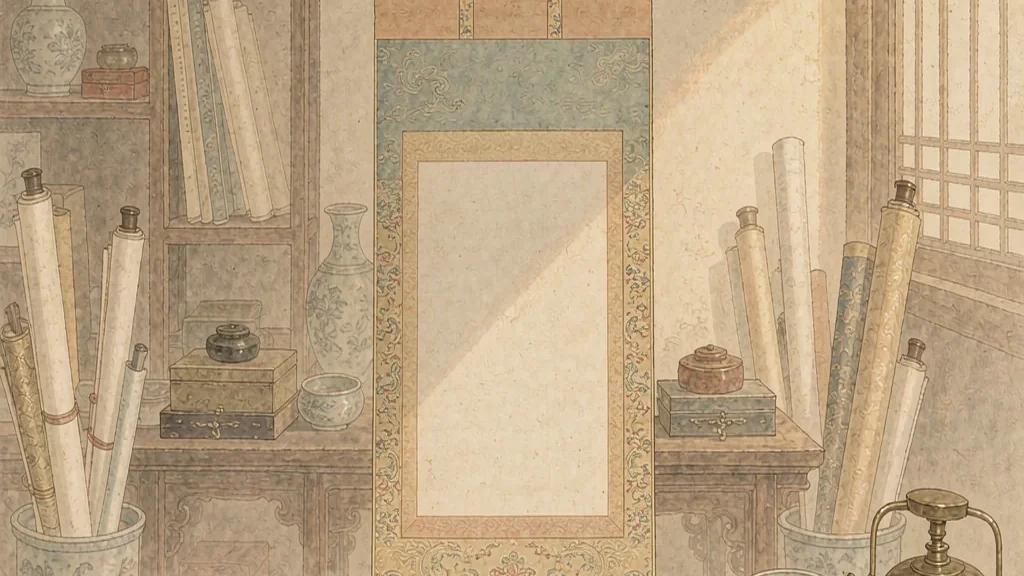
Mounting (zhuangbiao, also called framing or裱褙) is the craft of backing, bordering, and assembling a calligraphy or painting so that it can be displayed, stored, and preserved. A bare sheet of silk or paper is fragile and hard to hang; mounting turns it into a scroll, album, fan, or panel suited to its purpose. In Chinese art the mounter’s skill is almost as vital as the writer’s, because a great work can be ruined by poor mounting and elevated by a fine one.
Why Mounting Matters
Chinese paper and silk are thin and easily torn, wrinkled, or stained. Mounting reinforces the work with layers of backing paper and surrounds it with silk or brocade borders that both protect it and set it off visually. Without mounting, a scroll cannot be rolled, hung, or handled safely, and a painting cannot survive handling.
Beyond protection, mounting is an act of design. The color and width of the borders, the proportions of the title strip, and the choice of end papers all shape how the eye meets the writing. A good mounter is thus a silent collaborator who completes the artist’s intention through restraint and good taste.
The Handscroll Format
The handscroll (shoujuan) is a horizontal format meant to be unrolled a section at a time on a table. It consists of the artwork, followed by optional colophons (later owners’ inscriptions), all backed and edged, with a wooden roller at the viewing end and a protective outer wrapper. Reading a handscroll is a private, sequential experience.
Mounting a handscroll demands great care in aligning the sections and in choosing border silks that do not overpower the ink. Because the scroll may be opened thousands of times over centuries, the backing must be strong yet flexible, and the rollers must turn smoothly without stressing the paper.
The Hanging Scroll Format
The hanging scroll (zhongtang or liubiao) is a vertical format meant to be displayed on a wall, often seasonally or for a festival. It has a top stave with a cord and a bottom weighted rod so it hangs flat. The central painting or calligraphy is flanked by silk borders and a contrasting top and bottom section.
Hanging scrolls are the most common way to show a single fine work, and their mounting proportions follow long-established conventions. The mounter chooses silks whose tone complements the ink—quiet blues or beiges for scholarly works, richer colors for festive ones—so the whole object reads as finished.
Albums, Fans, and Couplets
Besides scrolls, works are mounted as albums (ceye), where leaves are bound like a book and can carry alternating painting and calligraphy; as folding fans (shanmian), a demanding format because of the fan’s ribs and shape; and as couplet scrolls (duilian), two vertical strips hung as a pair around a doorway.
Each format poses its own mounting problems. Fans must be backed without buckling; albums must open flat; couplets must match exactly in size and mounting so the pair feels balanced. The mounter’s versatility across formats is a mark of true mastery in the trade.
Materials and Tools
Traditional mounting uses rice starch paste (never modern glue, which can harm paper), several grades of backing paper, silk or brocade for borders, and wooden staves and rollers. Tools include wide brushes for pasting, a flat table, a burnishing stone, and a knife for trimming. The paste must be made fresh and applied thinly.
The choice of paper for backing affects both strength and how the work ages. A reversible, acid-free approach is prized, because a future mounter may need to remount the piece—Chinese mounting is meant to be undone and redone, which is how fragile treasures survive for centuries.
The Mounting Process
The basic steps are: clean and flatten the original; apply paste and lay on a backing; dry flat on the wall; trim; add borders and title strips; attach staves and rollers; and finally inspect and wrap. At each stage the work is kept under even tension so it dries without waves. Drying on a plastered wall is the classic method, letting moisture leave slowly.
Remounting an old piece is more delicate still, requiring the old backing to be lifted without tearing the original—a task for senior mounters only. Museums today combine traditional skill with conservation science, but the fundamental hand methods remain those of the old workshops.
Conservation and Re-mounting
Because mounting is reversible, important works are remounted every generation or two to replace degraded backings and clean stains. A famous handscroll may have been remounted dozens of times across a thousand years, each time by a mounter whose name is now lost but whose care preserved the ink we see.
Improper mounting—wrong paste, non-reversible adhesives, or harsh cleaning—can cause irreversible harm. This is why collectors treat the mounter with respect bordering on awe, and why a fine old mounting, with its mellow silks, is itself a collectible part of the object’s history.
Mounting as a Partner to Calligraphy
For the calligrapher, mounting closes the creative circle. A writer may finish a scroll, but it only becomes a finished artwork—something to give, display, or sell—after a mounter has set it. The relationship is practical and artistic at once, and many calligraphers kept a trusted mounter as a long-term partner.
Understanding mounting also helps viewers read a work correctly. The borders, seals, and colophons added during mounting are part of the object’s biography, recording ownership, admiration, and the passage of time. A mounted scroll is never just the ink; it is the ink plus its life.
❓ Frequently Asked Questions
What is calligraphy mounting?
It is the craft of backing, bordering, and assembling a work into a scroll, album, fan, or panel so it can be displayed, stored, and preserved.
Why is mounting important?
It protects thin paper or silk from damage and visually sets off the writing; poor mounting can ruin a great work, good mounting can elevate it.
What formats does mounting produce?
Common formats are handscrolls, hanging scrolls, albums, folding fans, and couplet pairs, each with its own mounting method.
What materials are used?
Rice starch paste, backing papers, silk or brocade borders, and wooden staves and rollers—chosen to be reversible and gentle on the paper.
Can old works be remounted?
Yes; remounting every generation or two replaces degraded backings and cleans stains, which is how fragile pieces survive for centuries.
Is mounting part of the artwork?
In a sense yes; the borders, seals, and added colophons record the object’s history and are part of how we read and value it.