Cursive Script
草书 · 876 words
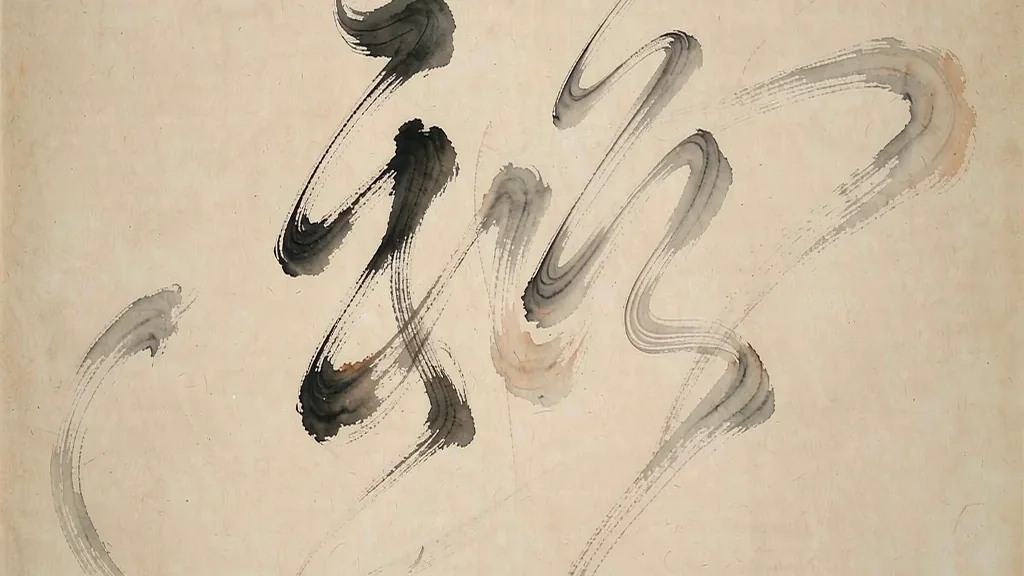
Among all the scripts of Chinese calligraphy, cursive script (草书, cǎo shū) is the most radical — a script that seems, to the uninitiated, like no script at all. Characters are reduced to abstract gestures, strokes merge into continuous ribbons of ink, and legibility is often sacrificed to expression. The word cǎo (草) means "grass" or "rough draft," suggesting something wild, untamed, and preliminary. But Chinese cursive script is anything but crude. It is a highly codified system of abbreviation and transformation, governed by rules as strict as those of regular script — rules that must be thoroughly mastered before they can be broken. Cursive script is the final freedom earned through long discipline, the dance that follows years of drill.
The Origins of Cursive Script
Cursive script emerged during the Han dynasty as a practical abbreviation of clerical script for rapid note-taking. The earliest form, known as zhāng cǎo (章草) — "clerical cursive" or "regulated cursive" — kept the flat, wide proportions of clerical script but introduced simplified and connected stroke forms. Characters were still largely separate, but the internal strokes were abbreviated and the brush moved more freely.
The transition from zhāng cǎo to modern cursive (jīn cǎo, 今草) occurred during the Eastern Jin dynasty, primarily through the work of Wang Xizhi. Wang transformed cursive from a practical shorthand into an art form, introducing flowing connections between characters and a wider range of expressive variation. The wild cursive (kuáng cǎo, 狂草) of the Tang dynasty pushed the script to its limits, producing compositions in which characters seem to dissolve into pure energy.
The Standard Cursive System
The apparent chaos of cursive script is deceptive. In fact, cursive script operates on a precise system of abbreviation. Each standard character has one or more standard cursive forms, established through centuries of practice and transmitted through copybooks. Learning cursive script is, in large part, learning this vocabulary of abbreviated forms. A character like 門 (door, simplified to 门) is reduced in cursive to a loop and a stroke — but that particular loop-and-stroke is the conventional form, not a personal invention.
The canonical reference for standard cursive forms is the Jíjiù Zhāng (急就章), a Han dynasty primer that was repeatedly copied in cursive by famous calligraphers. The Cǎo Shū Yùn (草书韵), a Song dynasty rhyme book of cursive forms, also served as a standard reference. A calligrapher who has not mastered these canonical forms is considered to write "wild grass" (野草, yě cǎo) — the cursive equivalent of bad handwriting.
The Tang Wild Cursive Masters
The Tang dynasty produced two calligraphers who brought cursive script to its most extreme expression: Zhang Xu (张旭, c. 658–747), known as "Crazy Zhang," and Huai Su (怀素, 737–799), the "Crazy Monk." Both specialized in wild cursive (kuáng cǎo), a style in which characters are distorted, stretched, and intertwined into compositions that read as pure visual music.
Zhang Xu was said to write while drunk, using his hair as a brush when a brush was not available. He would shout and dance while writing, entering a state of ecstatic possession. Yet the results, however wild, obeyed the inner logic of cursive script. His masterpiece, the Four Ancient Poems (古诗四帖), stands as one of the most audacious works in Chinese calligraphy. Huai Su was a Buddhist monk whose Autobiography (自叙帖) is a torrent of cursive energy, a "flying white" (飞白, fēi bái) tour de force in which the brush seems to skim the surface of the paper like a dragonfly.
The Aesthetics of Cursive Script
Cursive script aesthetics are built on three interrelated qualities: momentum (势, shì), transformation (变, biàn), and resonance (韵, yùn). Momentum is the forward drive of the brush, the sense that the writing is moving toward a destination. A great cursive work never pauses; each character leads inexorably to the next. Transformation is the constant variation of form — repeating characters must be written differently, and the same stroke type must not be repeated mechanically. Resonance is the overall harmony of the composition, the sense that every part belongs to a coherent whole.
The white space in a cursive work is as important as the black strokes. The areas where the brush has not touched the paper create shapes and rhythms of their own. A master calligrapher controls both the positive forms of the characters and the negative spaces around them. The viewer's eye is guided through the composition by both the trail of ink and the voids it leaves behind.
Learning Cursive Script
Cursive script is typically the last script taught in calligraphy education, undertaken only after the student has mastered regular and running scripts. The process begins with zhāng cǎo, the more legible clerical-cursive, then progresses to the standard cursive forms of Wang Xizhi, and finally to the wild cursive of the Tang masters. Students memorize the standard cursive forms character by character, a process that can take years.
The difficulty of reading cursive script has always limited its practical use. It is the script of art rather than communication, of private expression rather than public record. But that is precisely its value. Cursive script allows the calligrapher to go beyond the limits of language, to express what words cannot say. In the wild cursive of Zhang Xu or Huai Su, writing becomes pure gesture — a record not of meaning but of the movement of qi (气) through the body and the brush.
The Rules Beneath the Chaos
Cursive looks lawless but is governed by a precise system. Each standard character has established abbreviated forms, transmitted through primers and copybooks for nearly two thousand years, and a deviation is not personal style but error. The connection of strokes between characters follows conventions too: certain exits lead naturally to certain entries, so the flow is learned, not improvised. Writers who skip this vocabulary produce what tradition dismisses as wild grass, the cursive equivalent of bad handwriting. The discipline is why two strangers trained in the same models can read each other's scrolls. What looks like freedom is in fact fluency inside a strict grammar, and the apparent chaos is the surface of a deep, shared order that the eye of the trained reader moves through without effort.
Cursive as the Script of Emotion
Because cursive abandons legibility for speed and gesture, it became the natural vehicle for feeling. A letter written in a hurry, a draft composed in grief, a line scratched in joy, all found their form in cursive, where the brush could race ahead of the mind. The white space between strokes matters as much as the ink, since the voids shape the composition's breathing. Critics describe the effect through three qualities: momentum, the forward drive that never lets the line pause; transformation, the unwillingness to repeat a form; and resonance, the overall harmony that makes the parts cohere. In the hands of Zhang Xu or Huai Su, writing became pure gesture, a record not of meaning but of movement, the trace of energy moving through a body and a brush in a single unrepeatable pass.
Frequently Asked Questions
Chinese Vocabulary
草书 — : Cursive script: the most abbreviated and expressive Chinese script.
狂草 — : Wild cursive: the extreme form of cursive practiced by Zhang Xu and Huai Su.
章草 — : Clerical cursive: the early form of cursive retaining Han clerical characteristics.
今草 — : Modern cursive: the flowing cursive form developed by Wang Xizhi.
飞白 — : Flying white: dry-brush technique showing white paper through the ink, prized in cursive script.
势 — : Momentum, the forward drive that carries a cursive work from one character to the next.
变 — : Transformation, the constant variation that keeps repeated strokes from becoming mechanical.
韵 — : Resonance, the overall harmony that makes the parts of a composition cohere.
Fun Facts
- Zhang Xu was known for writing with his hair when the brush was not at hand — a story that may be legend but reflects the uninhibited spirit of wild cursive.
- Cursive script has its own dictionary — the 100,000-character Cǎo Shū Dà Zì Diǎn (草书大字典) — listing standard cursive forms for tens of thousands of characters.
- Some wild cursive works are intentionally illegible, meant to be appreciated as abstract art rather than read as text.
- The classic Han primer of urgent matters was copied in cursive by famous calligraphers so often that it became a standard reference for correct abbreviated forms.
- In cursive, the same character must never be written identically twice in one work; repeating characters are varied on purpose, a rule that separates art from mere writing.
- Because cursive sacrifices legibility, it became the script of private feeling, used for letters and drafts where the writer spoke to a friend or to himself rather than to the public.