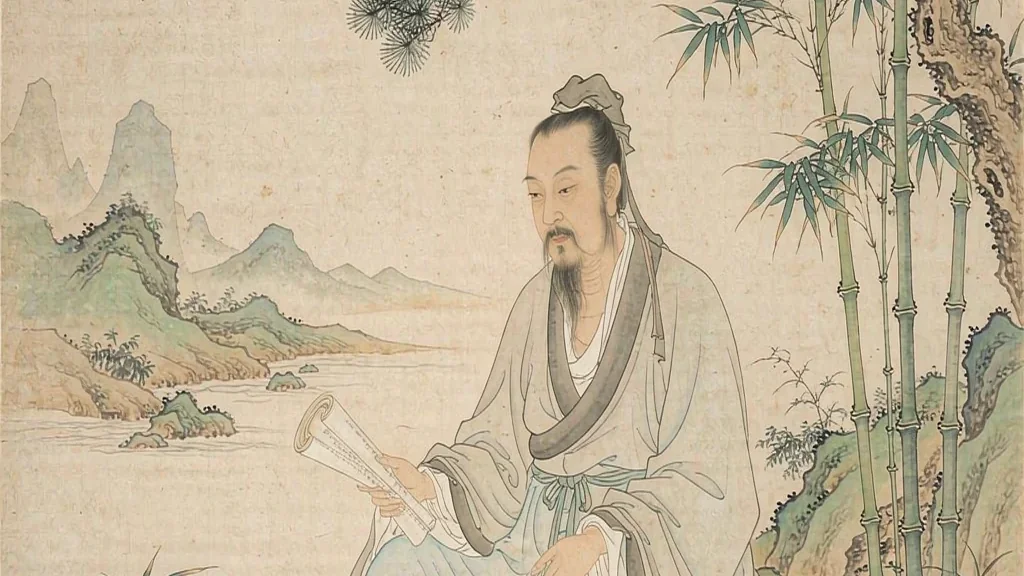
Zhao Mengfu (1254–1322) was a Yuan dynasty scholar-prince, calligrapher, and painter whose elegant regular and running script became so influential that it defined taste for the following three centuries. A descendant of the Song imperial family who served the Mongol Yuan court, he reconciled the refined Jin-Song tradition with Tang discipline and created the “Zhao style,” a model of grace that later emperors copied and critics both adored and resented.
A Prince in a Conquered Court
Zhao Mengfu belonged to the Song royal clan but lived after the Southern Song fell to the Mongols. He initially withdrew from public life, yet was later summoned to the Yuan capital, where his learning and art made him a valued servant of the new dynasty. This choice to serve alien rulers brought him criticism from loyalists, a shadow that never fully left his reputation.
Within the court he rose to high cultural office and became the leading artistic figure of his age. His dual identity—a Han Chinese aristocrat in Mongol service—gave his work a complex charge, and he seems to have answered the unease by turning toward classical beauty and restraint as a kind of refuge and statement.
The “Zhao Style” of Regular Script
Zhao’s regular script, the “Zhao style,” is celebrated for smoothness, evenness, and a flowing grace that softens the stern Tang manner. Where Tang masters like Liu Gongquan emphasized bone and tension, Zhao emphasized rounded, rhythmic continuity, producing characters that feel effortless and musical. His hand became a standard for official and elegant writing alike.
He achieved this by returning to the Jin dynasty ideal of naturalness while keeping Tang structure. The result is regular script that reads as both correct and beautiful, which is why it was so widely imitated. For centuries “Zhao style” copybooks were among the first a child met, and his manner shows up in countless later works.
Mastery of Many Scripts
Zhao Mengfu was unusual in excelling across scripts. He wrote seal, clerical, regular, running, and cursive with equal command, and he argued that a true master must learn them all, since each informs the others. His running script in particular is loved for its relaxed, singing quality, and his cursive shows a disciplined freedom.
This breadth reflected his scholarly belief that calligraphy should be grounded in history. He studied Wang Xizhi deeply and wrote essays urging a return to ancient models as the cure for the mannerism he saw in later Song writing. His own art was the proof of his theory: classical study, well absorbed, yields personal grace.
Theory: Return to the Ancients
Zhao’s central critical idea was “restore the ancient” (fugu): study the Jin and Tang masters directly rather than copying weak later imitations. He paired this with the claim that calligraphy and painting share the same brush principles, and he practiced what he preached by painting in a deliberately archaic, linear mode.
His “literati painting” essays helped set the direction of later Chinese art, linking scholarly writing and scholarly painting into one cultivated skill. The idea that a gentleman should be fluent in both was not new, but Zhao’s authority gave it renewed force, and the Ming-Qing ideal of the multi-talented amateur artist descends in part from him.
Calligraphy and Painting United
As a painter Zhao favored old subjects—horses, bamboo, landscape—done with calligraphic lines rather than descriptive shading. He famously said that the brush methods of the two arts are one, and his paintings show strokes that could stand as calligraphy. This fusion became a hallmark of the literati tradition.
His “Autumn Colors on the Qiao and Hua Mountains” and similar works use pale, dry, calligraphic contours to evoke rather than depict. The effect is scholarly and restrained, appealing to viewers who valued learned reference over spectacle. In this he shaped the taste that dominated later imperial collecting.
Influence on the Ming and Qing
Zhao’s influence grew after his death. The Ming dynasty court, and especially the Yongle and later emperors, promoted his style as the polite standard, and the Qing emperor Qianlong was a devoted admirer who covered Zhao’s works with his own seals and colophons. Whole schools of regular-script writers modeled themselves on him.
Not everyone approved. Some critics, especially in the Qing stele revival, faulted his manner as too sweet or too accommodating, and preferred the ruggedness of northern steles. Yet even his detractors conceded his technical mastery. The very intensity of the debate shows how central he remained to the tradition.
Controversy and Reputation
The charge that Zhao betrayed the Song by serving the Yuan never fully disappeared, and it colored how some judged his art as lacking in moral weight. Defenders answered that his loyalty was to culture, not to a particular regime, and that preserving classical art under foreign rule was itself a service.
Modern scholars tend to see the controversy as a lens onto the pressures on educated Chinese under conquest dynasties. Whatever one makes of the politics, his art’s quality is undisputed, and he is routinely named among the handful of calligraphers who changed the course of the tradition rather than merely following it.
Why Zhao Mengfu Matters
Zhao Mengfu matters because he rebuilt the bridge between the antique and his own time. By absorbing Jin naturalness and Tang discipline into a single graceful manner, he gave later centuries a model that was both teachable and beautiful, and his theory of “return to the ancients” redirected calligraphy toward serious study of the masters.
For students he is the great example of the versatile scholar-artist and of how deep copying can become true originality. His life also poses the enduring question of what loyalty means for an artist under a conquered state—a question Chinese culture has asked again and again.
❓ Frequently Asked Questions
Who was Zhao Mengfu?
He was a Yuan dynasty calligrapher and painter from the Song royal clan, whose graceful “Zhao style” dominated later taste for centuries.
What is the “Zhao style”?
It is his regular script known for smooth, rounded, rhythmic grace that softens the stern Tang manner while keeping its structure.
What was his main theory?
He urged a “return to the ancients”—studying Jin and Tang masters directly—and held that calligraphy and painting share one brush method.
Why was he controversial?
He served the Mongol Yuan court despite his Song royal blood, and some critics saw both his politics and his sweet style as lacking in weight.
How did he influence later art?
Ming and Qing courts promoted his manner as the polite standard, and his union of calligraphy and painting shaped literati art.
Did he paint as well as write?
Yes; he was a major literati painter who used calligraphic lines for old subjects like horses, bamboo, and landscape.