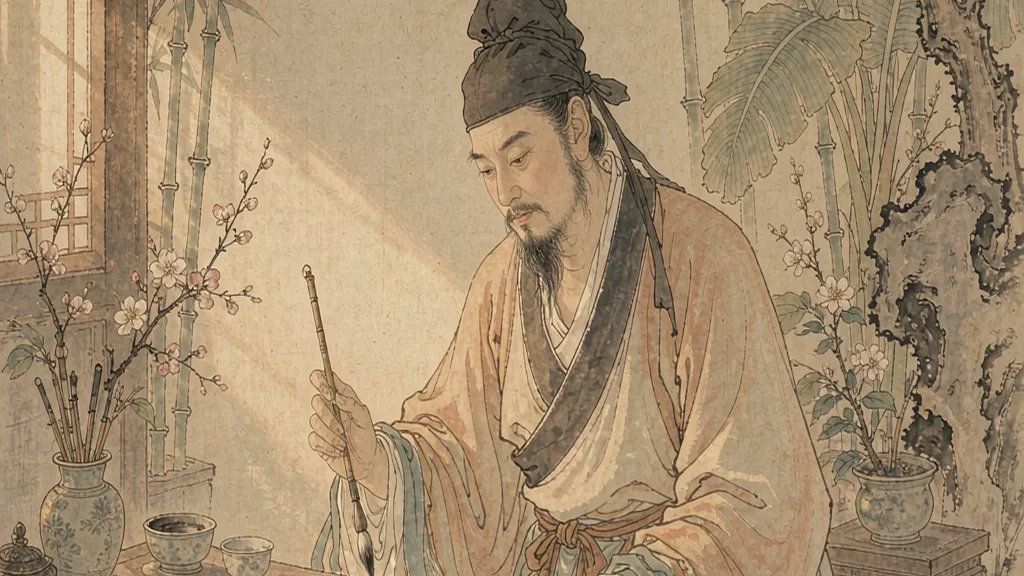
Huai Su (737–799) was a Tang dynasty Buddhist monk whose wild, untamed cursive script—known as “wild grass” (kuangcao)—raised Chinese calligraphy to the level of pure motion and feeling. A contemporary and spiritual heir of the great cursive master Zhang Xu, Huai Su turned the brush into a vehicle for spontaneous energy, producing works that later generations revere as the very summit of expressive writing. His surviving letters and the famous “Autobiography” scroll remain touchstones for anyone studying how Chinese characters can be released from their written cage and made to dance.
Early Life and the Monk Who Loved Writing
Huai Su was born in what is now Hunan province and entered a Buddhist monastery as a young man. According to records and his own later writings, he practiced calligraphy obsessively from childhood, scraping characters on whatever surface came to hand—temple walls, garments, even the polished backs of his fellow monks. Legend tells that, lacking paper, he planted thousands of banana trees around his lodgings and used their broad leaves as writing surfaces, earning the nickname “the Banana Monk.”
His religious life and his art were not separate pursuits. The discipline of monkhood gave him hours of quiet, and the empty mind cultivated in meditation seems to have fed the fearless spontaneity of his brush. Yet he also admitted to a fondness for wine, and like Zhang Xu before him he is said to have produced his most explosive work after drinking, when reason stepped aside and the hand moved on its own.
The “Wild Grass” of the Tang
Cursive script (caoshu) had long been a shorthand for quick writing, but by the Tang it had become an art form in its own right. Huai Su pushed it further than almost anyone, abandoning legibility for many viewers in favor of rhythm, speed, and spatial invention. In his mature works the individual strokes of a character melt into one another, the dots and hooks becoming leaps and sweeps across the silk.
What distinguishes “wild grass” from the more restrained “modern cursive” is precisely its abandonment of careful control. Huai Su’s lines whip and coil, thin in places as a drawn thread and suddenly thick as a dragged branch. The effect is less a reading of words than a visual record of a body in motion, and connoisseurs through the centuries have valued exactly this quality of “seeing the person in the strokes.”
The “Autobiography” Scroll
Huai Su’s single most celebrated work is the “Autobiography” (Zixu Tie), a long handscroll in wild cursive in which he recounts his own training and quotes admirers who praised his art. Written when he was past sixty, it is at once a literary self-portrait and a supreme demonstration of his late style: calmer in places than his youthful fireworks, yet more assured, with a long-breathed flow that carries the eye from one end of the scroll to the other.
The scroll survives in several early copies and reproductions, and the original is counted among the greatest treasures of Chinese cursive art. For students it is studied not only for its beauty but as evidence of how a calligrapher, late in life, could look back on a career and crystallize a whole philosophy of freedom into a single length of paper.
Meeting the Great Masters
As a young monk Huai Su traveled to the capital region to meet established calligraphers and seek criticism. He encountered Yan Zhenqing, the towering regular-script master, who wrote a preface for one of Huai Su’s works and discussed cursive theory with him. These exchanges appear in surviving texts that stage a dialogue between Yan’s structural gravity and Huai Su’s liberated movement.
He also deliberately positioned himself as the successor to Zhang Xu, the earlier Tang master of wild cursive. Later critics fused the two into the paired phrase “Zhang the Crazy, Huai the Drunk,” honoring them together as the two supreme exponents of the ecstatic mode of writing. Huai Su’s self-presentation as Zhang Xu’s heir was a canny move that fixed his place in the lineage of the art.
Technique and the Use of the Brush
Huai Su worked mostly with a fine, hard brush and thin ink, which allowed the lightning-fast strokes his manner demanded. He favored a center-tip grip and kept the brush turning so that the hair stayed springy, producing lines of remarkable evenness even at speed. Where the ink ran dry he let it, accepting the flying-white streaks as part of the life of the piece.
Because wild cursive depends so heavily on the whole-arm movement rather than the fingers alone, Huai Su’s practice implicitly argued for calligraphy as a discipline of the body. Later manuals on cursive repeatedly point to his work as the model for how circular, continuous motion should feel, and for how restraint and abandon must be balanced within a single sweep.
Reputation Among Contemporaries
During his lifetime Huai Su enjoyed considerable fame, and poets of the day wrote verses marveling at his performances, describing how onlookers gasped as he wrote and comparing his strokes to whirling snow, racing snakes, or thunder. Such literary tributes were important in the Tang, where calligraphy was a social art performed before an audience as much as a private one.
His reputation has never faded. Through the Song, Yuan, Ming, and Qing dynasties, emperors and scholars collected and copied his scrolls, and the “Autobiography” in particular was engraved on stone so that rubbings could circulate among students who could never hope to see the original.
Influence on Later Cursive Art
Huai Su set a standard that later cursive masters measured themselves against. In the Song dynasty, the eccentric genius Mi Fu and the literati master Huang Tingjian both absorbed lessons from his flowing manner, and Huang’s long, swinging lines owe a clear debt to the monk’s example. In later periods, when cursive became a favored medium for personal expression among scholar-officials, Huai Su’s name was invoked constantly.
Beyond China, his reputation traveled with the art of calligraphy into Korea and Japan, where wild cursive (in Japanese, gyō and sō styles) became a respected, if demanding, branch of brush art. Today his scanned scrolls appear in museums and textbooks worldwide as the definitive image of calligraphy as liberated gesture.
Legacy and Modern Appreciation
In the modern era Huai Su is studied both as a historical figure and as a symbol of artistic freedom. Art historians note that his life—monk and rebel, disciplined and drunk—encapsulates a tension at the heart of Chinese aesthetics, between rule and spontaneity. His works are regularly featured in exhibitions of Tang art and in surveys of calligraphy as a fine art.
For the practicing student, Huai Su remains a threshold: his wild cursive cannot be imitated by technique alone, and teachers warn that copying him too early leads to empty flourishes. Yet the aspiration he represents—to write so that the self disappears into the line—continues to draw new generations to the brush.
The Man Behind the Myth
It is worth separating the historical monk from the legend that grew around him. The banana-tree story, the wine, the admiring poets—these were shaped by a culture that loved the image of the inspired outsider. Still, the core is believable: a provincial monk of modest means who through relentless practice and a readiness to break rules became one of the most admired calligraphers his civilization produced.
Reading Huai Su today means reading a personality preserved in motion. Where a regular-script stele shows order and restraint, his scrolls show a mind in flight, and that contrast is part of why Chinese calligraphy has so often been called the art most capable of revealing the writer’s character.
Where to See His Work
The “Autobiography” and a handful of shorter letters survive through tracings, stone engravings, and later copies, housed in major collections and reproduced in countless anthologies. Because the originals are fragile and rarely displayed, most people encounter Huai Su through published facsimiles and rubbing copies, which themselves have a long scholarly tradition behind them.
Museums with strong Chinese painting-and-calligraphy holdings periodically mount exhibitions devoted to Tang cursive, and these are the best occasions to sense the scale and energy of his handscrolls in person. Until then, careful study of high-quality reproductions remains the standard path for students and admirers alike.
❓ Frequently Asked Questions
Who was Huai Su?
Huai Su was a Tang dynasty Buddhist monk and calligrapher, famous for his “wild grass” cursive script and his masterpiece, the “Autobiography” scroll.
What is “wild grass” cursive?
It is the most liberated form of cursive script, where characters link and dissolve into sweeping, fast strokes that favor rhythm and feeling over strict legibility.
What is the “Autobiography” scroll?
It is Huai Su’s long handscroll in wild cursive, written late in life, in which he recounts his training and quotes admirers of his art.
How did Huai Su learn calligraphy?
He practiced obsessively from childhood, reportedly writing on banana leaves and temple walls, and later traveled to meet masters such as Yan Zhenqing.
Why is he compared to Zhang Xu?
Zhang Xu was an earlier Tang master of wild cursive; Huai Su presented himself as his successor, and later critics honored the two together as the supreme exponents of the style.
Can beginners copy Huai Su’s style?
Teachers usually advise against it early, since his wild cursive depends on mastery of basic scripts; copying him too soon can produce empty, formless flourishes.