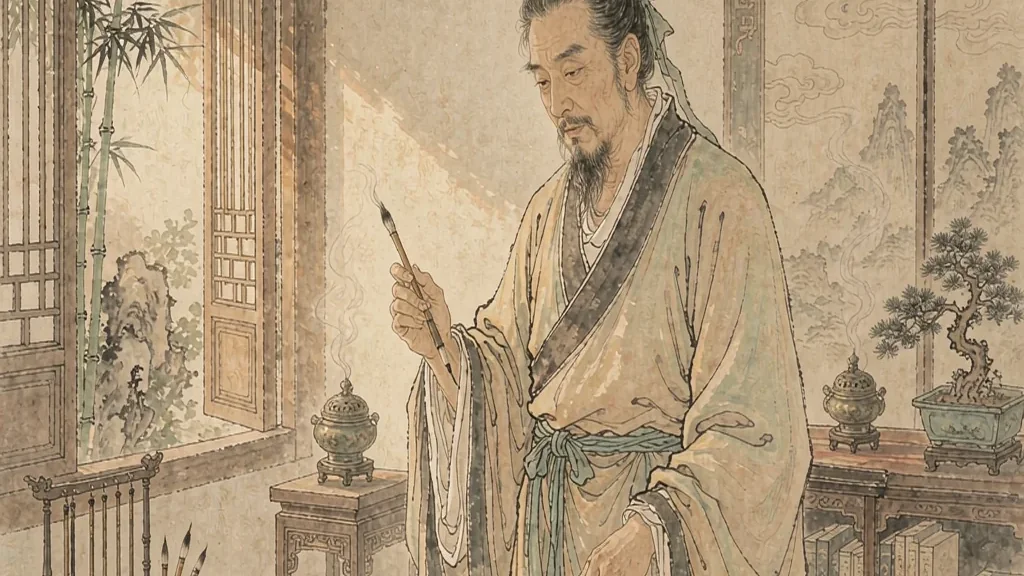
Zhang Xu (张旭, c. 8th century) was a Tang-dynasty calligrapher so identified with wild cursive script that he earned the nickname "Mad Zhang" (张颠, Zhāng Diān). He is counted among the greatest masters of cursive calligraphy, admired for strokes that seem to dance, leap, and abandon ordinary restraint while still obeying a deeper order. Along with Huai Su, he defined the "wild cursive" (颠草) ideal that later artists both revered and imitated. This article looks at his life, his art, and the strange sources of his inspiration.
Life of a Tang Official and Artist
Zhang Xu lived during the high Tang, a golden age of poetry, painting, and calligraphy under the emperor Xuanzong. He held minor official posts but is remembered almost entirely for his art and his eccentric habits. Contemporary accounts describe him as given to drink and sudden fits of writing.
His reputation rested not on rank but on raw talent. In an era that prized both discipline and brilliance, Zhang Xu supplied the brilliant, ungoverned pole — a reminder that the Tang imagination had room for the ecstatic as well as the measured.
The "Mad" Reputation
Zhang Xu's nickname "Mad Zhang" came from his habit of writing only after drinking, sometimes using his hair dipped in ink as a brush, or writing on walls and garments when paper was lacking. Such behavior shocked polite society and delighted legend-makers.
Yet the madness was performative and purposeful. By loosening ordinary control, he sought a state in which the brush could move straight from feeling. The wildness on the page was not chaos but a different kind of discipline — one trained until it could look free.
Wild Cursive Script
Zhang Xu specialized in "wild cursive" (颠草, diān cǎo), the most extreme branch of cursive writing, where characters fuse and distort almost beyond reading. In his hands the line became pure energy: thick and thin, fast and slow, rising and plunging across the surface.
Wild cursive demands total command of structure beneath the surface, because the writer cannot pause to correct. Zhang Xu's achievement was to make the impossible look inevitable, each wild stroke landing where it belonged in a composed whole.
Sources of Inspiration
Legend says Zhang Xu found models outside the writing desk. He claimed to have learned from the movements of a sword-dance performer, from the noise and flow of the natural world, and from the gait of people in the street. These stories point to a key idea: brush movement mirrors bodily and natural movement.
Whether literal or not, the accounts show that he treated calligraphy as physical performance, not mere handwriting. The body, trained and then released, became the instrument through which ink moved.
Zhang Xu and Huai Su
Zhang Xu is often paired with Huai Su, the monk-calligrapher of the next generation, as the two pillars of wild cursive. Where Zhang was the earthly "madman" of wine and walls, Huai Su was the disciplined monk who nonetheless wrote with equal fury. Together they set the type later summed as "Zhang boneless, Su thin" in contrasting line qualities.
Their friendship across generations shows how a style passes hand to hand. Huai Su openly admired Zhang Xu, and later critics measured wild-cursive masters against the pair as a standard.
Technique and Control
For all its appearance of abandon, Zhang Xu's cursive relied on flawless knowledge of character structure and brush loading. The brush had to be charged with enough ink for a long run, then managed so the line did not choke or flood. Speed alone destroys; speed plus structure creates the magic.
Modern teachers use his example to show that freedom in calligraphy is earned, not assumed. One must first master regular and running scripts before wild cursive can say anything coherent rather than merely scribble.
Influence and Legacy
Zhang Xu's wild cursive influenced not only later calligraphers but the self-image of the artist as inspired outsider. The idea that great work needs a trance-like state — wine, motion, emotion — owes much to his legend and to Tang romanticism generally.
His works survive mostly through copies and records, since originals were often on walls or casual surfaces. Still, his status as a founder of wild cursive has never faded, and he remains a touchstone for anyone who would make the brush move like wind.
Beyond the Wild: His Other Skills
For all his fame as a wild cursive showman, Zhang Xu was no stranger to discipline. He was also accomplished in regular script, the strict, squared style that demands patience above all. Contemporaries noted that his wildness was effective precisely because it rested on solid fundamentals; a writer who cannot build a character correctly has nothing to break apart with flair and risks only noise.
This balance is the real lesson of his career. The legend of the drunken madman can hide the truth that Zhang Xu trained for years before he could afford to let go. Later artists who imitate only the frenzy, without the groundwork, produce chaos rather than art. His life suggests that true freedom in any craft is the late reward of early obedience to its rules.
Wild Cursive and Later Art
Zhang Xu's wild cursive helped establish the idea that great calligraphy is not mere handwriting but inspired performance. Later artists and critics returned to his example whenever they wanted to defend spontaneity against rigid formalism, and the romantic image of the artist possessed by feeling owes much to his legend in the Tang imagination.
His prestige was such that later emperors and collectors prized any trace of his hand, and copyists worked hard to preserve his manner for students who would never see an original. Through these copies and through the parallel example of Huai Su, the wild-cursive lineage he began kept flowing into the Ming and Qing, and even into modern experimental brushwork that still cites him as a founder.
❓ Frequently Asked Questions
Who was Zhang Xu?
He was a Tang-dynasty calligrapher celebrated as a supreme master of wild cursive script and nicknamed "Mad Zhang."
Why was he called "mad"?
He wrote in drunken, impulsive bursts, sometimes with his hair as a brush, which looked wild to contemporaries.
What is wild cursive?
It is the most extreme cursive style, where characters fuse and distort almost beyond legibility while showing great energy.
How did he find inspiration?
Legend says from sword dances, nature, and street movement — treating brushwork as bodily, physical performance.
Who was Huai Su?
A later monk-calligrapher paired with Zhang Xu as the two great masters of wild cursive.
Was his writing really uncontrolled?
No. Beneath the wild look lay deep control of structure and brush; the freedom was trained, not accidental.