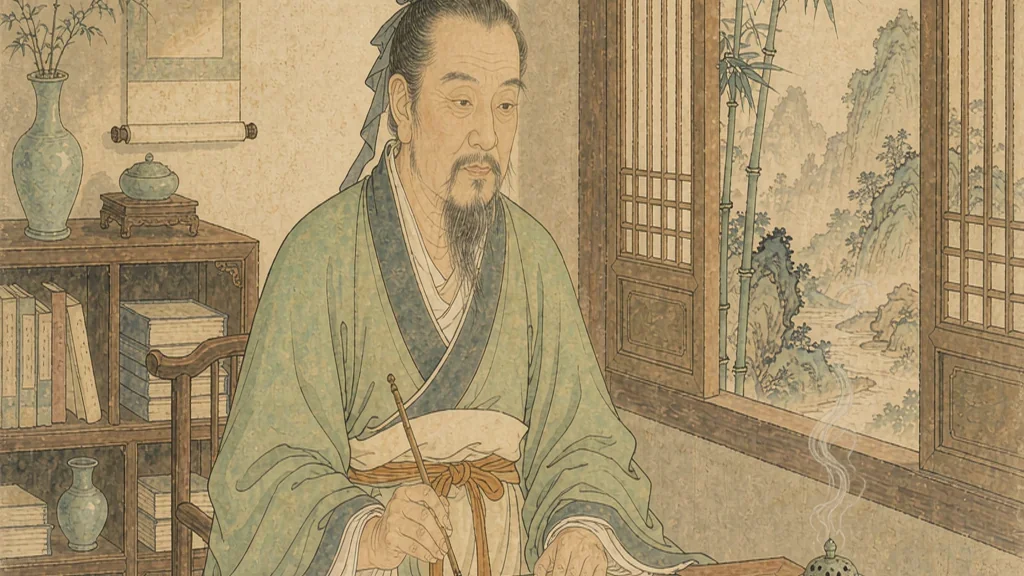
Liu Gongquan (778–865) was a Tang dynasty calligrapher whose regular script became so admired that it was engraved across the empire and studied for a thousand years. Alongside Yan Zhenqing he forms the celebrated pair “Yan-Liu,” the two pillars of mature Tang regular writing. Beyond his art, Liu is remembered for a single pointed remark—that a correct heart makes a correct brush—which turned a comment about handwriting into a lesson about character that Chinese society never forgot.
Life at the Tang Court
Liu Gongquan was born into a family of modest official standing and rose through the examination system to serve several Tang emperors as a court calligrapher and official. He lived through a turbulent late-Tang period of palace intrigue and decline, yet his reputation for integrity and his skill with the brush kept him in favor across changing reigns. He was often asked to write imperial stele inscriptions, and his hand became nearly synonymous with official, exemplary writing.
His long life—he died past eighty—spanned the careers of many rivals and successors, and his steady presence at court helped regular script retain its prestige as the script of government and monuments. Contemporary accounts note that emperors treasured his writing and that nobles competed to employ him for family inscriptions.
The “Liu Style” of Regular Script
Liu’s regular script is marked by lean, taut strokes and a bony, disciplined structure. Where Yan Zhenqing’s characters are full and monumental, Liu’s are tighter, with sharp turning points and a clear, almost architectural logic. Connoisseurs sum up the contrast by saying Yan is “plump and vigorous” while Liu is “bony and stern.”
This leanness was not mere mannerism. Liu had studied earlier masters, especially the Wei and Tang stele tradition, and he distilled their strength into a personal manner that emphasized precision. His characters sit firmly on the page, each component balanced, and the whole gives an impression of moral seriousness—which may be why his style was favored for inscriptions meant to last.
The Famous “Heart and Brush” Saying
The best-known anecdote about Liu Gongquan concerns the emperor who asked him the secret of good writing. Liu replied that the brush is correct only when the heart is correct, implying that a calligrapher’s moral state shows in his strokes. The phrase “xin zheng ze bi zheng” entered common speech as a compact moral lesson.
Whether or not the exchange happened exactly so, the saying captures a deep Chinese belief that calligraphy is not neutral handwriting but an expression of the person. Liu’s own reputation for upright conduct gave the words weight, and later teachers used them to remind students that character and craft cannot be separated.
Major Surviving Works
The works by which Liu is known today are mostly stone inscriptions, since paper scrolls from his hand are scarce. Among the most studied are the “Stele of the Mysterious Tower” and the “Stele of Shence Army Monk’s Banner,” both in his mature regular script. These were carved so that rubbings could circulate, and they became classroom texts for generations.
Because stone preserves form even after the paper original is gone, Liu’s inscriptions did the work that fragile scrolls could not: they carried his style to every province where a rubbing could be taken. Students learning regular script in later dynasties almost invariably began with Yan or Liu, and Liu’s steles were among the first they copied.
Technique and Stroke Discipline
Liu’s manner rewards control above all. His horizontal strokes often show a slight rising energy, his verticals are straight and confident, and his turning hooks are clean and decisive. The overall effect depends on consistent pressure and a steady center-tip grip, leaving little room for the casual or the accidental.
Teachers point to Liu as the calligrapher who shows that restraint is itself a form of power. Where a cursive master impresses by release, Liu impresses by holding everything in exact tension. Learning his style is often recommended after a student has some basic command, because it demands patience and exactness rather than flair.
Place in the “Yan-Liu” Tradition
Pairing Yan Zhenqing and Liu Gongquan as “Yan-Liu” is one of the most durable groupings in Chinese art history. The two represent complementary ideals of Tang regular script, and together they defined the standard against which later regular-script writers measured themselves. A student who mastered both had command of breadth and tightness, warmth and severity.
In the Song dynasty and after, when scholars debated whether to model themselves on Jin dynasty grace or Tang monumentality, the Yan-Liu norm remained the practical foundation of instruction. Even calligraphers who rebelled against Tang heaviness, such as the Song master Mi Fu, acknowledged the pair’s mastery even as they sought other models.
Influence on Later Ages
Liu’s influence extended far beyond his lifetime. In the Song, Yuan, Ming, and Qing, his steles were copied in private academies and by examination candidates who needed a clear, respectable hand. The imperial examination system, which valued neat regular script, kept demand for his manner high well into the nineteenth century.
His prestige also spread to neighboring cultures. In Korea and Japan, where Chinese writing was adopted, Liu’s regular script was among the models transmitted through monks and envoys. In Japan his manner influenced the development of formal kana and Chinese-style writing, and Korean neo-Confucian scholars prized his stern, moral clarity.
Comparison with Yan Zhenqing
The contrast between the two is a standard teaching tool. Yan’s characters are generous and rounded, built on a broad central axis, conveying warmth and grandeur; Liu’s are narrow and angular, conveying discipline and reserve. A common saying advises learning Yan first for structure and Liu later for refinement, or the reverse, depending on the teacher.
Both, however, share the Tang commitment to monuments that endure. Their scripts were designed to be carved, read at distance, and remembered—qualities that distinguish Tang regular script from the more intimate, letter-like writing of the Jin aristocracy that came before them.
Modern Study and Appreciation
Today Liu Gongquan remains a core figure in calligraphy education. Rubbings of his steles are reprinted constantly, and beginning students of regular script worldwide still encounter his “Mysterious Tower” stele as one of the first models to copy. His style suits learners because its logic is visible: every stroke has a clear job.
For historians he matters as the calligrapher who gave Tang regular script its most disciplined face, and as the man whose offhand moral saying became a lasting cultural proverb. Few artists have shaped both the look of Chinese writing and a piece of its ethical vocabulary so completely.
❓ Frequently Asked Questions
Who was Liu Gongquan?
He was a Tang dynasty court calligrapher renowned for a lean, disciplined regular script and remembered for the saying that a correct heart makes a correct brush.
What is the “Yan-Liu” pairing?
It joins Liu Gongquan with Yan Zhenqing as the two defining masters of mature Tang regular script, representing contrasting but complementary ideals.
What did Liu mean by “right heart, right brush”?
He meant that a person’s moral character shows in their handwriting, turning a technical question into a lesson about integrity.
Which works survive by Liu?
Mainly stone steles such as the “Stele of the Mysterious Tower,” preserved and studied through rubbings rather than original paper scrolls.
How does Liu differ from Yan Zhenqing?
Yan’s characters are full and rounded; Liu’s are narrow, angular, and restrained, conveying discipline rather than warmth.
Why is Liu still studied by beginners?
His style shows clear, logical structure, making it an excellent model for learning the discipline of regular script.