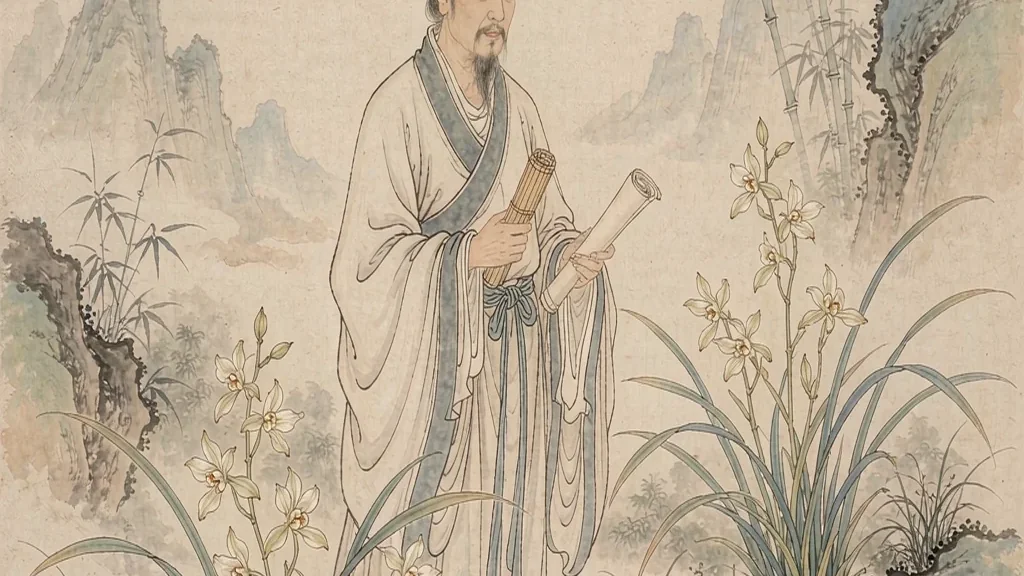
Wang Xizhi and the Orchid Pavilion Preface
王羲之《兰亭序》 · 1021 words
In the annals of Chinese art, no single figure looms larger than Wang Xizhi (王羲之, 303–361 CE), the "Sage of Calligraphy" (书圣, shū shèng). For over sixteen centuries, his name has been synonymous with the art of writing at its highest level. His Lanting Xu (兰亭序), the "Preface to the Orchid Pavilion," is the most famous and most copied work of calligraphy in Chinese history — a text that has spawned an entire industry of scholarly commentary, tracing copies, and artistic emulation. But Wang Xizhi was not merely a technical virtuoso; he was the first calligrapher to fully articulate the philosophical and aesthetic dimensions of the art, transforming writing from a craft into a vehicle for the expression of the scholar's innermost self.
The Historical Context of Wang Xizhi
Wang Xizhi lived during the Eastern Jin dynasty (317–420), a period of political division and instability. The north was ruled by non-Chinese regimes, while the south was governed by a refugee court that had fled the fall of the Western Jin. For the educated elite of the south, political power was limited, and cultural cultivation became an alternative arena for competition and self-expression.
The Wang clan was one of the most powerful families of the period. Wang Xizhi's grandfather and father had both served as high officials, and he was expected to follow in their footsteps. He did eventually hold office, rising to General of the Right Army (右军将军, yòu jūn jiāng jūn) — a title by which he is still often called, Wang Youjun (王右军). But he was never comfortable in government, and he retired early to devote himself to calligraphy, Daoist philosophy, and the company of fellow literati.
The Orchid Pavilion Gathering
The year 353 CE was the fifty-first year of Wang Xizhi's life. On the third day of the third lunar month — the Spring Purification Festival — he gathered forty-one friends and relatives, including his sons Wang Xianzhi and Wang Huizhi, at the Orchid Pavilion near Shaoxing. The party engaged in a "winding stream" game: cups of wine were floated down a small stream, and whenever a cup stopped, the person nearest had to compose a poem and drink. By the end of the day, twenty-six poems had been composed.
Wang Xizhi, who had been drinking, took up a brush and wrote a preface to the collected poems. The result is the Lanting Xu, 324 characters in running script. The work is suffused with the melancholy awareness that joy is fleeting — a theme announced in the opening lines and developed with exquisite subtlety. The calligraphy captures the mood perfectly: graceful and lively in the first half, slower and more reflective toward the end, as Wang's tipsiness wore off and his mood deepened.
The Fate of the Original Manuscript
After its creation, the Lanting Xu remained in the Wang family for generations. The original was passed to Wang Xizhi's descendants, eventually reaching the Tang dynasty, where it came to the attention of Emperor Taizong (r. 626–649). Taizong was an ardent admirer of Wang Xizhi's calligraphy and made the acquisition of the Lanting Xu a personal mission. According to the Tang writer He Yanzhi, Taizong's agent Xiao Yi tricked the original owner's descendant, Bian Cai, a monk, into surrendering the manuscript.
Taizong had expert copyists produce traced duplicates — the finest of these, attributed to Feng Chengsu, survives today in the Palace Museum in Beijing. The emperor then ordered the original buried with him in his mausoleum. Whether the original still lies in the Zhao Mausoleum (昭陵) is unknown, but no one has seen it since the seventh century. All surviving versions of the Lanting Xu are copies, yet even as copies they are revered as the supreme models of running script.
Wang Xizhi's Calligraphic Achievement
Wang Xizhi's contribution to Chinese calligraphy is twofold: he perfected the technical language of the art, and he established its philosophical foundations. Technically, he regularized and refined the running and cursive scripts that his predecessors had only begun to develop. His stroke technique is unparalleled in its subtlety and range — every line carries a full spectrum of pressure, speed, and direction changes. His compositions are masterpieces of rhythmic structure, with characters arranged in subtle dialogue across the page.
Philosophically, Wang articulated the ideal of "naturalness" (自然, zìrán) as the highest value in calligraphy. For him, the goal was not technical perfection but the spontaneous expression of the writer's nature — the Daoist ideal of wú wéi (无为), or non-purposive action, applied to the art of writing. A work of calligraphy should flow as naturally as water or wind, without strain or artifice. This ideal has remained central to Chinese aesthetics ever since.
Wang Xizhi's Other Masterpieces
While the Lanting Xu is Wang Xizhi's most famous work, his other surviving compositions reveal the full range of his genius. The Kuai Xue Shi Qing Tie (快雪时晴帖, "Sudden Clearing After Snowfall") is a short letter in running script, treasured for its warm, spontaneous quality. The Sang Luan Tie (丧乱帖, "Disturbance of Mourning") expresses grief with heart-wrenching intensity. The Kong Shi Dang Tie (孔侍中帖) shows Wang's cursive at its most elegant.
The Seventeen Ties (十七帖) is a collection of Wang's letters in cursive script, compiled by a later emperor. This work became the standard model for cursive study — generations of calligraphers learned to write cursive by copying the Seventeen Ties character by character. The work demonstrates Wang's complete mastery of the cursive vocabulary, every abbreviation correct and every connection graceful.
The Wang Xizhi Legacy
Wang Xizhi's influence on Chinese calligraphy is so pervasive that it is almost invisible — like water to a fish. Every calligrapher who has practiced in the past 1,600 years has been shaped by his example. The Tang emperor Taizong's promotion of Wang's style established it as orthodox; the Song revival of Jin dynasty elegance was a return to Wang; and even the Qing epigraphic school, which challenged the Wang-dominated tradition, defined itself in opposition to a standard that Wang had set.
In modern China, Wang Xizhi remains the most revered figure in calligraphic history. Museums compete for the smallest fragment of his surviving work. Calligraphy students still begin their studies with copies of his copies. His surname, Wang, is synonymous with calligraphy itself. The Sage of Calligraphy still rules, sixteen centuries after his death.
Why the Lanting Xu Became the Model of Models
The Lanting Xu holds its place not because it is the oldest or the largest work but because it seems to do everything at once. In running script, Wang Xizhi balanced liveliness and calm so completely that later writers treated it as the textbook of the semi-cursive hand. Its fame was sealed by politics: Emperor Taizong's obsession turned Wang into orthodoxy, and the imperial tracing copies spread his forms across the empire. Because no original survives, the work lives through copies, yet that very absence helped it, each generation re-copying and re-interpreting the master anew. The preface also married form to feeling, opening in pleasure and closing in melancholy, so it demonstrated that calligraphy could carry thought, not just display skill. For sixteen centuries it has been the first thing a student of running script is given to imitate, the measure against which all else is judged.
Frequently Asked Questions
Chinese Vocabulary
王羲之 — : Wang Xizhi (303–361): the Sage of Calligraphy, most revered calligrapher in Chinese history.
兰亭序 — : The Orchid Pavilion Preface: Wang Xizhi's masterpiece of running script.
书圣 — : Sage of Calligraphy: the honorific title given to Wang Xizhi.
王右军 — : Wang Youjun: Wang Xizhi's title, meaning 'General of the Right Army.'
十七帖 — : The Seventeen Ties: a collection of Wang Xizhi's cursive letters, a standard model for cursive study.
王献之 — : Wang Xianzhi, Wang Xizhi's son and himself one of the greatest calligraphers of the age.
曲水流觞 — : The winding-stream cup game played at the Orchid Pavilion gathering.
唐太宗 — : Emperor Taizong of Tang, the ruler whose admiration made Wang Xizhi orthodox.
Fun Facts
- Wang Xizhi was so devoted to calligraphy that he was said to practice by writing on his clothes, eventually tearing through the fabric.
- Emperor Taizong of Tang collected over 2,000 sheets of Wang Xizhi's calligraphy, only a fraction of which survive today.
- The character 之 appears twenty times in the Lanting Xu, and Wang Xizhi made each one different — a feat that has fascinated calligraphers for centuries.
- The gathering game at the Orchid Pavilion, floating wine cups down a winding stream, was a spring ritual of purification that combined drinking, poetry, and the outdoors.
- Wang Xizhi's son Wang Xianzhi was himself ranked among the greatest calligraphers, and father-and-son pairs were long measured against the two Wangs.
- Emperor Taizong admired Wang so fervently that he had the Lanting Xu copied by his best tracers and even composed his own preface in imitation of the master.