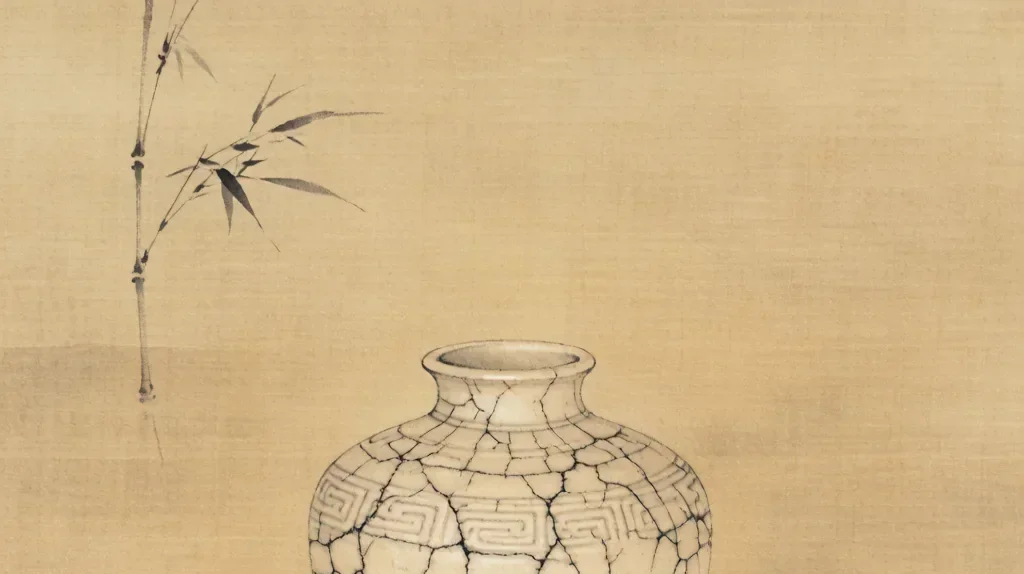
Gē yáo (哥窑), known in English as Ge ware, is the "elder brother" kiln of the Song dynasty — a family of Chinese porcelain celebrated above all for a glaze deliberately broken into a fine, icy network of crackles. Where most ceramic traditions treat a cracked glaze as a flaw to be avoided, Ge ware makes the crackle its central glory. The surface is mapped by a double pattern of dark, branching lines and finer golden-brown threads, a look the Chinese call "gold thread, iron wire" (金丝铁线, jīn sī tiě xiàn). For nearly a thousand years this quietly imperfect beauty has been treasured by emperors, scholars, and collectors as one of the supreme achievements of Chinese ceramic art, and its mystery only deepened because the kiln that made it has never been found.
The Legend of the Two Brothers
The most famous story attached to Ge ware appears in Ming dynasty texts such as the Ge gu yao lun and the Di jing jing wu lüe. It tells of two brothers surnamed Zhang who both made porcelain in the Southern Song. The elder brother, the maker of Ge (哥) ware, supposedly fired his glaze so that it cracked into the celebrated pattern. The younger brother's kiln produced a sleek, uncrackled celadon that later writers sometimes identified with the famous Longquan wares of Zhejiang. The nickname "brother kilns" (兄弟窑) comes from this tale, with Ge meaning "elder brother" and the younger's workshop remembered as Di (弟) ware.
Like many origin legends, this one is as much folklore as fact. No Song-era document records the two Zhang brothers, and the story first appears centuries after the wares were made. Still, the legend captures something real: Ge ware and the related imperial and Longquan traditions are unmistakably kin, sharing clays, glazes, and a world of taste centered on the scholar's table. The tale of the brothers has endured because it gives a human face to a ceramic whose actual history is frustratingly silent.
Kiln Location and the Search for the Site
Perhaps the greatest puzzle in the study of Ge ware is simply: where was it made? Later tradition placed the Ge kilns in the Longquan region of southern Zhejiang, a mountainous area rich in the porcelain stone and firewood needed for large kilns. Longquan certainly produced vast quantities of celadon in the Song and Yuan, and some crackled pieces from the area could be the ancestors of the Ge tradition. Yet despite generations of archaeological survey, no kiln site has been conclusively identified as the producer of classic Song-dynasty Ge ware.
Other scholars have argued that Ge ware was actually made much farther north, near the Southern Song capital at Hangzhou, possibly as a civilian offshoot of the imperial Guan kilns. The resemblance between Ge and Guan wares — both crackled, both with dark bodies showing at the foot — keeps this debate alive. Until a kiln is excavated with wasters that match the classic Ge profile, the "where" of Ge ware will remain one of the great unsolved questions of Chinese ceramics, a gap that only adds to its romance.
The Crackle Glaze Technique
The crackle of Ge ware, technically called crazing, is born from a mismatch between the clay body and the glassy glaze laid over it. In a perfect ceramic the glaze and body shrink together as the piece cools from the firing temperature. In Ge ware they do not: the glaze, richer in glass-forming ingredients, contracts at a different rate than the coarser, iron-bearing body beneath. The tension pulls the still-fragile glaze skin into a web of tiny fissures. In most workshops this would be a rejected failure; in Ge ware it is the entire point.
Achieving the effect on purpose took great control. Potters built up several layers of glaze, each with a slightly different recipe and expansion behavior, so that cracks opened at more than one scale. The wide primary cracks and the narrow secondary cracks thus belong to different glaze layers. The kiln's cooling schedule, the thickness of the application, and the exact mineral mix of the body all had to be tuned together. This is why genuine Ge crackle looks so organic and unforced — it is the record of a physical process, not a pattern painted on.
"Gold Thread, Iron Wire" — The Signature Pattern
The phrase "gold thread, iron wire" describes the two-tier crackle that defines Ge ware. The larger, darker lines are the "iron wire" (铁线, tiě xiàn): broad, near-black fissures that form the primary network across the surface. Filling the panels between them is a finer mesh of "gold thread" (金丝, jīn sī): narrow, brownish-gold lines that read almost like hairline writing against the pale glaze.
The contrast was sometimes heightened on purpose. After firing, the open crackle could be wiped with a dark stain — ink, tea, or an iron-rich solution — that seeped into the wider gaps and darkened them into iron wire, while the shallowest lines kept a lighter tone. Over centuries the staining and the slow accumulation of dirt and handling deepened the pattern further, so that an old Ge piece often shows its crackle more boldly than a fresh one would. The result is a surface that looks at once geological and calligraphic, like frost on a window or a map of rivers seen from the sky.
Body and Glaze Characteristics
Ge ware is built on a body that is unusually dark: a deep gray, brownish, or almost black clay high in iron. Because the glaze was often applied thinly at the rim and left off the foot entirely, these dark areas show through and create the famous "purple mouth and iron foot" (紫口铁足, zǐ kǒu tiě zú) effect shared with Guan ware — a reddish-dark lip and a blackened base that frame the pale glaze like ink borders on a scroll.
The glaze itself is thick, lustrous, and slightly uneven, ranging in color from warm beige and putty gray to a very pale, almost milky celadon. Connoisseurs prize a glaze with the soft, waxy sheen of well-aged jade rather than a bright glassy shine. The surface often pools where the glaze runs thicker, and the crackle follows the topography of those pools. In the best pieces the body, glaze, and crackle feel inseparable — a single quiet composition rather than three separate effects.
Connoisseurship and Authentication
Because genuine Song-dynasty Ge ware is rare and has been imitated for six centuries, telling a true piece from a later copy is a serious discipline. Experts look first at the crackle: on old wares the lines usually vary in width and direction and feel integrated with the glaze, whereas many later copies show a more mechanical, repetitive grid. The body color at the foot, the feel of the glaze in raking light, the shape of the vessel, and any marks of wear all enter the judgment.
Provenance is decisive when it exists. Pieces with a continuous recorded history in a famous collection — an imperial catalogue, a noted European or Japanese holding — carry far more confidence than anonymous examples. Scientific study helps too: analysis of the body's trace elements can sometimes indicate a region or period, though it cannot yet name a specific lost kiln. For the ordinary lover of ceramics, the practical lesson is humility: Ge ware is a field where even museums label pieces cautiously, and where a "Song Ge" label is sometimes quietly softened to "Ge-type" ware of uncertain date.
Ge Ware and Guan Ware — A Comparison
Ge ware is most often compared with Guan ware (官窑), the formally "official" or imperial kiln ceramic of the Southern Song. The two are cousins in look and sometimes in origin, and both can show crackle over a dark body with the purple-mouth-iron-foot framing. The usual distinctions are matters of degree. Ge ware is associated above all with the dense, two-scale "gold thread, iron wire" crackle and a somewhat freer, more rustic feel. Guan ware, made for court use, tends toward larger, more regular crazing and a finer, greyer body, with shapes that follow stricter imperial taste.
In practice the line blurs, and some scholars suspect that "Ge" and "Guan" were not always clearly separate categories in the Song but became distinct mainly through later legend and collecting habits. What can be said with confidence is that both belong to the same southern Song achievement: a move away from bright, showy color toward restrained, near-monochrome surfaces whose interest lies in texture, subtlety, and the play of light on a imperfect, living glaze.
Famous Pieces in Imperial and Museum Collections
The finest Ge ware survives mainly because it was collected by emperors. The Southern Song court itself prized crackled celadon, and later Ming and Qing rulers expanded the holdings, cataloguing them in the imperial archives. Today the greatest assemblies of Song and Song-style Ge ware sit in the Palace Museum in Beijing and the National Palace Museum in Taipei, the two halves of the former Qing imperial collection. Both hold small bowls, brush washers, jars, and incense burners whose crackle has been admired for generations.
Beyond China, important Ge-type pieces entered the great encyclopedic museums through trade and collecting: the British Museum and the Percival David collection in London, the Topkapı Palace in Istanbul with its celebrated Chinese porcelain holdings, the Metropolitan Museum of Art in New York, and major collections in Japan, where crackled celadon long influenced local tea-ceremony taste. Because so few indisputable Song examples exist, each well-documented piece is studied closely, photographed, and published, becoming a reference point for the whole field.
Imitations Through the Ming and Qing Dynasties
The prestige of Ge ware guaranteed that it would be copied. From the Ming dynasty onward, kilns produced "Ge-type" (哥式) wares in large numbers, and the fashion peaked under the Qing emperors Yongzheng and Qianlong, both passionate connoisseurs of Song ceramics. The imperial kilns at Jingdezhen were ordered to reproduce the crackled look, and they did so cleverly — sometimes by mixing materials into the glaze that would craze on command, sometimes by incising a pattern that mimicked natural crackle.
These later imitations are valuable in their own right: they show how the Song ideal was understood and reinterpreted, and many are beautifully made. But they differ in feel from the originals, often with a whiter body, a more uniform glaze, and a crackle that is decorative rather than structural. For collectors the Ming–Qing copies form a parallel history of Ge ware, a centuries-long conversation in which each age tried to capture what the elder brother's kiln had done by accident and intent at once.
Modern Revival and Living Craft
In the present day Ge ware has moved from mystery to living craft. Around Longquan and in studio workshops elsewhere in China, artisans have spent decades reconstructing the lost recipes — testing clay bodies, glaze minerals, and cooling curves to coax the double crackle back into being. Their success is uneven and honest: some pieces come close to the Song feeling, others are openly modern interpretations, but the knowledge is being kept alive rather than merely remembered.
Support has come from the recognition of traditional ceramics as Intangible Cultural Heritage, with training programs, exhibitions, and state and private museums giving the work a stage. Younger makers are also pushing the tradition outward, using Ge-type glazes on contemporary forms, jewelry, and design objects so that the crackle speaks to new audiences. The old puzzle — where the kiln was, who the brothers were — may never be fully solved, but the ware itself is no longer silent.
📝 Chinese Vocabulary
🎉 Fun Facts
❓ Frequently Asked Questions
What exactly is the "crackle" in Ge ware?
It is a deliberate crazing of the glaze caused by the body and glaze contracting at different rates as the piece cools. The network of fine fissures is prized as the ware's defining beauty, not a flaw.
Why is it called the "brother kiln"?
A later legend pairs Ge ware with an uncrackled "younger brother" kiln as two workshops run by brothers surnamed Zhang in the Southern Song, giving Ge its name meaning "elder brother."
How can you identify authentic Ge ware?
By the double "gold thread, iron wire" crackle over a dark grey or black body, often on small scholar's objects, with the purple-mouth-iron-foot effect at rim and foot. Provenance and expert study confirm true Song pieces.
What is the difference between Ge ware and Guan ware?
Both are southern Song crackled celadons on dark bodies, but Ge ware is known for its dense two-scale gold-thread-iron-wire crackle and freer feel, while Guan ware tends toward larger, more regular crazing and stricter imperial forms.
Where was Ge ware made?
Tradition points to Longquan in Zhejiang, but no kiln site has been definitively proven, and some scholars place it near Hangzhou. The true location remains unknown.
Is Ge ware still made today?
Yes. Modern artisans in Longquan and beyond have reconstructed crackle-glaze recipes, and Ge-type ceramics are now made both as faithful revivals and as contemporary designs, supported as Intangible Cultural Heritage.