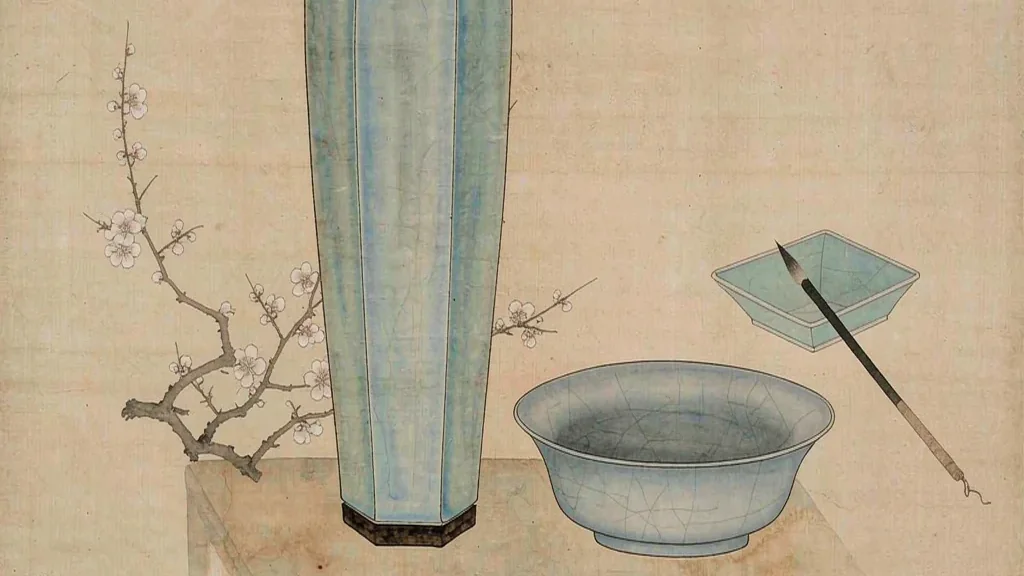
Among the most celebrated of all Chinese ceramics, Ru ware (汝窑) is a refined type of celadon stoneware made for the imperial court during the late Northern Song dynasty. Produced for only a short span of years, it is treasured for a soft, blue-green glaze that painters likened to the sky after rain, a finely cracked surface, and an almost imperceptible restraint in form. So few genuine pieces survive that Ru ware has become a byword for rarity and refinement in the study of Chinese porcelain.
Origins and the Northern Song Court
Ru ware was created to serve the taste of the Song imperial household, most famously associated with the court of Emperor Huizong. The Song emperors prized restraint, subtlety, and a closeness to nature, and their workshops favored quiet monochrome glazes over showy decoration. Ru kilns supplied vessels for the palace rather than for the open market.
Unlike commercial wares, Ru pieces were shaped to a narrow court aesthetic: modest in size, flawless in glaze, and free of painted imagery. This imperial purpose explains both their exceptional quality and their tiny surviving numbers.
The Qingliangsi Kiln Site
The principal Ru production center has been identified at Qingliangsi in present-day Baofeng County, Henan province. Archaeological excavation there uncovered kiln remains, wasters, and tools consistent with a supervised, court-oriented workshop. The location fits historical references to Ru kilns operating in the Henan region.
Finds at the site helped scholars distinguish true Ru ware from later imitations, since the local clay body, glaze recipes, and firing methods left characteristic traces that copies seldom reproduced exactly.
The Distinctive Glaze
The heart of Ru ware's appeal is its glaze, a translucent blue-green celadon applied in multiple layers over a pale body. The color is soft and slightly milky, neither bright nor gray, and it pools thicker in recesses to create gentle tonal variation across a single vessel.
A small amount of pigment was worked into the glaze to produce the cool tone. The firing had to be carefully controlled, because the same recipe could yield different results under slightly different heat and atmosphere.
Crackle and Surface Texture
Ru surfaces show a deliberate network of fine cracks known as crackle, formed as the glaze cooled and contracted at a different rate from the body beneath. Far from a flaw, this pattern was valued as a quiet kind of ornament. Connoisseurs gave the finest markings poetic names.
The most admired Ru crackle was fine and even, sometimes described with the phrase "crab-claw" markings. The effect turns a plain surface into a subtle, living texture that rewards close looking.
Forms and Vessels
Surviving Ru vessels are mostly small: shallow brush-washing bowls, bottles, dishes, and a few eccentric shapes such as a narcissus bowl or a vase with lobed sides. Their utility was domestic and scholarly — objects for washing brushes, holding water, or displaying on a scholar's table.
Decoration is almost entirely absent. Where relief appears, it is usually a molded or incised motif barely visible beneath the glaze, keeping the eye on color and contour rather than pattern.
Scarcity and Surviving Pieces
Ru ware was made for a brief period before the Song court fled southward, and production appears to have ended abruptly. The combination of short output and court-only use means that complete pieces are exceedingly rare in collections worldwide.
Because so few exist, almost every authenticated Ru object is documented and studied individually. A single vessel can anchor the reputation of a museum's Chinese ceramics holdings.
Comparison With Other Song Wares
The Song era produced several celebrated monochrome wares, each with its own body and glaze. Ru is often ranked first among them for its glaze quality, but it shares the period's love of restraint with Guan, Ge, Jun, and Ding wares.
Where Jun ware is known for spontaneous blue and purple splashes, and Ding ware for pale ivory and carved decoration, Ru keeps to a single cool color and an unbroken calm. The contrast helps explain why collectors treat Ru as the summit of the group.
The "Sky After Rain" Aesthetic
A recurring phrase in Chinese writing compares the Ru glaze to "the sky after rain" — the moment when clouds clear and a pale blue shows through. This image captures both the color and the mood the potters sought.
The ideal reflects a broader Song sensibility that found beauty in understatement and in echoes of the natural world. A Ru bowl is valued less as an object of display than as a small, settled glimpse of weather and light.
Later Imitations and Revival
From the Ming and Qing dynasties onward, imperial and private kilns tried to recreate Ru glazes, with mixed success. Qing emperors especially admired Song ceramics and commissioned copies, yet the originals remained the standard against which all imitations were judged.
In recent decades, craftspeople in Henan and elsewhere have studied excavated fragments to revive Ru techniques, producing wares inspired by the old glazes for collectors and cultural institutions.
Studying and Appreciating Ru Ware
To appreciate Ru ware, viewers are encouraged to look at the glaze in shifting light, to feel the weight and thinness of the piece, and to notice the tiny supporting marks left by the kiln's firing method. These details separate genuine Ru from the many later homages.
Museums with notable holdings often display Ru pieces alone or with a few companion Song wares, letting the quiet glaze speak without competition from busier ceramics.
❓ Frequently Asked Questions
What is Ru ware?
Ru ware is a type of imperial celadon stoneware made for the Northern Song court, celebrated for its soft blue-green glaze and fine crackle.
Why is Ru ware so rare?
It was produced for only a short period at a court-run kiln and was not made for the open market, so very few complete pieces have survived.
What color is a Ru glaze?
It is a pale, cool blue-green, often described in Chinese as "sky blue" and compared to the sky after rain.
What is the crackle on Ru ware?
The crackle is a fine network of glaze cracks formed during cooling; connoisseurs valued it as subtle surface ornament.
Where was Ru ware made?
The main production site is identified at Qingliangsi in present-day Baofeng County, Henan province.
How is Ru ware different from other Song wares?
Unlike Jun's color splashes or Ding's carved decoration, Ru keeps to a single calm glaze color with almost no surface pattern.