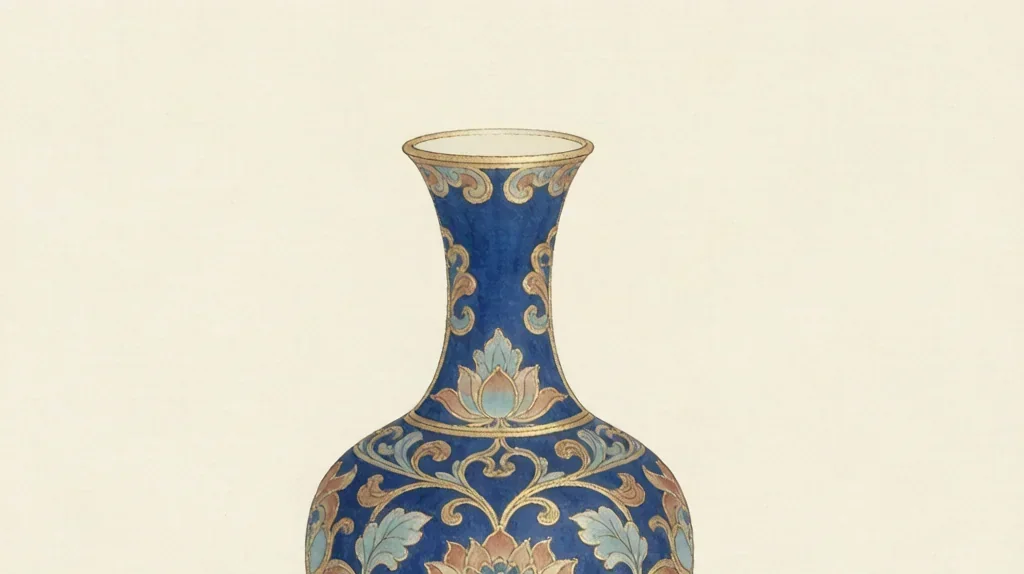
Among the decorative arts of imperial China, few command attention as immediately as cloisonné (景泰蓝, jǐngtàilán), with its dazzling surfaces of colored enamels separated by delicate metal wires and polished to a jewel-like brilliance. The Chinese term Jingtai Blue refers to the technique's association with the Jingtai reign (1450-1457 CE) of the Ming Dynasty, when the craft reached an early peak of technical and aesthetic refinement. Yet the technique itself — in which thin metal wires are affixed to a metal body to create compartments that are then filled with colored enamel pastes and fired — originated not in China but in the eastern Mediterranean, reaching China through the Silk Road during the Yuan Dynasty (1271-1368 CE). Chinese artisans adopted this foreign technique and transformed it, developing a distinctive aesthetic vocabulary of auspicious motifs, imperial symbols, and vibrant color palettes that made cloisonné one of the most recognizable products of Chinese decorative art.
Origins and Introduction to China: The Silk Road Connection
The technique of cloisonné enameling originated in the ancient Near East, with the earliest known examples dating to the 13th century BCE in Mycenaean Greece and Cyprus. The technique spread through the Byzantine Empire and the Islamic world, where it was used to decorate jewelry, weapons, and religious objects. The introduction of cloisonné to China is traditionally attributed to the Mongol Yuan Dynasty, which ruled over the largest contiguous land empire in history and facilitated unprecedented cultural exchange along the Silk Road. Arab and Persian artisans, brought to the Mongol court at Khanbaliq (present-day Beijing), introduced enamel-working techniques to Chinese metalworkers. The earliest Chinese cloisonné objects, dating to the late Yuan and early Ming periods, show clear evidence of this cross-cultural genesis: their forms are Chinese, but their color palettes and some decorative motifs betray Islamic influence.
The Cloisonné Process: A Marriage of Metal, Enamel, and Fire
The production of a cloisonné object is a multi-stage process that requires the coordinated skills of metalworkers, enamelists, and polishers, with each object passing through seven to ten distinct stages. First, a copper body is formed by hammering sheets of copper into the desired shape. Second, thin copper wires (cloisons), typically 0.5 to 1.5 millimeters wide, are bent by hand to follow the design outlines and attached to the copper body. Third, the object is fired briefly to fix the wires in place. Fourth, enamel pastes — made from powdered colored glass mixed with water — are carefully applied to fill each compartment created by the wires. Multiple applications and firings are required: a single cloisonné object may be fired four to six times. Fifth, after the final firing, the surface is ground smooth with abrasives until the enamel and wire surfaces are perfectly flush. Finally, the exposed copper wires are gilded, and the object is polished to achieve the characteristic glossy surface.
Ming and Qing Cloisonné: Imperial Patronage and Aesthetic Evolution
The history of Chinese cloisonné is closely tied to imperial patronage. The Ming Dynasty cloisonné of the 15th century is characterized by a bold, monumental quality: the enamel colors are thick and saturated, the wire patterns are relatively simple, and the objects have a robust, almost architectural presence. Ming cloisonné decorative motifs include lotus scrolls, cloud patterns, dragons, phoenixes, and the Eight Buddhist Emblems. The reign of the Qianlong Emperor (1735-1796) brought a spectacular revival. Qing cloisonné under Qianlong achieved new levels of technical virtuosity: the wirework became incredibly fine and intricate, the enamel palette expanded to include delicate pinks and soft greens, and the objects grew to monumental scale — Qianlong cloisonné included massive temple censers, throne screens, and even architectural elements. The Qianlong workshops also experimented with painted enamels, in which enamel colors were painted directly onto a white enamel ground without the use of wires, a technique introduced by European Jesuit missionaries at the Qing court.
Cloisonné in the Modern Era: Tradition, Innovation, and Global Markets
The 20th century brought significant challenges to cloisonné production. The fall of the Qing Dynasty in 1911 eliminated the imperial workshops, and the wars and economic disruptions that followed devastated the craft. However, the establishment of the People's Republic of China in 1949 brought a new model of support: the government established state-owned cloisonné factories. The Beijing Enamel Factory, founded in 1956, became the primary center of cloisonné production in China. In the post-Mao reform era, cloisonné has experienced a commercial revival. The technique has been recognized as a National Intangible Cultural Heritage since 2006, and master artisans like Zhang Tonglu (born 1942) have been designated National Masters of Arts and Crafts. The international market for Chinese cloisonné has grown significantly: a pair of Qianlong period cloisonné cranes sold at Christie's Hong Kong in 2010 for HK$129 million. In 2019, the Palace Museum held a major exhibition displaying over 130 masterpieces.
The Art of the Craft
The creation of this craft requires years of patient practice. From the selection of raw materials to the final finishing touches, every step reflects an artisan's deep knowledge and devotion. In an age of mass production, these handmade objects carry a special value — each piece is unique, bearing the subtle marks of the hands that shaped it. Collectors and museums around the world have come to recognize the extraordinary skill involved, and this craft stands as a proud testament to Chinese artistic heritage.
Auspicious Motifs and Symbols
Chinese cloisonné is rarely abstract; its surfaces are a coded language of good wishes. The dragon (龙) and phoenix (凤) speak of imperial authority and harmonious union, while the lotus scroll (缠枝莲) winds endlessly to suggest continuity and purity. The Eight Buddhist Emblems (八吉祥) — the wheel, conch, umbrella, canopy, lotus, vase, fish, and knot — appear on court pieces as blessings of doctrine and protection. Cloud bands and ruyi heads frame the field with wishes for ease and fortune, and the character for longevity (寿) or happiness (福) is often worked in among the foliage. Because cloisonné was made for palaces and temples, its imagery had to read as both beautiful and correct: a wrong motif could offend a patron or break a ritual. The wire cells forced designers to simplify each shape into clear, repeatable units, so the symbolism is bold and legible rather than subtle. A single vase might therefore carry a small encyclopedia of hopes — for rank, for sons, for long life, and for peace — all locked in enamel.
From Censers to Screens
Cloisonné was never only about vases. The imperial workshops turned the technique to a wide range of objects, each shaped for a function at court or in the altar room. Incense burners (鼎式炉) and censers perfumed halls and temples; stem cups and bowls served at ritual meals; boxes and jars held cosmetics, tea, and precious trinkets. The Qianlong reign pushed scale to extremes, producing towering screen panels, monumental temple censers, and even architectural fittings such as balustrade rails and door pulls in enameled metal. Smaller pieces — snuff bottles, belt hooks, and hair ornaments — carried the same dense decoration into daily life. Because the process joins a copper armature to glassy color, cloisonné could take almost any form a founder could model, then enrich it with pattern. This versatility is part of why the craft survived: it could serve the emperor's altar and the scholar's desk alike, and later the export market, without changing its essential grammar of wire and color.
The Wire-Setter's Craft
Of all the stages, the one that defines cloisonné is the setting of the wire. A craftsman takes thin copper wire, often under two millimeters wide, and bends it by hand and small pliers to trace every contour of the design: a petal, a scale, a cloud. The wire is fixed to the copper body, sometimes with a brief low firing, sometimes with an adhesive, and it must stand perfectly upright and even, because the enamel will later be packed against it. A single complex piece can hold kilometers of wire, and a slipped curve cannot simply be painted over — it has to be lifted and reset. Trainees spend years just learning to read a pattern and translate it into clean wire. The skill is physical and cognitive at once: the hand must be steady, but the eye must hold the whole composition. When the wires are right, the later filling and firing almost cannot fail; when they are wrong, no amount of polish will hide it.