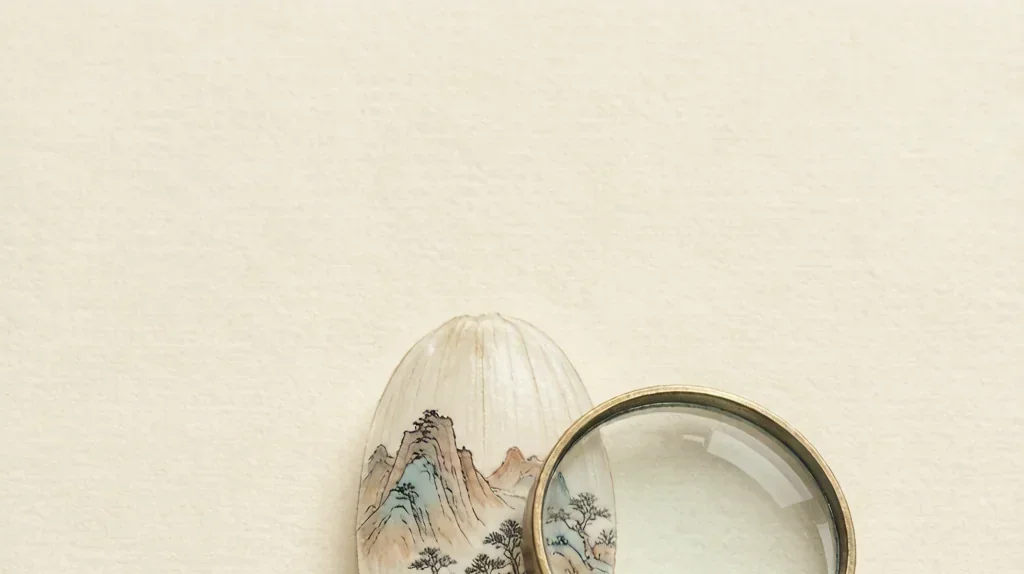
Microcarving is the Chinese art of cutting or engraving minute designs into tiny, often hard surfaces such as ivory, bamboo, peach stone, olive pit, and other small materials. Practitioners work with magnifying aids and extraordinarily fine tools to render landscapes, figures, poems, and entire scenes at a scale where detail is measured in millimeters. Long valued as a feat of patience and precision, microcarving sits at the intersection of sculpture, literati taste, and the delight in objects that reveal themselves only on close inspection. The art answers a distinctly Chinese enthusiasm for the miniature: the idea that the whole world can be folded into a seed, a stone, or a thumb-sized vessel, and that greatness of skill is proved not by size but by the control of the smallest possible mark. In a culture that treasured the scholar's handheld curiosity, the microcarving was the ultimate curiosity, a thing to be carried, shown, and wondered over, and its wonder was the point.
Origins and Early History
The taste for tiny carved objects in China can be traced back many centuries, with earlier examples appearing in jade and bone. The art matured as scholars and collectors came to prize clever, pocket-sized curiosities that could be carried, gifted, or contemplated at a desk, and the miniature fit the scale of scholar life.
By the Ming and Qing dynasties, microcarving had become a recognized specialty, often linked to the world of the scholar's studio and to the broader fashion for ingenious small things. The same era that loved the snuff bottle and the seal loved the pit-boat, and all three shared a cult of the tiny.
The literary record is rich. Classical essays describe carved seeds and stones with wonder, and these accounts did as much as the objects to fix microcarving's reputation, because in China an art that poets praised became an art worth preserving, and the words outlived many of the seeds.
Materials Used
Microcarvers have worked in a surprising range of substances. Olive pits and peach stones were favorites because their tough, fine grain holds crisp detail and their irregular shapes inspired creative compositions. Bamboo, ivory, and animal horn also served, each bringing its own color and resistance.
Each material demands a different touch. Hard, dense substances resist the blade but keep a sharp line, while softer ones are easier but risk chipping at the smallest scale. The carver chooses the substance to match the subject, since a tiny boat wants the toughness of a pit and a tiny poem wants the smoothness of ivory.
Ivory, historically prized for its even grain and pale tone, allowed the finest lettering, which is why so many micro-engraved poems were cut into ivory slips and seals. Modern practice has moved away from ivory for ethical reasons, and contemporary carvers use legal materials while keeping the old methods.
The Olive-Pit and Peach-Stone Tradition
Among the most famous microcarvings are boats and figures carved from a single olive pit or peach stone. Historical accounts describe pits worked into tiny riverboats crowded with miniature passengers, windows, and even inscribed poetry, so that a discarded seed becomes a vessel for an entire scene.
The appeal lies in the contrast: a discarded seed becomes a vessel for an entire scene. Such pieces were treasured as conversation pieces and as proofs of a craftsman's almost impossible control, and a well-carved pit-boat could make a reputation on its own.
The boat form is ideal because it uses the pit's long shape. A carver reads the seed's natural outline as a hull, then hollows cabins, cuts a canopy, and pops tiny figures into the hold, so the object feels discovered rather than imposed, as if the boat had always been waiting inside the stone.
Tools and Technique
The basic toolkit is small and custom-made: tiny steel gravers, fine drills, and sometimes a magnified viewer or loupe. The carver works slowly, removing almost nothing at a time, since a single slip can ruin hours of effort and there is no material to spare for a second try.
Good microcarving depends less on force than on steadiness of hand and breath. Many practitioners train for years before attempting the most delicate inscriptions, and the discipline resembles calligraphy, where control, not strength, makes the line.
Modern optics help but do not replace the hand. A loupe or microscope reveals the work; it does not do it, and the carver must still judge pressure by feel. The tool is an extension of the nerve, and the steadiest workers are those who can slow their own breath to match the cut.
Subjects and Themes
Common subjects include landscapes with tiny pavilions and trees, seated scholars, boats, flowers, and short classical poems. A single peach-stone boat might carry a famous verse engraved along its hull in characters a few millimeters tall, turning the object into a moving anthology.
Themes often draw on literati culture — retreat, friendship, wine, and nature — so the object is both a technical marvel and a small literary gesture. The carver was often a learned man who chose verses that spoke to his own mood, and the piece reads as a kind of miniature confession.
Portraiture at this scale is rare but striking. A face a few millimeters across, cut so that the expression survives, is a test of observation as much as of hand, and the best examples make the viewer lean close and then smile at the life captured in something so small.
Relationship to Snuff Bottles and Seals
Microcarving overlaps with related miniature arts. Inside-painted snuff bottles hide landscape and calligraphy on the inner wall of a tiny vessel, while seal carving packs a name or phrase into a few characters on a stone, and all three delight in compression.
All three share the delight in compression: saying much in little. Collectors of one form often appreciate the others, and some artisans practiced more than one, moving from a pit-boat to a seal to a snuff bottle with the same steady hand and the same love of the small.
The seal deserves emphasis. Seal carving is microcarving's closest relative, because both cut meaning into a hard, handheld stone, and many seal carvers also engraved tiny landscapes on the sides of seals, blurring the line between the two arts so completely that catalogues often list them together.
Famous Historical Accounts
Classical Chinese writing preserves vivid descriptions of microcarved wonders, including pit-boats so detailed that viewers marveled at how a seed could hold a scene. These literary records helped fix the art's reputation as a pinnacle of ingenuity and kept it alive in memory.
Such accounts also show that microcarving was appreciated as much for the wonder it provoked as for any practical use. The object's job was to astonish, and the astonishment was a form of pleasure that the literati especially valued, the pleasure of seeing the impossible made small and holdable.
The records sometimes strain belief, and later writers likely embellished, but the core is reliable: seeds and stones were indeed carved with remarkable finesse, and the survival of a few such pieces in museums confirms that the wonder was real and not merely poetic.
Modern Practice and Preservation
Today microcarving survives through individual artisans and cultural inheritors who teach the craft in workshops and schools. Modern optics and tools make the work somewhat easier, but the patience required has not changed, and the slowness remains the craft's defining condition.
Museums and collectors continue to value historic pieces, and contemporary carvers often exhibit at craft fairs, keeping the tradition visible to new audiences. Some pair old materials with new subjects, carving tiny scenes of modern life into pits and stones to show the art is not frozen.
Preservation faces the usual threats: few apprentices, slow回报, and competition from machine-made novelties. Yet the very difficulty of microcarving protects it, because no machine easily replicates the judgement of a human hand at a millimeter, so the human skill keeps its rare value.
Appreciating a Microcarving
To enjoy a microcarving, look first with the naked eye for the overall form, then with magnification for the hidden detail: a poem, a face, the grain of a tiny plank. The reward is the slow discovery of scale, the moment when a seed becomes a world.
The best pieces balance technique with feeling — precision that serves a scene rather than showing off the carver's steadiness alone. When the skill disappears into the subject, the viewer forgets the difficulty and sees only the little boat, the little poem, the little life, and that forgetting is the highest success.
In the end microcarving teaches humility before scale. It shows that smallness is not the opposite of greatness, that a few millimeters can hold a landscape, a verse, and a lifetime of trained patience, and that the most astonishing things are sometimes the ones we can close in a fist.
❓ Frequently Asked Questions
What is Chinese microcarving?
It is the art of engraving tiny, detailed designs into small hard materials such as olive pits, peach stones, bamboo, and ivory.
What materials are used?
Common materials include olive pits, peach stones, bamboo, ivory, and horn, chosen for fine, dense grain that holds detail.
What is a "pit boat"?
A pit boat is a tiny boat carved from a single olive pit or peach stone, often with figures, windows, and inscribed poetry.
How do carvers work at such scale?
They use custom fine gravers and magnification, removing material slowly and steadily to avoid ruining delicate detail.
Is microcarving still practiced?
Yes; individual artisans and cultural inheritors teach and exhibit the craft, often at museums and craft fairs.
How is it related to snuff bottles?
Both delight in compression and hidden detail; inside-painted snuff bottles share the miniature, literati sensibility.