Lanzhou Hand-Pulled Noodles (兰州拉面, Lánzhōu Lāmiàn), known throughout China simply as 'Lanzhou Lamian,' is far more than a bowl of noodle soup—it is a living artifact of the Silk Road, a testament to centuries of cultural exchange, and one of the most technically demanding dishes in the Chinese culinary repertoire. Originating from Lanzhou, the capital of Gansu Province and the historic gateway between China and Central Asia, this dish carries the flavors of the ancient trade routes in every steaming bowl. The city's position at the crossroads of civilizations meant that merchants, monks, and travelers from across Eurasia passed through, bringing with them spices from Persia, culinary techniques from the Islamic world, and noodle-making traditions from China's heartland. Lanzhou Lamian is the delicious result of this fusion—a dish that combines the hand-pulled noodle artistry of Han Chinese cuisine with the rich beef broths and aromatic spices beloved by the Muslim Hui people who have lived in Gansu for over a thousand years. Today, it is one of the most widely consumed foods in China, with an estimated 50,000 Lanzhou noodle shops across the country serving over 3 million bowls daily, and its popularity continues to spread across the globe.
One Clear, Two White, Three Red, Four Green, Five Yellow
The aesthetic philosophy of Lanzhou Lamian is encapsulated in a five-character mantra known to every noodle master and aficionado: 一清 (yī qīng, one clear), 二白 (èr bái, two white), 三红 (sān hóng, three red), 四绿 (sì lǜ, four green), 五黄 (wǔ huáng, five yellow). These five elements define the visual and gustatory perfection of the dish, and a bowl that fails any one of these criteria is considered incomplete. 'One clear' refers to the broth (汤清, tāng qīng)—a crystalline, amber liquid that must be so transparent you can see the noodles resting at the bottom of the bowl. Achieving this clarity while maintaining deep flavor requires simmering beef bones and meat with a precise blend of spices for six to eight hours, then carefully skimming and filtering until not a trace of cloudiness remains. 'Two white' describes the sliced daikon radish (白萝卜, bái luóbo) that floats in the broth—tender, translucent discs that absorb the beefy essence while providing a clean, slightly sweet counterpoint to the richness. 'Three red' is the chili oil (辣椒油, làjiāo yóu) drizzled on top—a signature element made by infusing oil with a proprietary blend of ground chilies, Sichuan peppercorn, star anise, cinnamon, and sesame seeds, creating a crimson pool that delivers fragrance more than ferocious heat. 'Four green' refers to the generous handful of fresh cilantro and chopped scallions (香菜蒜苗, xiāngcài suànmiáo) sprinkled over the bowl just before serving, their bright, herbaceous freshness cutting through the savory depth of the broth. Finally, 'five yellow' describes the noodles themselves (面黄, miàn huáng)—a pale golden hue achieved through the addition of peng hui (蓬灰), a traditional alkaline mineral powder made from the ashes of a desert plant called pengcao that gives the dough its characteristic color, elasticity, and distinctive 'bite' (筋道, jīndào).
The Ancient Chemistry of Hand-Pulled Noodles
The heart of Lanzhou Lamian lies in the extraordinary art of hand-pulling noodles (拉面, lāmiàn)—a technique that transforms a simple dough of wheat flour, water, and alkaline ash into strands of extraordinary delicacy through a process that resembles alchemy as much as cooking. The secret begins with peng hui, the alkaline powder derived from burning the pengcao plant (蓬草) that grows in the arid lands of Gansu and Inner Mongolia. Chemically similar to kansui used in Japanese ramen, peng hui raises the pH of the dough, strengthening the gluten network and giving the noodles their signature springy texture and yellow tint. Without this alkaline treatment, the dough would tear rather than stretch, and the noodles would lack their characteristic chew.
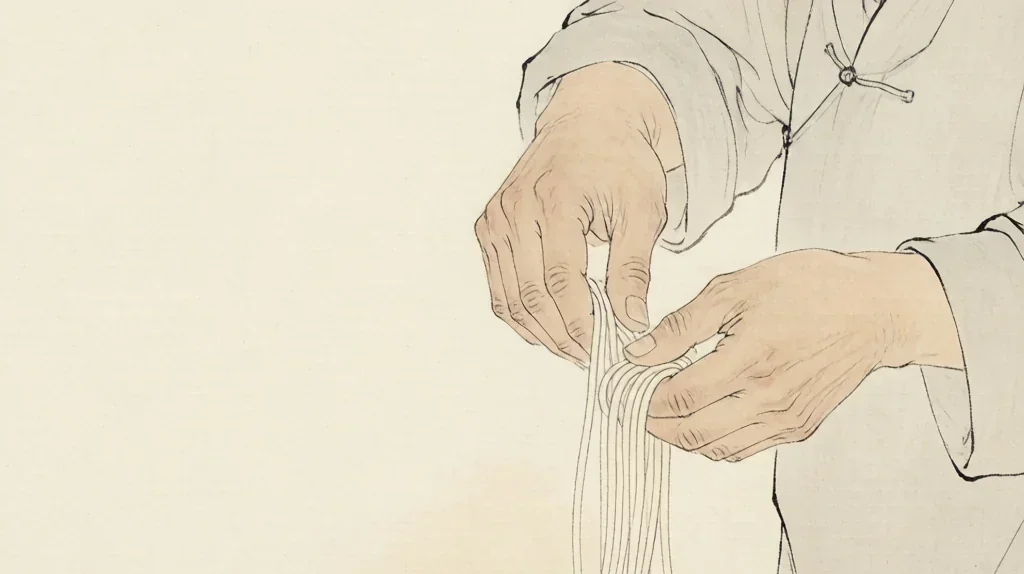
A master noodle puller—known as a lamiàn shīfu (拉面师傅)—begins with a rested piece of dough weighing approximately 500 grams. Through a mesmerizing sequence of stretching, folding, twisting, and slapping against a floured steel table, the single mass of dough is transformed into a cascade of uniform noodles. Each fold doubles the number of strands: one fold yields two strands, two folds yield four, three yield eight, and so on. The shīfu can produce noodles of varying thicknesses by controlling the number of folds and the force of stretching. The thinnest variety, known as 'dragon's whiskers' (龙须面, lóngxū miàn), can be pulled to 12 or even 14 folds—producing 4,096 to 16,384 individual strands from a single lump of dough, each fine enough to pass through the eye of a needle. The standard Lanzhou Lamian noodle is typically pulled through six to eight folds, yielding noodles about 2-3 millimeters in diameter with the ideal balance of tenderness and resilience. This technique takes years to master; apprentices spend their first year simply kneading dough before they are even allowed to attempt pulling noodles for customers.
Silk Road Flavors in a Bowl
The broth of Lanzhou Lamian is a masterpiece of subtlety that reflects the dish's Central Asian heritage. Unlike the aggressively spiced broths of Sichuan or the rich, dark soy-based stocks of eastern China, the Lanzhou broth achieves its depth through patience and precision. The base is beef—specifically, a combination of beef shank, oxtail, and bones that are blanched first to remove impurities, then simmered gently for hours with a carefully guarded spice mix. Each noodle shop guards its spice blend as a trade secret passed down through generations, but common components include star anise, cinnamon, fennel seed, Sichuan peppercorn, ginger, white cardamom, and dried tangerine peel. The spices are bundled in a cloth sachet and removed before serving, contributing fragrance and flavor without clouding the broth or leaving gritty residue.
The beef itself is a critical component. Traditionally, the meat is boiled whole, then removed, pressed under weights to compact the fibers, and sliced paper-thin against the grain just before serving. These translucent slices of beef, with their marbled fat and tender texture, are arranged over the noodles like petals. The combination of chewy noodles, clear broth, meltingly tender beef, crisp radish, fragrant chili oil, and fresh herbs creates a sensory experience that engages every element of taste and texture—salty, savory, spicy, fresh, tender, chewy, and crisp all in a single spoonful.
From Gansu to the World
Lanzhou Lamian has experienced a remarkable transformation from a regional specialty to a national obsession and an emerging global phenomenon. In China, Lanzhou noodle shops are ubiquitous, found in every city from Harbin to Haikou, often recognizable by their green signs with white characters and the sight of a shīfu pulling noodles in the front window. The shops are frequently run by Hui Muslim families from Gansu and Qinghai provinces, who have created a diaspora of noodle entrepreneurs spreading their culinary heritage across the country. The Chinese government has actively promoted Lanzhou Lamian as a cultural export, providing training programs and small-business loans to help Hui families establish noodle shops, which now number in the tens of thousands and generate billions of yuan in annual revenue.
Internationally, Lanzhou Lamian is following in the footsteps of Japanese ramen and Vietnamese pho to become the next Asian noodle soup sensation. Shops have opened in major cities from London to Sydney, Los Angeles to Dubai, introducing global diners to the hypnotic spectacle of hand-pulled noodles and the comfort of a perfectly balanced beef broth. The dish's appeal crosses cultural boundaries—its clean, pure flavors resonate with health-conscious diners, its handcrafted nature appeals to those seeking authentic culinary experiences, and its affordability makes it accessible to everyone. In 2020, the Chinese government officially recognized the 'Lanzhou Beef Noodle Making Technique' as a National Intangible Cultural Heritage, cementing the dish's status as not merely a food but a living tradition worthy of preservation for future generations.
Ordering by Width: The Language of Noodle Thickness
In a Lanzhou shop the first thing you say is not the topping but the width. The craft has a precise vocabulary of thickness, from mao xi, the finest capillary strands, through er xi and the standard widths, to jiu ye, a flat chive-leaf shape, and finally da kuan, a broad ribbon that eats almost like a belt. Each width changes the mouthfeel: thin noodles deliver more broth per bite and suit a lighter finish, while wide ones show off the chew that penghui gives the dough. A skilled master can hit any requested grade from a single lump of dough simply by controlling folds and pull strength. Regulars know their preference the way coffee drinkers know their roast, and asking for the wrong width is a gentle tell that you are a newcomer. Learning the widths is the fastest way to feel like a local in a Lanzhou queue.
The Hui Cooks: A Muslim Culinary Lineage
Lanzhou lamian is inseparable from the Hui, a Chinese Muslim community that has shaped the cuisine for centuries. The dish is halal by tradition: the broth is built from beef and beef bones, never pork, and the spice blend reflects a Central Asian-inflected palate of star anise, cardamom, and Sichuan peppercorn. Hui families from Gansu and Qinghai carried the recipe across China as they opened noodle shops, creating a diaspora of small businesses that now number in the tens of thousands. This Muslim lineage is also why the dish feels different from pork-forward northern foods, and why you will often see Arabic script alongside Chinese on a shop's sign. The Hui connection explains both the clean beef broth and the cultural confidence of a food that wears its faith and its Silk Road history openly, in every bowl.
A Bowl for Breakfast: How Lanzhou Eats Its Noodles
In Lanzhou itself, lamian is not a special-occasion meal but a daily rhythm, most intensely at breakfast. Office workers and students queue before dawn, order by width, and eat standing at the counter, the whole ritual lasting only a few minutes. The bowl is customized at the end with a ladle of chili oil, a handful of cilantro and scallion, and sometimes a side of garlic or a cold dish to cut the richness. Slurping is expected and encouraged, both for speed and because it cools the noodles and lifts the aroma. Prices stay low, which is exactly the point: this is nourishing, hot food for ordinary people, served fast. Travelers who expect a leisurely restaurant experience are often surprised by the standing-counter speed, but that urgency is the authentic local way to take a bowl of Lanzhou.
Lanzhou Lamian and Other Chinese Noodles
Lanzhou lamian belongs to a vast Chinese noodle family but occupies a distinct niche. Unlike Shanxi dao xiao mian, which are shaved into chewy irregular ribbons, Lanzhou noodles are pulled into round, uniform strands defined by their springy bite. They differ from the lo mein and chow mein of eastern China, which are boiled then sauced or stir-fried rather than served in a clear broth. And they are lighter than Chongqing or Sichuan noodle soups, which lean on chili and numbing oil. What sets Lanzhou apart is the marriage of hand-pulling theater with a broth so clear you can see the noodles beneath it, plus the strict five-part color code of clear, white, red, green, and yellow. Understood among its cousins, lamian reads as the restrained, broth-first member of China's noodle chorus, prized for purity as much as for spectacle.