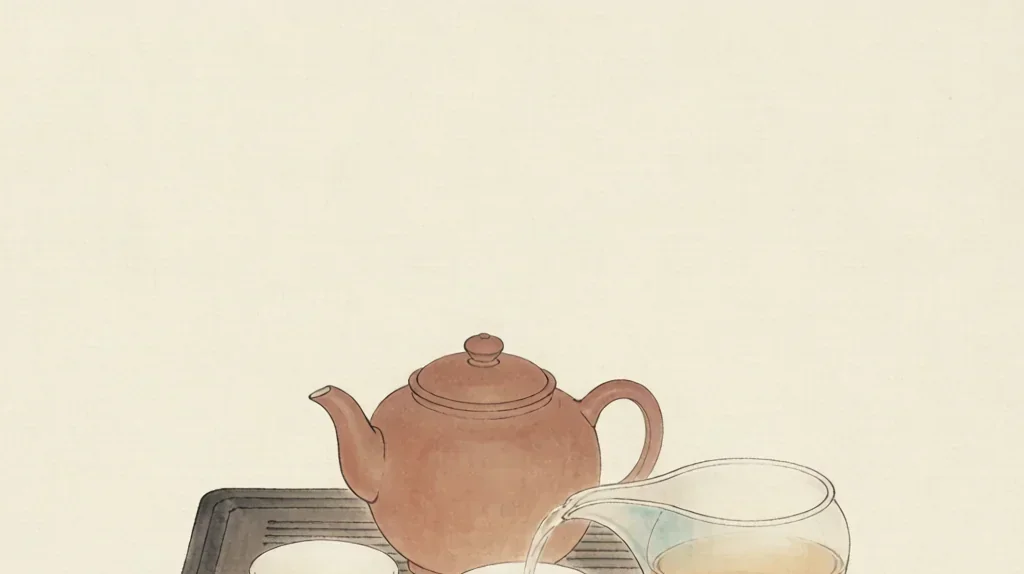
The Gongfu Tea Ceremony (工夫茶, Gōngfū Chá) is one of the most refined and elaborate tea rituals in Chinese culture, originating from the Chaozhou (潮州) region of Guangdong Province in southern China. The term 'gongfu' (工夫) — not to be confused with the martial art 'kung fu' (功夫) — means 'skill cultivated through time and effort,' emphasizing that this is a tea practice requiring patience, precision, and deep appreciation. Unlike the Japanese tea ceremony (茶道, chadō), which emphasizes formal etiquette and spiritual discipline, the Gongfu Tea Ceremony is rooted in the pursuit of the perfect cup of tea, using a precise set of tools and techniques designed to extract maximum flavor from high-quality oolong teas, particularly those from the Wuyi Mountains and Fenghuang Mountain. The ceremony transforms tea drinking from a simple act of refreshment into a meditative sensory experience, where every gesture — from warming the cups to pouring the brew — carries both practical purpose and aesthetic grace.
The Tools of the Trade: Mengchen Pots and Ruochen Cups
At the heart of the Gongfu Tea Ceremony lies an intimate set of specialized tools, collectively known as the 'Four Treasures of Gongfu Tea' (工夫茶四宝). The most essential of these is the teapot, traditionally a small Yixing (宜兴) zisha clay teapot known as a Mengchen Pot (孟臣壶, Mèngchén Hú). These teapots are remarkably small — typically holding only 100 to 150 milliliters of water, about the size of a mandarin orange. Named after Hui Mengchen (惠孟臣), a celebrated Yixing master potter of the Ming Dynasty, these miniature teapots are prized for their unglazed porous clay, which absorbs the essence of the tea with each brewing session, gradually developing a seasoned patina that enhances subsequent infusions. The small size is deliberate: it ensures the leaves are concentrated in a confined space, allowing for multiple short infusions that reveal the tea's evolving flavor profile across many steepings.
The companion to the Mengchen pot is the set of Ruochen Cups (若琛杯, Ruòchēn Bēi), tiny porcelain cups named after another master craftsman, Ruochen, and typically no larger than a walnut shell. These diminutive cups, usually three in number arranged in the shape of the Chinese character 品 (pǐn, meaning 'to taste' or 'quality'), serve both practical and philosophical purposes. Their small size allows the tea to cool quickly for immediate appreciation, while the number three — representing heaven, earth, and humanity — embodies the harmony central to Chinese philosophy. The complete set of tools also includes a tea tray (茶盘, chápán) with a slotted surface for draining water, a tea scoop (茶匙, cháchí) for measuring leaves, a tea needle (茶针, cházhēn) for clearing the spout, and a fairness pitcher (公道杯, gōngdào bēi) to ensure each cup receives an equal pour. Every tool has its role, and mastering their use is part of the gongfu discipline.
The Ritual Steps: From Leaf to Cup
The Gongfu Tea Ceremony unfolds through a sequence of deliberate, poetic movements that transform tea brewing into performance art. The ritual begins with warming the vessels (温壶, wēn hú) — hot water is poured into the teapot and cups to preheat them, ensuring the brewing temperature remains stable. The heated water is then discarded, and the tea leaves are introduced. The first step with the leaves is 'viewing the tea' (赏茶, shǎng chá), where the dry leaves are presented to guests in a tea caddy or on a bamboo tray, allowing appreciation of their appearance and fragrance before brewing.
Next comes the 'black dragon enters the palace' (乌龙入宫, wūlóng rù gōng), where the tea leaves are carefully scooped into the preheated pot. Hot water is poured in a high, steady stream — a technique called 'high mountain, flowing water' (高山流水, gāoshān liúshuǐ) — to agitate the leaves and release their aroma. The first infusion is immediately discarded in a step known as 'washing the tea' (洗茶, xǐ chá) or 'awakening the leaves' (醒茶, xǐng chá), which rinses away dust, moistens the leaves, and prepares them for full extraction. From the second infusion onward, each steep is brief — often only 10 to 30 seconds — with the brewing time gradually increasing through successive rounds. A high-quality oolong can yield eight, ten, or even more infusions, each revealing a different facet of the tea's character: the first steep might present floral top notes, the second a deeper roasted body, and later steeps a lingering sweetness known as 'hui gan' (回甘).
Guan Gong Patrols and Han Xin Counts: The Poetry of Pouring
The most iconic and visually captivating moment in the Gongfu Tea Ceremony is the pouring sequence, described through two vivid historical metaphors. The first is 'Guan Gong Patrols the City' (关公巡城, Guān Gōng Xún Chéng), named after the legendary Three Kingdoms general Guan Yu, who was known for his unwavering loyalty and vigilance. In this movement, the tea master pours the brewed tea into the tiny cups in a continuous, circular motion, moving the pot back and forth across the row of cups without stopping — just as Guan Gong would ride through the city walls on patrol, distributing his attention equally among all sectors. This technique ensures that each cup receives tea of the same strength, as the liquor at the beginning of the pour is lighter and the end is stronger. The circular motion blends the two seamlessly.
The second metaphor is 'Han Xin Counts His Troops' (韩信点兵, Hán Xìn Diǎn Bīng), referencing the brilliant Han Dynasty general Han Xin, famed for his strategic precision. After the main pour is complete, the tea master tilts the pot and lets the last concentrated drops fall one by one into each cup — like a general counting his soldiers to ensure none is missed. This final distribution guarantees that every guest receives the fullest expression of the tea's flavor. These two pouring techniques embody the dual values of fairness (equitable distribution) and attention to detail (ensuring no drop is wasted), transforming what could be a mundane act into a performance rich with cultural resonance. Guests are expected to appreciate not just the taste of the tea but also the skill and grace of the pour, often expressing admiration with a gentle tap of the fingers on the table — a gesture known as 'finger kowtow' (叩指礼, kòu zhǐ lǐ), said to originate from Emperor Qianlong traveling incognito and thanking his servant without revealing his identity.
Gongfu Tea vs. Japanese Chanoyu: Two Paths, One Leaf
While both the Chinese Gongfu Tea Ceremony and the Japanese Chanoyu (茶の湯, 'the way of tea') share deep historical connections — Japanese tea culture was, after all, brought from China by Buddhist monks — they have evolved into remarkably different practices. The Japanese tea ceremony, heavily influenced by Zen Buddhism and codified by the tea master Sen no Rikyū (千利休) in the 16th century, is fundamentally a spiritual and aesthetic discipline. Every element — the architecture of the tea room, the placement of utensils, the seasonal flower arrangement, even the sound of water boiling — is orchestrated to create an atmosphere of wabi-sabi (侘寂), an appreciation of rustic simplicity and the beauty of imperfection. The ceremony can last up to four hours and follows a strict, unchanging sequence of prescribed movements and phrases.
The Gongfu Tea Ceremony, by contrast, is centered on the tea itself. While it certainly possesses meditative qualities, its primary aim is to brew the best possible cup of tea. The ritual is more flexible, with variations depending on the tea being served, the preferences of the host, and the occasion. It is also inherently social — while the Japanese ceremony often features a single guest of honor, Gongfu tea is typically shared among a small group of friends or family, with conversation flowing freely between steeps. The Chinese practice emphasizes sensory pleasure: the visual beauty of the leaves unfurling, the evolving aromas released with each infusion, the changing color of the liquor, and the layered flavors on the palate. If Japanese tea ceremony is a path to enlightenment through aesthetic discipline, Gongfu tea is a path to conviviality and appreciation through sensory mastery. Both, however, share a common root in the belief that tea, when approached with mindfulness and skill, can elevate the ordinary into the extraordinary.
The Four Pillars: Respect, Harmony, Frugality, and Tranquility
Beyond the technical mastery of water temperature, steeping time, and pouring technique, the Gongfu Tea Ceremony embodies four core spiritual values: Respect (敬, jìng), Harmony (和, hé), Frugality (俭, jiǎn), and Tranquility (静, jìng). Respect is expressed in every gesture — the host carefully warms the cups for the guests, pours with equal attention to each person, and offers the first cup to the eldest or most honored participant. Guests, in turn, show respect by appreciating the tea with full attention, holding the tiny cup with both hands, and savoring the aroma before drinking. The entire ceremony operates on a foundation of mutual courtesy.
Harmony is the essence of the brewing process itself — the water must be at just the right temperature, neither too hot to scald the leaves nor too cool to extract properly; the steeping time must be perfectly balanced to avoid bitterness or weakness; the tea master's movements must flow in a harmonious rhythm. Frugality is reflected in the small scale of the ceremony: tiny pots, tiny cups, and the practice of using every last drop. This is not about austerity but about the Confucian ideal that true richness lies in quality, not quantity — a single perfect sip is worth more than a pot of careless tea. Tranquility is the atmosphere the ceremony creates — the gentle sound of water, the quiet focus on the brewing process, the calm rhythm of repeated infusions. In the noisy, fast-paced world of modern China, the Gongfu Tea Ceremony offers a pocket of stillness, a space where time slows down and the only thing that matters is this cup, this moment, this shared experience. These four pillars connect the Gongfu Tea Ceremony to the broader philosophical traditions of Confucianism, Daoism, and Buddhism that have shaped Chinese civilization for millennia.
Water and Heat: The Hidden Variables
Gongfu brewing lives or dies on two quiet variables: water and heat. Practitioners prefer soft, sweet water — spring or filtered — because harsh minerals flatten a tea's aroma, and they warm the vessels first so the brewing temperature does not crash on contact. The heat itself is tuned to the leaf: delicate green and white teas want water around 80 to 85 degrees so the leaves do not scorch and turn bitter, while oolong, black, and pu'er need a full rolling boil to open up. Because each infusion is so short, a few degrees of error shows immediately in the cup. Enthusiasts speak of the 'water level' (shuǐ wèi) as a skill in itself, judging when to pour and when to wait. Mastery here is invisible — no fancy move, just the right temperature held steady through a dozen steepings. The leaf gets its chance to speak only when the water is right.
Choosing the Leaf: Teas Suited to Gongfu
Gongfu method suits teas that reward many infusions, especially oolong, pu'er, and dark teas, whose leaves unfurl slowly and change from steep to steep. A rolled Tieguanyin might open from tight green pellets into full leaves over eight rounds; a aged pu'er can keep giving for twenty. High-quality black teas and white teas also work, offering a gentler arc, while delicate green teas are usually given cooler water and shorter time so they do not bitter. The method is less kind to chopped, bagged tea, which dumps all its flavor at once and has nothing left to reveal. Choosing the leaf is therefore part of the art: a good gongfu session starts with a whole-leaf tea worth revisiting a dozen times. The equipment exists to serve the leaf, not the other way around.
Gongfu Tea in Daily Life Today
Once the preserve of Chaozhou households and connoisseurs, gongfu tea is now a living hobby across China. Tea shops in Shanghai, Chengdu, and Shenzhen invite customers to sit for a multi-round tasting, and a compact travel set — a tiny pot, three cups, and a tray — fits in a backpack for picnics and office breaks. Young people have taken it up as a slower alternative to coffee-cup takeout culture, sharing infusions over talk the way past generations did. Online communities trade tips on water, timing, and famous mountains, and festivals celebrate the craft. Far from being a museum piece, the ceremony has become a small daily luxury: ten minutes, one portion of leaves, and a pocket of calm. It proves the old idea that mindfulness need not be solemn — sometimes it is just a good cup, poured with care, again and again.