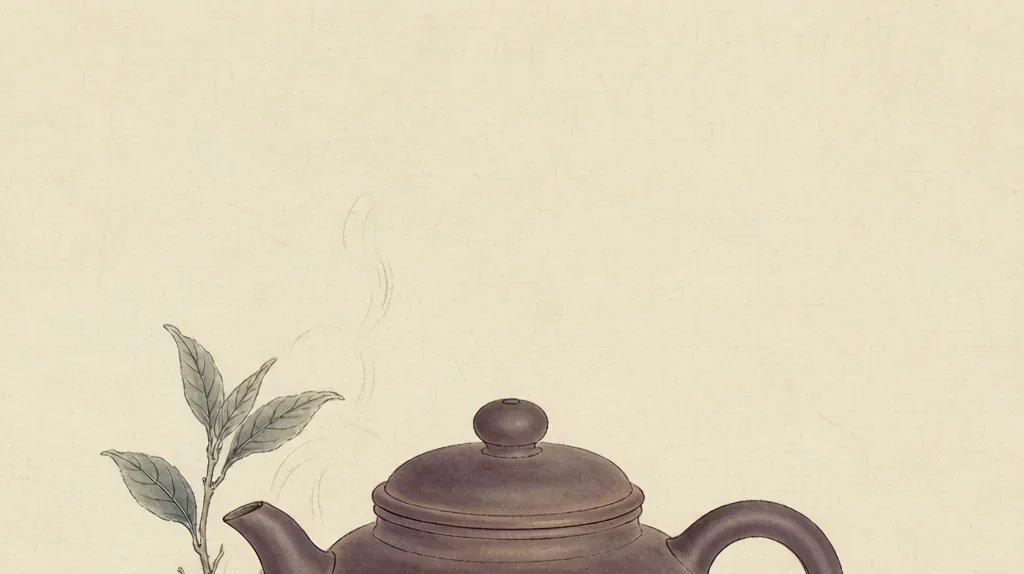
In the pantheon of Chinese cultural artifacts, few objects embody the marriage of function and art as perfectly as the Yixing zisha teapot. Produced from the unique purple clay (紫砂, zǐshā) deposits found only in the hills surrounding Yixing (宜兴), a county-level city in southern Jiangsu Province, these unglazed stoneware teapots have been the vessel of choice for China's most discerning tea drinkers for over five hundred years. What makes a zisha teapot extraordinary is not merely its aesthetic beauty — the rich, earthy colors, the organic forms, the masterful craftsmanship — but its unique material properties. The clay's distinctive porous, double-pore structure allows the pot to 'breathe,' absorbing trace amounts of tea oils with each use while allowing heat and moisture to dissipate gently, a quality that tea connoisseurs describe as 'brewing tea without stealing its flavor' (泡茶不走味, pào chá bù zǒu wèi). Over time, a well-used zisha teapot develops a seasoned interior that enhances the flavor of subsequent infusions, becoming more valuable with each brew. A Yixing teapot is not merely a tool for making tea; it is a living object, a companion that matures alongside its owner, and for many Chinese tea lovers, it is the most intimate and cherished possession they will ever own.
The Five-Colored Earth: Zisha Clay Varieties
The foundation of every Yixing teapot is the extraordinary clay from which it is made — a material so distinctive that it has been designated as a protected geographical indication by the Chinese government. The term 'zisha' (紫砂) literally means 'purple sand,' but the clay deposits of Yixing actually encompass a palette of natural colors that artisans poetically call 'the five-colored earth' (五色土, wǔ sè tǔ). These clays are not artificially colored; their hues derive from the specific mineral compositions — primarily iron oxide, quartz, mica, and kaolinite — found in different strata of the Huanglong Mountain (黄龙山) deposits, the most famous source of zisha clay.
The three principal varieties are zini (紫泥, purple clay), zhuni (朱泥, vermilion clay), and duanni (段泥, duan clay). Zini, the most common and versatile, fires to a range of deep purples and reddish-browns depending on kiln temperature and atmosphere. It has a medium porosity that works well with most tea types, particularly oolong and black teas. Zhuni, with its higher iron oxide content, fires to a brilliant orange-red or cinnabar hue. It is the densest and least porous of the three, with a fine, almost glassy texture when polished, and is prized for use with high-aroma teas like lightly oxidized oolongs, as it preserves and intensifies fragrance. Duanni, a naturally occurring blend of different clay strata, fires to a warm, creamy beige or golden-yellow, and is the most porous variety, making it ideal for green and white teas whose delicate flavors benefit from the clay's breathability. Beyond these primary types, master potters also blend clays to achieve specific colors and properties — adding crushed minerals or mixing different clay varieties to create teapots in hues of blue-green (本山绿泥, běnshān lǜ ní), dark brown, or even near-black. The clay itself is processed through a laborious preparation that involves weathering the mined ore outdoors for months, grinding it to a fine powder, mixing it with water, kneading it to remove air bubbles, and aging it — sometimes for years — before it is ready for the potter's wheel. This meticulous preparation is essential to achieving the smooth, dense surface and the precise shrinkage control required for the tight-fitting lids that are the hallmark of a well-made zisha teapot.
Masters of Clay: Gong Chun and Shi Dabin
The history of Yixing teapots is inseparable from the lives and works of the master potters who elevated utilitarian clay vessels into objects of artistic reverence. The legendary originator of Yixing teaware is Gong Chun (供春), who lived during the Zhengde reign of the Ming Dynasty in the early 16th century. According to tradition, Gong Chun was a servant in the household of a scholar who studied at the Jinsha Temple near Yixing. While his master attended to his studies, Gong Chun observed the temple's monks crafting crude clay vessels and became fascinated by the material. He began to experiment on his own, using the natural clay from the temple grounds, and eventually shaped a teapot that mimicked the gnarled, textured surface of an old tree knot — a design that became known as the 'Gong Chun teapot' (供春壶), the prototype of Yixing artistry. Though only a handful of authenticated Gong Chun pieces survive — and even those are debated by scholars — his legacy as the father of Yixing teapots is unquestioned, and his name is invoked with reverence by every subsequent generation of potters.
The golden age of Yixing teapots began in the late Ming Dynasty with the emergence of Shi Dabin (时大彬), widely regarded as the greatest zisha master in history. Working in the late 16th and early 17th centuries, Shi Dabin revolutionized teapot design by moving away from the large, coarse pots of earlier periods to create smaller, more refined vessels — a shift that coincided with the rise of the Gongfu Tea Ceremony and its preference for intimate, hand-sized teapots. Shi Dabin's genius lay in his ability to balance form and function: his teapots poured perfectly, with smooth, unbroken streams that did not drip; their lids fit with such precision that they seemed to merge with the body; and their proportions achieved a harmony that felt both natural and inevitable. He also pioneered the practice of signing his work with a seal impressed into the base of each pot, transforming the teapot from an anonymous craft object into a signed work of art. Shi Dabin's influence was so profound that for centuries, any fine zisha teapot was simply referred to as a 'Dabin pot.' The tradition of master potters continued through the Qing Dynasty with figures like Chen Mingyuan (陈鸣远), known for his nature-inspired forms — teapots shaped like pumpkins, tree trunks, bamboo joints, and lotus seed pods — and Yang Pengnian (杨彭年), who collaborated with the scholar-artist Chen Mansheng (陈曼生) to create the 'Mansheng Eighteen Styles,' a series of teapot designs that integrated calligraphy and poetry directly onto the clay surface, fusing the art of the potter with the art of the literatus.
Breathing Clay: The Science of Porous Perfection
What truly distinguishes a Yixing zisha teapot from porcelain, glass, or glazed ceramic vessels is its unique physical structure at the microscopic level. Zisha clay, when fired at temperatures between 1100 and 1200 degrees Celsius, develops a distinctive 'double-pore structure' (双重气孔结构, shuāngchóng qìkǒng jiégòu) — a network of both open and closed pores distributed throughout the clay body. The open pores form interconnected channels that allow air and moisture vapor to pass slowly through the walls of the pot, while the closed pores trap minute amounts of tea liquor within the clay matrix. This structure is the result of the clay's natural mineral composition: the quartz particles in the clay provide a rigid skeleton, while the mica and kaolinite create the fine, interconnected porosity. When examined under an electron microscope, the surface of a zisha teapot reveals a landscape of microscopic channels and cavities — a structure that is impossible to replicate with artificial materials.
This porosity produces several practical benefits that tea connoisseurs have treasured for centuries. First, it provides natural thermal insulation: the trapped air in the closed pores slows heat loss, keeping tea warm for longer than a glazed vessel of the same thickness. Second, it allows the pot to 'breathe' during brewing, releasing excess steam and preventing the tea leaves from stewing — a crucial advantage when brewing delicate oolong teas that require precise temperature control. Third, and most significantly, the porous walls gradually absorb the essential oils and aromatic compounds of the tea brewed within them, a process known as 'seasoning' (养壶, yǎng hú). Over months and years of dedicated use, the interior of the pot develops a glossy, dark patina, and the pot itself begins to contribute subtle flavor notes to subsequent brews — not enough to adulterate the tea, but just enough to add depth and roundness. This is why serious zisha collectors dedicate each pot to a single type of tea (one for Tieguanyin, another for pu'er, yet another for black tea), ensuring that the seasoning remains pure and the flavors do not cross-contaminate. The relationship between a tea drinker and their zisha pot is thus cumulative and deepening: the pot becomes more valuable — both functionally and sentimentally — with every infusion.
Raising the Pot: The Culture of Yang Hu
The practice of 'raising a pot' (养壶, yǎng hú) is one of the most intimate rituals in Chinese tea culture, transforming the relationship between object and owner into something approaching companionship. A new zisha teapot arrives from the potter raw and unseasoned, its surface matte and slightly rough to the touch. Before its first use, it undergoes an initial 'opening' ceremony (开壶, kāi hú): the pot is simmered in clean water, sometimes with a small amount of the tea it will be dedicated to, to remove any residual clay dust, open the pores, and begin the seasoning process. This is followed by its first proper brewing session, where the hot tea begins its slow work of penetrating the clay.
From that moment forward, the daily ritual of yang hu unfolds. After each brewing session, the tea leaves are removed, and the pot is rinsed only with hot water — never soap or detergent, which would strip away the accumulating oils and impart unwanted flavors. The exterior of the pot is gently polished with a soft, dry cloth while it is still warm from the rinse, a motion that gradually burnishes the surface to a deep, lustrous sheen. Over months, the pot's color deepens and enriches; over years, it develops a jade-like translucency that seems to glow from within; over decades, the seasoning becomes so profound that pouring hot water into an empty pot releases a faint but unmistakable fragrance of the teas it has brewed over a lifetime. This is the ultimate goal of yang hu: to create a pot that is so thoroughly seasoned, so deeply infused with the essence of tea, that it has become irreplaceable — a unique object that embodies the history of every cup ever brewed within it.
The philosophy underlying yang hu reflects broader Chinese cultural values. There is a Confucian dimension — the cultivation of character through patient, daily practice. There is a Daoist dimension — the appreciation of natural processes, the beauty of things shaped by time rather than artifice. And there is a deeply personal dimension — the pot becomes a companion through the years, a silent witness to conversations, solitary reflections, and the quiet rhythms of daily life. As the Chinese saying goes, 'One pot, one life' (一壶一人生, yī hú yī rénshēng): the teapot and its owner grow old together, each enriching the other through the shared experience of tea.
Shapes and Artistic Forms
Yixing teapots are celebrated as much for their forms as for their clay. Across the centuries, potters have drawn shapes from nature and scholarly life: pumpkin and gourd pots, sections of bamboo, lotus pods, tree-stump textures, and smooth pebble-like ovals. The most admired pieces achieve a balance where the spout, lid, handle, and body feel like one continuous gesture, so the pot sits comfortably in the hand and pours without dripping. Some masters inscribed calligraphy or poetry onto the surface, turning the vessel into a small canvas. Because each pot is shaped by hand or pressed in a personalized mold, no two are identical, and the form itself becomes a signature. The result is a teaware tradition where utility and sculpture are impossible to separate.
The Tea Ceremony Connection
The rise of the small Yixing pot is tied directly to the Gongfu tea ritual that matured in Fujian and Guangdong. As connoisseurs began brewing oolong and later pu-erh in many short infusions, they needed a vessel that held heat, breathed gently, and fit two cupped hands. The unglazed purple clay was ideal: it seasoned to the tea, kept the liquor warm, and poured with control. A full session became a choreography of warming the pot, rinsing the leaves, and pouring in arcs, with the Yixing vessel at its center. The pot was not merely a tool but a partner in the performance, its evolving patina a record of countless sittings. In this way the teapot and the ceremony grew up together, each shaping the other.
Collecting and Authenticity
Because fine Yixing ware commands high prices, the market is crowded with fakes, and learning to judge a pot has become its own discipline. Collectors inspect the clay's grain, the fit of the lid, the evenness of the pour, and the clarity of the maker's seal impressed into the base. Antique pots by named masters can fetch fortunes, while contemporary work is valued for both craft and the artist's reputation. Government limits on mining have made original clay scarce, adding to the premium on authenticated material. Serious buyers favor pots with a documented lineage or a respected living maker, and many keep each acquisition dedicated to one tea. The hunt for a genuine, well-made pot is part of the pleasure, blending connoisseurship with the patience the teaware itself teaches.
Zisha in Contemporary Life
Yixing teapots are no longer only the pursuit of connoisseurs. Workshops in Jiangsu still train new masters, and factories produce affordable machine-assisted pots that bring the shape and feel of purple clay to ordinary households. Young urban drinkers, rediscovering tea as a calm alternative to coffee, have adopted small Yixing pots for daily brewing, often sharing them on social media. Designers collaborate with traditional potters on updated forms, and some makers experiment with lighter clays or modern silhouettes. Yet the old values persist: a pot is meant to be used, raised slowly, and kept for life. Whether humbly mass-produced or painstakingly hand-made, the Yixing teapot remains a living craft, bridging a Ming-dynasty invention and the routines of the present day.