Picture a winter evening in Chengdu. Outside, the Sichuan mist has settled in, cold and damp, the kind of chill that seeps into your bones. Inside, a table of friends sits around a brass pot divided by a metal partition into two swirling halves—one a deep, chili-laden crimson, the other a pale, mushroom-fragrant broth. Steam rises, carrying the scent of star anise, Sichuan peppercorn, and beef tallow. Chopsticks dart in and out of the pot, depositing thin slices of lamb, curls of tofu skin, and crisp lotus root. Faces are flushed, conversations are loud, and the meal will continue for hours. This is hot pot (火锅, huǒ guō)—the most social, the most democratic, and arguably the most beloved meal in China.
Hot pot is not just food. It is an event. Unlike a banquet, where dishes arrive from the kitchen fully formed, hot pot puts the cooking in the hands of the diners. You choose what goes in, you decide how long it cooks, you compose your own dipping sauce. The meal is collaborative and interactive in a way that few other dining formats can match. It is impossible to eat hot pot alone and have the same experience. Hot pot demands company, and it rewards it with warmth, variety, and the particular intimacy that comes from sharing food from a single pot.
Origins: From Mongolian Steppes to Imperial Palace
The most widely accepted origin story of hot pot places its birth on the Mongolian steppes, among the nomadic horsemen of Genghis Khan's armies. According to legend, Mongol warriors would gather around a campfire, fill their metal helmets with water or broth, and cook strips of meat—usually lamb or horse—directly in the boiling liquid. The method was practical: it required minimal equipment, cooked food quickly, and fed many people from a single heat source. As the Mongol Empire expanded across Asia, the practice spread, evolving and adapting to local ingredients and tastes.
By the time of the Qing Dynasty (1644–1912), hot pot had become a favorite of the imperial court. The Qianlong Emperor was said to be particularly fond of it; records indicate that he hosted a banquet featuring 1,550 hot pots to celebrate his longevity, serving over 5,000 guests. The imperial version was elaborate, with intricately designed copper pots, premium ingredients, and carefully calibrated broths. But hot pot never lost its democratic character. Even as emperors enjoyed it in the Forbidden City, commoners in every province were cooking their own versions over charcoal braziers in homes and street stalls.
The Two Great Traditions: Beijing and Chongqing
Chinese hot pot is not a single dish but a family of traditions, and the two most iconic branches could hardly be more different.
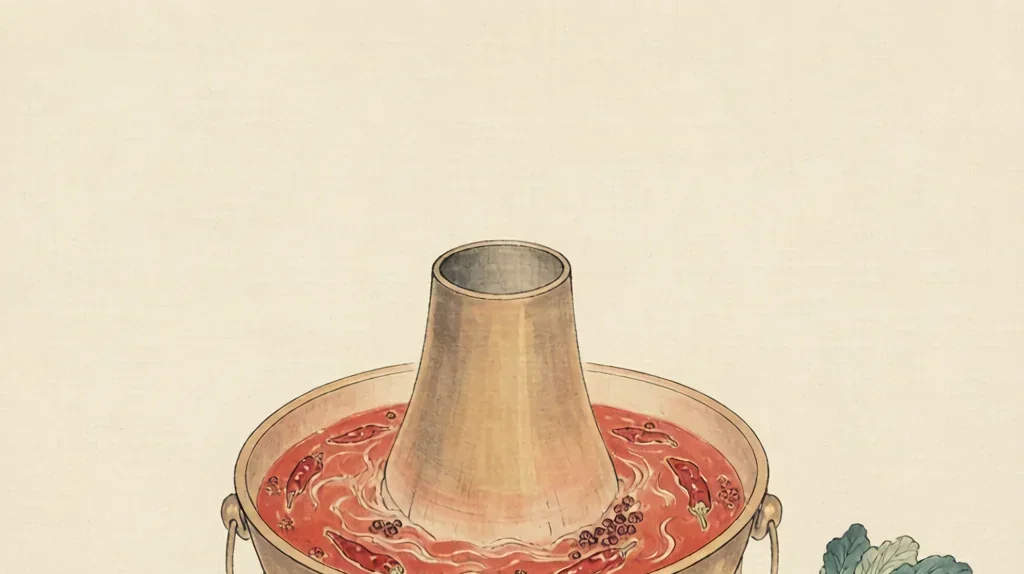
Beijing Hot Pot (北京涮羊肉, Běi jīng shuàn yáng ròu) — The northern style, often called "instant-boiled lamb," is a study in restraint. The pot is a distinctive copper vessel with a tall chimney in the center, heated by charcoal burning inside. The broth is simple—often just water with scallions, ginger, and goji berries—because the focus is entirely on the quality of the lamb. The meat, sliced paper-thin from frozen leg of lamb, is swished through the boiling water for mere seconds until it turns from pink to brown. It is then dipped in a sesame-based sauce (芝麻酱, zhī ma jiàng) mixed with fermented tofu, chive flower paste, and chili oil. The experience is clean, pure, and almost minimalist—the opposite of what most people expect from Chinese food.
Beijing hot pot is a winter ritual. Restaurants specializing in it are packed from November through February, their windows fogged with steam, their tables crowded with platters of lamb, cabbage, glass noodles, and frozen tofu. The meal ends, traditionally, with a bowl of the now-flavorful broth, enriched by everything that has been cooked in it, accompanied by a sesame flatbread (烧饼, shāo bǐng) to soak up the last drops.
Chongqing Hot Pot (重庆火锅, Chóng qìng huǒ guō) — If Beijing hot pot is a string quartet, Chongqing hot pot is a full orchestra playing at top volume. The broth is the star: a deep, dark, incendiary liquid made from beef tallow, mountains of dried chilies, Sichuan peppercorns, fermented bean paste, and a dozen spices. The pot is often divided into sections—a "nine-grid" pot (九宫格, jiǔ gōng gé) is traditional—allowing different ingredients to be cooked in different compartments without mixing. The broth is not just a cooking medium; it is the soul of the meal, growing richer and more complex as the evening progresses.
Chongqing hot pot emerged from the laboring classes of this Yangtze River port city. Dock workers and boat trackers needed cheap, filling, warming food, and the offal that more affluent diners rejected—tripe, aorta, intestines—was abundant and affordable. To this day, tripe (毛肚, máo dù) remains the quintessential Chongqing hot pot ingredient, its honeycomb texture perfectly engineered to trap the spicy broth. The heat of Chongqing hot pot is not a gimmick; it is a response to the city's famously humid, sweltering climate. In traditional Chinese medicine, eating hot, spicy food causes the body to sweat, which cools you down. It sounds paradoxical, but ask any Chongqing native on a 38-degree summer day, and they will tell you: the cure for heat is more heat.
The Art of Dipping Sauce
The dipping sauce (蘸料, zhàn liào) is where the diner becomes the chef. Every hot pot restaurant provides a sauce station with an array of ingredients, and every region has its orthodox combination. In the north, the base is sesame paste (芝麻酱, zhī ma jiàng), thinned with water and enriched with fermented tofu, chive flower paste, chili oil, and cilantro. The sesame paste coats the mouth and tempers the heat while adding its own nutty richness.
In Chongqing and Sichuan, the orthodox sauce is dramatically simpler: sesame oil (香油, xiāng yóu) with minced garlic and a pinch of salt. The oil serves a dual purpose—it cools the food as it coats it, and it protects the stomach from the intense heat of the broth. Some Chongqing purists will add nothing else. Others will customize with oyster sauce, vinegar, chopped peanuts, and fresh chilies. The sauce station is a place of personal expression, and the debates about the correct combination can be as passionate as any political argument.
In the Cantonese tradition, the dipping sauce often features raw egg yolk beaten with soy sauce and scallions, which creates a rich, velvety coating for the cooked ingredients. In Yunnan, the sauce might include fermented bean paste, ground peanuts, and fresh herbs. The variety is endless, and exploring different combinations is one of the great pleasures of hot pot.
What Goes into the Pot
The ingredient list for hot pot is limited only by imagination. The essentials include:
- Meats: Paper-thin slices of lamb (northern style), beef, pork belly, chicken. The slicing is critical—the meat must be thin enough to cook in seconds, thick enough to retain its texture.
- Offal: Tripe, aorta, kidney, liver, tongue—the "other" parts that hot pot aficionados often prefer to prime cuts. Tripe, in particular, is beloved for the way its textured surface captures the broth.
- Seafood: Shrimp, fish fillets, squid, fish balls, shrimp paste. Freshness is paramount; the cooking time is brief.
- Tofu: Firm tofu, frozen tofu (which becomes spongy and absorbs broth like a sponge), tofu skin, tofu puffs. Frozen tofu is a revelation to first-timers—its porous structure drinks the broth and releases it in a burst when bitten.
- Vegetables: Napa cabbage, tong hao (chrysanthemum greens), spinach, lotus root, potato, winter melon, mushrooms of every variety—enoki, shiitake, king oyster, wood ear.
- Noodles and Starches: Glass noodles, udon, rice cakes, dumplings. These are typically added near the end of the meal to absorb the now-intensely-flavored broth.
The order of cooking matters. Meats and offal go in first, flavoring the broth. Tofu and mushrooms follow, absorbing those flavors. Vegetables go in next, cooking quickly. Starches come last, to soak up everything. Veterans know the rhythm; novices learn it through trial and error and occasional gentle correction from their dining companions.
Hot Pot Etiquette: The Unwritten Rules
Hot pot has its own code of conduct, learned through experience and rarely stated aloud. You do not put your chopsticks directly into your mouth and then back into the communal pot—use the serving chopsticks or ladle provided. You do not double-dip. You do not fish around in the pot for a specific piece; find it, pick it up, and move on. You pay attention to cooking times—overcooked meat is a tragedy, undercooked meat is a health hazard. You share, you refill others' drinks, and you never, ever rush a hot pot meal. The meal is done when the conversation is done, not when the food is gone.
There is also the question of the broth at the end of the meal. In Beijing, drinking the enriched broth with sesame flatbread is a cherished ritual. In Chongqing, the broth—now a concentrated, oily, intensely spicy liquid—is rarely consumed directly. But many restaurants will package it for you to take home, where it becomes the base for a next-day noodle soup or stir-fry. Waste is not in the hot pot vocabulary.
Hot Pot Around the World
Hot pot has spread globally with the Chinese diaspora and, more recently, with the rise of hot pot chains like Haidilao, which has brought the experience to cities from Los Angeles to London. Each new location adapts the format to local tastes—Japanese shabu-shabu is a direct descendant of northern Chinese hot pot, Thai suki is a Southeast Asian cousin, and Swiss fondue shares the same communal, dip-it-yourself DNA. But the Chinese versions remain the most varied and the most deeply embedded in social life.
In China itself, regional variations continue to multiply. There is Hainan-style hot pot with coconut milk broth, Guizhou-style with sour tomato broth, Yunnan-style with wild mushroom broth, and Northeastern-style with pickled cabbage broth. Each version reflects its region's climate, agriculture, and temperament. Together, they form a map of China that you can taste.
The next time you gather around a bubbling pot with friends, chopsticks in hand, faces flushed with steam and spice, remember that you are participating in a tradition that stretches back to the campfires of Mongol horsemen. Hot pot has conquered empires, crossed oceans, and won hearts on every continent. It is the meal that cooks itself while you talk, the meal that brings people together over a single flame, the meal that proves, definitively, that the best food is the food you share.
📝 Chinese Vocabulary
- 火锅 (huǒ guō) — Hot pot, literally "fire pot"
- 涮 (shuàn) — To swish or dip briefly in boiling liquid, the core hot pot technique
- 芝麻酱 (zhī ma jiàng) — Sesame paste, the base of northern-style dipping sauce
- 九宫格 (jiǔ gōng gé) — Nine-grid pot, the traditional Chongqing hot pot vessel
- 毛肚 (máo dù) — Tripe, the most beloved Chongqing hot pot ingredient
Hot Pot and Health: Warming From Within
In traditional Chinese medicine, eating hot and spicy food is not seen as a summer contradiction but as a remedy. The theory holds that sweating induced by chili and Sichuan peppercorn helps the body release internal heat and cope with humid weather, which is why Chongqing natives happily eat fiery hot pot on sweltering days. Modern nutrition tells a simpler story: a hot pot meal built around lean slices, tofu, and abundant vegetables can be balanced and light, while one dominated by fatty meats and oily broth is rich. The communal format also encourages slow eating and sharing, which supports portion moderation. The practical wisdom is to vary ingredients, alternate spicy and mild broths, and finish with broth rather than only oil. Viewed this way, hot pot is less a guilty indulgence than a flexible template that can lean healthy or hedonistic depending entirely on what you choose to cook.
The Hot Pot Vessel: From Copper Chimney to Divided Pot
The vessel is half the experience. The classic Beijing pot is a copper cauldron with a tall central chimney where charcoal burns, heating a clear broth around the rim and giving the meat a subtle smoky note. Chongqing's tradition favors a wide, shallow vessel, often divided into a nine-grid layout so different items cook in separate compartments without mingling. The yuan yang, or mandarin duck pot, splits the broth into a spicy side and a mild side, letting a table of mixed tolerance eat from one source. Today many home and restaurant pots run on induction or electric burners, with built-in dividers and precise heat control. What unites them is the central flame and the shared rim: the pot is not just cookware but the physical center of the meal, the object around which conversation and chopsticks orbit for hours.
❓ Frequently Asked Questions
🎉 Fun Facts
- The Qianlong Emperor of the Qing Dynasty once hosted a hot pot banquet for 5,000 guests, featuring 1,550 individual pots—a record that still stands in the annals of hot pot history.
- Chongqing hot pot restaurants often serve their broth in pots that have been used continuously for years—the broth is never fully discarded, only replenished, creating an ever-evolving "master stock."
- Haidilao, China's most famous hot pot chain, is legendary for its customer service: while you wait for a table, you can get a free manicure, shoeshine, or snack on unlimited sunflower seeds.
- The divided yuan yang pot lets diners with different spice tolerance share one meal, with the mild half traditionally placed on the right so right-handed guests can reach it easily.
- Chongqing hot pot was added to China's National Intangible Cultural Heritage list in 2009, recognizing its broth-craft and communal eating ritual as cultural heritage worth protecting.
- In many northern households the meal ends with the enriched broth and a sesame flatbread, and the copper pot itself is often a family heirloom passed down through generations.