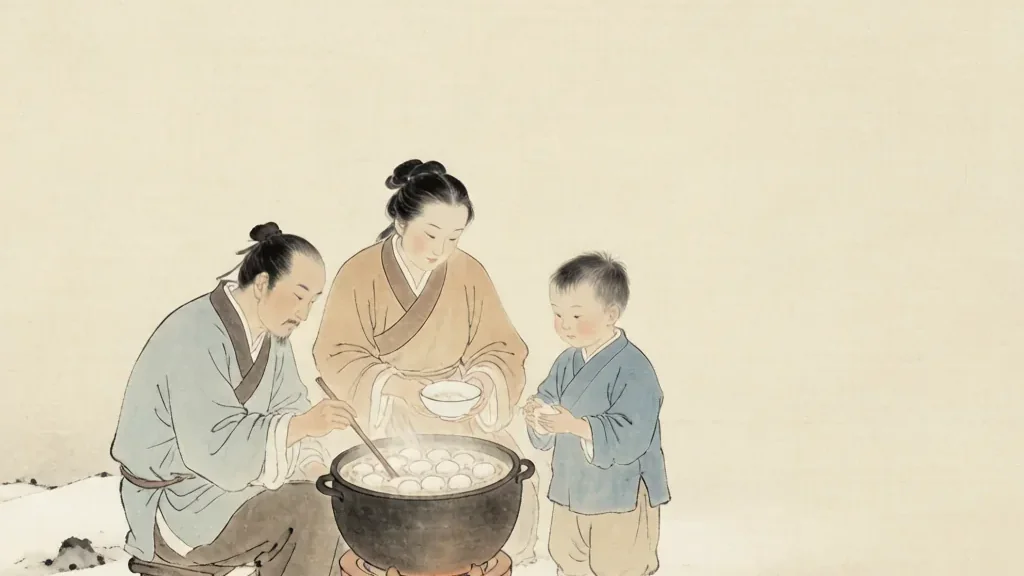
On the longest night of the year, when the sun reaches its southernmost point and the shadows stretch their furthest across the land, Chinese families gather around steaming bowls of food to celebrate Dongzhi (冬至, Dōngzhì) — the Winter Solstice Festival. It is one of the oldest and most important festivals in the Chinese calendar, older than the Spring Festival itself, and it carries a message of extraordinary hope: from this moment on, the darkness begins to retreat, and the light returns.
The ancient Chinese observed the heavens with remarkable precision. As early as the Zhou Dynasty (1046–256 BCE), astronomers used a sundial called a gui (圭) to measure the length of shadows cast by the sun. They discovered that on one particular day each year, the noon shadow was the longest it would ever be — the day when the sun was farthest south, when daylight was shortest and night was longest. That day they named Dongzhi, which literally means "Winter's Extreme" or "Winter's Arrival." It falls on or around December 21st or 22nd in the modern Gregorian calendar.
In the traditional Chinese understanding of the cosmos, the universe is governed by the interplay of yin and yang — the two opposing yet complementary forces. The winter solstice is the moment of peak yin: the coldest, darkest, most still point of the year. But it is also the turning point. From Dongzhi onward, yang begins to grow. The days grow longer. Warmth slowly returns. It is the seed of spring hidden within the depths of winter. For this reason, Dongzhi was sometimes called the "Little New Year" (小年, xiǎonián) — a time of renewal, reunion, and the quiet birth of a new cycle.
The Physician Who Healed a Whole City
The most beloved story associated with Dongzhi is the origin of the dumpling (饺子, jiǎozi) — and it begins with a man of medicine, not a man of myth. His name was Zhang Zhongjing (张仲景, Zhāng Zhòngjǐng), and he lived during the Eastern Han Dynasty (25–220 CE). Zhang is one of the most revered physicians in Chinese history, often called the "Medical Sage" (医圣, yī shèng). His masterwork, the Treatise on Cold Damage (伤寒论), laid the foundations of Chinese clinical medicine and is still studied by practitioners today.
The story goes that Zhang Zhongjing was returning to his hometown in Nanyang, in present-day Henan Province, around the time of the winter solstice. It was a bitter winter. The land was frozen, the wind cut like a knife, and snowdrifts lined the roads. As Zhang traveled, he saw something that broke his heart: the poor people of the countryside, unable to afford warm clothing or adequate food, were suffering terribly. Many had frostbitten ears — ears so blackened and cracked by the cold that some were rotting away. The peasants wrapped their heads in rags, but there was little they could do against the merciless winter.
Zhang Zhongjing could not simply walk past. He stopped his journey and set up a great medical tent by the roadside. He decided to prepare a remedy that would warm the body from within and heal the frostbitten ears. He called it "Qūhán Jiāo'ěr Tāng" (祛寒娇耳汤) — "Cold-Dispelling Tender-Ear Soup."
The First Dumplings
Zhang Zhongjing's recipe was ingenious. He took lamb, hot peppers, and warming medicinal herbs and chopped them finely together. Then he wrapped small portions of this filling in small rounds of dough, folding each one into the shape of an ear — pinching the edges together so that each little parcel curved like a human ear. He dropped these "tender ears" into boiling broth and cooked them until they floated to the surface, plump and steaming.
From the winter solstice until New Year's Eve, Zhang and his disciples served the soup freely to the suffering people. Each patient received two of the ear-shaped dumplings in a bowl of hot broth. The warming lamb and herbs drove the cold from their bodies, and the hot soup nourished their weakened systems. Miraculously — or rather, through the good doctor's medical wisdom — their frostbitten ears began to heal. The blackened flesh recovered. The pain subsided. The people were saved.
The "tender ears" — jiao'er (娇耳) — became known over time as jiaozi (饺子), the modern Chinese word for dumpling. The shape of the dumpling, that familiar crescent curved like an ear, is a living memory of Zhang Zhongjing's compassion. Every winter, when northern Chinese families fold dumplings by the hundreds on the eve of Dongzhi, they are reenacting a two-thousand-year-old act of healing.
Tangyuan: The Southern Tradition
While northern China honors Dongzhi with dumplings, southern China celebrates with a completely different food: tangyuan (汤圆), sweet glutinous rice balls. The contrast between the two traditions is one of the most charming features of the festival.
Tangyuan are small, round balls made from glutinous rice flour, filled with sweet pastes of black sesame, peanut, red bean, or sweet osmanthus. They are simmered in boiling water until they float, then served in their own sweet soup, sometimes with fermented rice wine (酒酿, jiǔniàng) or osmanthus flowers. The roundness of tangyuan is deeply symbolic: the Chinese word yuan (圆) means both "round" and "complete," and it sounds like the word for "reunion" (团圆, tuányuán). Eating tangyuan on Dongzhi represents family togetherness and the hope for completeness and harmony in the coming year.
In some regions, the tangyuan are colorful — pink, green, yellow, and white — made by mixing vegetable juices into the rice flour. In Sichuan and parts of the south, families also prepare a savory version. But everywhere, the meaning is the same: a circle has no end, and so may the family remain unbroken.
A Festival of Reunion
Above all, Dongzhi is a festival of family reunion. There is an old Chinese saying: "Winter solstice is as big as the New Year" (冬至大如年, dōngzhì dà rú nián). Historically, Dongzhi was a time when even those who had traveled far would strive to return home. Government offices closed. The emperor offered sacrifices to Heaven. Ordinary families slaughtered a chicken or a duck, made offerings to their ancestors, and sat down together for the most important meal of the winter season.
In Hong Kong and southern China, this tradition remains especially strong. Families gather for a feast that almost always includes tangyuan, and everyone is expected to be present. There is a folk belief that if you do not eat tangyuan on Dongzhi, you will not age a year — which sounds like a blessing until you realize it means you will not "grow" and will be left behind. Better to eat your tangyuan and grow with your family.
The festival also carries a quiet, philosophical message. The ancients saw in the solstice a profound truth about life: that the darkest moment is also the moment when light begins to return. That after the coldest night, the warmth must come. That endings and beginnings are woven together. The return of the sun — yáng shēng (阳生), "the birth of yang" — is not a dramatic reversal but a slow, certain turning, like a seed that has been resting in frozen earth finally beginning to swell.
Traditions Across China
Beyond dumplings and tangyuan, Dongzhi customs vary widely. In Ningxia and parts of the northwest, families drink a warm mutton soup that is believed to drive out the cold. In Fujian and Taiwan, families prepare a savory rice-and-meat dish called "winter solstice rice" (冬至米). In Jiangnan (the region around Shanghai and the lower Yangtze), red bean porridge is eaten — a tradition linked to an ancient belief that the ghost of a wronged man named Gonggong appeared on Dongzhi, and that red beans could ward off his evil influence.
In many regions, families also make ancestral offerings on Dongzhi, sweeping tombs and presenting food to honor those who came before. The festival is thus both a celebration of the living family gathered around the table and a moment of connection with the ancestors whose memory keeps the family whole across generations.
Today, Dongzhi may not have the fireworks of the Spring Festival or the lanterns of Yuanxiao, but it holds a special warmth in the Chinese heart. It is the festival of the longest night — and the promise that the light is coming back. When you fold a dumpling into the shape of an ear, or float a round tangyuan in a bowl of sweet soup, you are joining a chain of memory that stretches back two thousand years to a physician's tent by a frozen road, where one man's compassion gave a whole city back its warmth.
Counting the Nines to Spring
Dongzhi begins the coldest stretch of the year, and Chinese tradition meets it with a gentle countdown called 'counting the nines' (shu jiu). From the solstice, people mark eighty-one days in blocks of nine, since nine was seen as the fullest expression of winter's yin. A favorite pastime was to draw a branch with eighty-one plum blossoms and color one petal every nine days; when the last flower was filled, spring had arrived. Folk rhymes describe each period, from the ice-bound first nine to the thawing final one. The practice turned a long, dark season into something measurable and hopeful, a quiet game against the cold. It also gave households a shared calendar apart from the moon, a way to watch winter pass petal by petal until the days were warm again.
The Astronomy Behind the Solstice
Long before modern instruments, Chinese astronomers tracked Dongzhi with care. Using a sundial-like stone marker called a gui, they measured the noon shadow cast by the sun and found the day when it stretched longest, proof that the sun had reached its southern extreme. That observation placed Dongzhi as one of the twenty-four solar terms, the calendar that divided the year by the sun's position to guide farming. The festival thus rests on precise sky-watching, not only on story. Because the solstice is the pivot between shrinking and growing daylight, it was read as the moment yin peaked and yang began to rise. Emperors offered sacrifices to Heaven on this day, and farmers used it to time the slack of winter. The astronomy explains why Dongzhi felt like a turning point: it literally is one, written in the length of a shadow.
Honoring Ancestors at Dongzhi
Dongzhi is a time for the living family and for the dead. Across many regions, households sweep ancestral graves and set out offerings of food, often the very dumplings or tangyuan eaten that night, to keep the memory of previous generations present at the table. The act joins the reunion of the living with respect for those who came before, a way of saying the family line stays unbroken across death as well as distance. In Fujian, Taiwan, and parts of the south, the grave-tending is especially careful, blending the warmth of the meal with the solemnity of the visit. Because the solstice was historically a moment when even officials returned home, the day gathered everyone, past and present, into a single circle. The food, the graves, and the gathering together make Dongzhi not just the longest night but the most rooted one.
❓ Frequently Asked Questions
📝 Chinese Vocabulary
冬至 — : Winter Solstice, literally "winter's extreme." The 22nd of the 24 solar terms, marking the longest night and the return of yang energy.
饺子 — : Dumplings. Ear-shaped dough parcels filled with meat or vegetables, invented according to legend by Zhang Zhongjing to cure frostbite.
汤圆 — : Sweet glutinous rice balls served in soup. Their roundness symbolizes family reunion and completeness.
张仲景 — : The Han Dynasty physician (c. 150–219 CE) known as the "Medical Sage," credited with creating the first dumplings.
祛寒娇耳汤 — : "Cold-Dispelling Tender-Ear Soup," Zhang Zhongjing's original lamb-and-herb dumpling broth that healed frostbitten ears.
阳生 — : The 'birth of yang,' the solstice turning point when light begins to return.
数九 — : The custom of counting nine-day periods from Dongzhi until spring.
酒酿 — : Fermented glutinous rice wine, often added to tangyuan soup.
🎉 Fun Facts
- Dongzhi is one of the 24 solar terms (二十四节气), a calendar system developed by the ancient Chinese to track seasonal changes. It is the only solar term that became a major festival.
- The dumpling's Chinese name jiaozi (饺子) was originally written as jiao'er (娇耳), meaning "tender ear" — a direct reference to the dumpling's ear-like shape and its healing purpose.
- The phrase "Winter solstice is as big as the New Year" (冬至大如年) reflects Dongzhi's historical importance. During the Han Dynasty, government officials actually had a holiday on Dongzhi to rest and reunite with family.
- Traditional Chinese medicine views Dongzhi as a key time for nourishing the body (进补, jìnbǔ). Many people eat foods like lamb, ginger, and walnut on this day to strengthen their constitution for the winter.
- In Taiwan, Dongzhi tangyuan are sometimes made with a single especially large rice ball inside the pot. Whoever finds the big tangyuan is said to be blessed with good fortune in the coming year.
- After Dongzhi, households traditionally begin 'counting the nines' (shu jiu), marking the eighty-one days to spring by filling in one petal of a plum-blossom drawing every nine days.