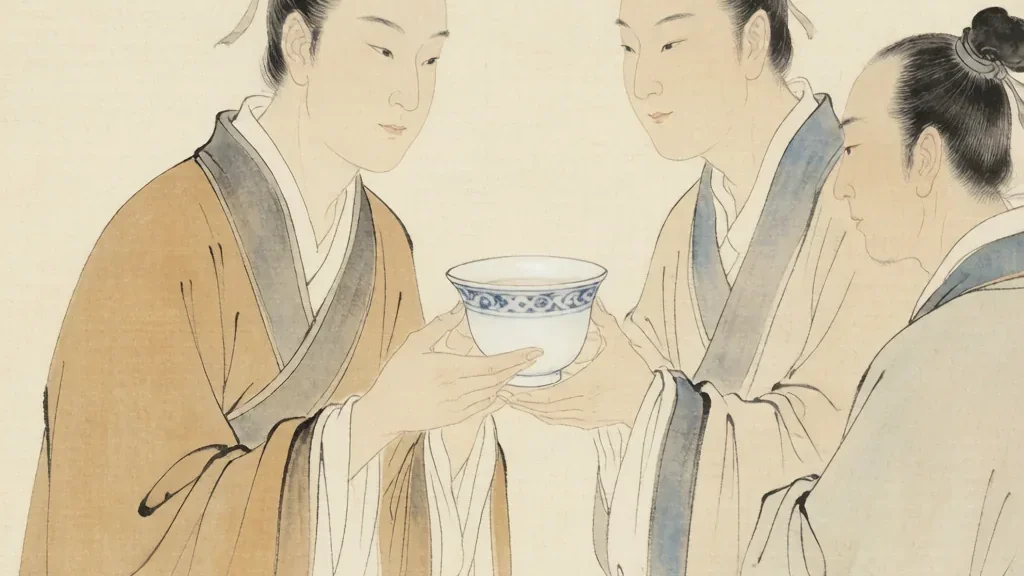
Fill a small porcelain cup with a clear liquid, hold it up with both hands, turn to your host, and drain it in one swallow. The host does the same. The cup is refilled. You turn to the next person at the table, the gesture is repeated, and again the cup is refilled. By the end of the meal, dozens of toasts have been exchanged, the conversation has grown louder and warmer, and a small ceremony of mutual respect has been performed — one cup at a time. This is 中国酒文化 (zhōng guó jiǔ wén huà), "Chinese wine culture," and it is one of the most enduring, elaborate, and — to outsiders — sometimes intimidating social rituals in the world.
To call it "wine culture" is, however, slightly misleading. The English word "wine" suggests grape wine, but the Chinese 酒 (jiǔ) is broader: it means any alcoholic beverage, and the drinks at the center of Chinese drinking culture are not grape wines but yellow wine (黄酒, huáng jiǔ) — brewed from grain — and baijiu (白酒, bái jiǔ) — distilled from grain. Grape wine, though known in China since the Han Dynasty, was a minor presence until the modern era. The dominant Chinese alcoholic tradition is a grain tradition, with a history older than recorded civilization itself.
Nine Thousand Years of Chinese Drinking
In 2004, archaeologists excavating the Neolithic village of Jiahu (贾湖) in Henan Province made a startling discovery. Chemical analysis of pottery sherds dating to around 7000 BCE — nine thousand years ago — revealed residues of a fermented beverage made from rice, honey, and fruit (hawthorn or grape). This is the oldest known alcoholic beverage in the world, predating the earliest grape wines of the Middle East by some two thousand years. Whatever else may be said about Chinese culture, it can be said with confidence: the Chinese have been drinking for a very long time.
By the Shang Dynasty (c. 1600–1046 BCE), alcohol was central to both religious ritual and aristocratic life. Shang bronze vessels — extraordinary objects in their own right — were largely made for the pouring and drinking of alcohol in ancestor-worship ceremonies. The Shang rulers were notorious for their drunkenness; the founding document of the succeeding Zhou Dynasty, the "Announcement Against Drink" (酒诰, jiǔ gào), castigated the last Shang king for his intemperance and made excessive drinking a punishable offense for Zhou officials. The tension between alcohol as sacred ritual and alcohol as moral danger runs through all of Chinese history.
Through the Han, Tang, Song, Yuan, Ming, and Qing dynasties, alcohol production and consumption grew ever more sophisticated. New brewing techniques were developed; new grain varieties were cultivated specifically for brewing; regional styles emerged. The Tang Dynasty (618–907) was perhaps the golden age of Chinese drinking, an age when the greatest poets wrote their greatest poems drunk, and when the culture of the banquet reached a refinement that later ages would imitate but never quite equal.
Yellow Wine: The Ancient Brew
The oldest continuing tradition of Chinese alcohol is yellow wine (黄酒, huáng jiǔ), a brewed beverage made from rice or millet, fermented with a unique Chinese ingredient called qu (曲, qū). Qu is a culture of mold, yeast, and bacteria grown on cooked grains — a kind of "fermentation starter" that simultaneously breaks down the grain's starches into sugars and ferments those sugars into alcohol. This dual process, called parallel fermentation, is unique to East Asian brewing and produces a beverage of remarkable complexity, with flavors ranging from sweet to dry, nutty, savory, and umami.
The most famous yellow wine is Shaoxing wine (绍兴酒, shào xīng jiǔ), from the city of Shaoxing in Zhejiang Province. Shaoxing wine is aged in clay jars for years — sometimes decades — and develops a deep amber color and a rich, complex flavor that pairs well with food (it is also used extensively in Chinese cooking, especially in red-braised dishes). A traditional Shaoxing family would brew a jar of wine when a daughter was born and bury it, to be dug up and drunk at her wedding — a custom that gave Shaoxing wine its alternative name of "daughter's wine" (女儿红, nǚ'ér hóng). Yellow wine is typically drunk warm, in small porcelain cups, and is considered more of a literary, contemplative drink than baijiu — the drink of poets and scholars rather than of toasts and banquets.
Baijiu: The Spirit of Modern China
The dominant Chinese spirit today is baijiu (白酒, bái jiǔ), "white liquor" — a distilled spirit typically between 35% and 65% alcohol by volume, making it one of the strongest spirits in the world. Distillation was introduced to China (or independently developed) during the Yuan Dynasty (1271–1368), probably via the Middle East. The new technology was applied to the traditional grain-and-qu brewing process, producing a spirit of extraordinary character.
Baijiu is classified by its aroma profile, which is determined by the production method and the grains and qu used. The four major categories are:
· Sauce aroma (酱香, jiàng xiāng) — complex, savory, soy-sauce-like, with a long finish. The prototype is Maotai (茅台, máo tái) from Guizhou Province, the most famous (and most expensive) baijiu in the world, made from sorghum and distilled in a complex year-long process involving nine steamings, eight fermentations, and seven distillations. Maotai is the official state liquor of China, served at state banquets and gifted to foreign dignitaries; a bottle can cost hundreds or even thousands of dollars.
· Strong aroma (浓香, nóng xiāng) — fruity, floral, and intense. The most popular style by far, accounting for over 70% of baijiu production. Famous brands include Wuliangye (五粮液) from Sichuan, made from five grains (sorghum, wheat, rice, glutinous rice, corn), and Luzhou Laojiao (泸州老窖).
· Light aroma (清香, qīng xiāng) — clean, light, and slightly sweet. The prototype is Fenjiu (汾酒) from Shanxi, one of the oldest baijiu brands, lighter and more accessible than the strong-aroma style.
· Rice aroma (米香, mǐ xiāng) — soft, floral, with a distinct rice sweetness. Common in southern China and Southeast Asia; Sanhua Jiu (三花酒) from Guilin is a representative brand.
For a Western drinker, baijiu is an acquired taste — and many never acquire it. The flavors are pungent, funky, and unlike any Western spirit. But for the Chinese, baijiu is the spirit of celebration, business, friendship, and family — the drink that oils the wheels of every important social occasion. By volume, baijiu is the most consumed spirit in the world, and Maotai is the most valuable liquor brand on earth.
Li Bai: The Poet Who Drank the Moon
No figure embodies Chinese wine culture more fully than the Tang Dynasty poet Li Bai (李白, 701–762 CE). Li Bai was, by any measure, one of the greatest poets in the Chinese language — and also one of its most legendary drinkers. He wrote freely and often about wine: of drinking alone with the moon, of drinking with friends on the river, of drinking to forget exile and disappointment, of drinking to find the Dao. His poem "Drinking Alone Under the Moon" (月下独酌) begins with one of the most famous lines in Chinese poetry:
Among the blossoms, a single jar of wine.
No one else here, I bare myself to heaven.
I raise my cup to invite the moon.
He, my shadow, and I — three companions.
The legend of Li Bai's death is, fittingly, a wine legend. According to popular tradition, he was drinking on a boat on the Yangtze at night, leaned over the side to embrace the reflection of the moon in the water, fell in, and drowned. The story is almost certainly apocryphal — historical records suggest he died of illness — but it captures something essential about the poet's image: a man so in love with wine and moonlight that the boundary between them dissolved. His contemporary and friend Du Fu (杜甫) wrote a poem listing the "Eight Immortals of the Wine Cup," a group of Tang notables famous for their drinking; Li Bai appears in the list, described as drinking "a hundred cups" before composing "a hundred poems."
Li Bai was not alone. The Tang Dynasty produced a remarkable constellation of drinking poets — Wang Wei, Bai Juyi, Du Fu himself — for whom wine was both muse and metaphor. The convention that "one cup of wine makes a poem" became a literary cliché: the poet drinks, the inspiration comes, the poem is born. This association of alcohol with artistic creation is one of the most distinctive features of Chinese literary culture and persisted through the Song and Ming into modern times.
Drinking Games and Banquet Rituals
The Chinese banquet is a structured social event, and the drinking within it follows elaborate conventions. The most basic unit is the toast (敬酒, jìng jiǔ): one person raises a cup to another, often with a brief speech of respect or affection, and both drink. The toaster holds the cup with both hands, may clink it against the other's cup lower as a sign of deference (the lower the cup, the greater the respect), and then drains it. The person toasted is expected to reciprocate later in the meal.
At formal banquets, the host makes the first round of toasts to the most honored guests, then to the table as a whole. Then the guests toast the host, then each other. Subtle hierarchies are negotiated through the order and depth of toasts: toasting an elder before they toast you shows respect; refusing a toast from a senior is a serious discourtesy. The phrase "干杯" (gān bēi, "dry cup") means "drain your glass" — equivalent to "bottoms up" — and is the most common toast. To drink only a sip when "干杯" is called is to slight the toaster.
To make the drinking more festive, the Chinese developed a wide variety of drinking games (酒令, jiǔ lìng), some of great antiquity. The most elegant were literary: one player recites a line of classical poetry, and the next must recite a line that follows it, or that rhymes, or that contains a specific character. Failure means a forfeit — a cup of wine. Other games involve guessing fingers (划拳, huá quán), where two players simultaneously shout a number from 0 to 10 and extend that many fingers; if the sum of the extended fingers equals one of the two shouted numbers, that player wins and the loser drinks. The shouts — traditional, rhymed, sometimes bawdy — are one of the loudest and most joyful sounds of a Chinese banquet, and a good player is admired as a master of speed, memory, and arithmetic.
A more sophisticated game uses flower sticks (花签, huā qiān) — slips of bamboo or paper drawn from a cup, each bearing a line of poetry, the name of a flower, and a rule about who must drink. Drawing the "Peony" stick might require the oldest person at the table to drink; drawing the "Plum Blossom" might require the newest friend to drink; the "Willow Catkin" might require everyone to drink. The game combines literature, chance, and gentle social engineering — and it has the practical function of distributing the drinking evenly, so that no one is singled out or left out.
Wine and the Rites: The Sacred Dimension
Beyond the banquet, alcohol has always had a sacred dimension in Chinese culture. The earliest bronze vessels of the Shang Dynasty were made for offering alcohol to ancestors — a practice that continues today in the form of pouring wine on the ground at Qingming (tomb-sweeping) or before a wedding altar. A cup of wine is offered to the ancestors at the New Year's eve dinner; a few drops are splashed on the ground at a building site to bless the earth; a glass is poured at the grave of a departed friend. In each case, the wine is a medium between the living and the dead, the visible and the invisible — a tradition older than writing itself.
The Wedding Ceremony includes the "cross-cupped wine" (交杯酒, jiāo bēi jiǔ): the bride and groom, arms linked, each drink from a cup, then exchange cups and drink again. The act seals the marriage as surely as a signed contract — and the shared cup symbolizes the shared life to come. At the Dragon Boat Festival, realgar wine (雄黄酒, xióng huáng jiǔ) — wine infused with the mineral realgar — was traditionally drunk to ward off evil spirits and disease, especially by children (whose foreheads were marked with the wine in lieu of drinking). At the Double Ninth Festival, chrysanthemum wine was the prescribed drink, believed to promote longevity. Every festival, in short, has its proper wine — and drinking it is part of the ritual, not a departure from it.
Modern Drinking: From Banquets to Craft
Modern Chinese drinking culture is a complex blend of tradition and change. Business banquets still revolve around baijiu and the rituals of toasting — to refuse a toast from a senior business partner is, in many industries, a serious social misstep, and the amount of baijiu consumed at a single banquet can be staggering. (Foreign business travelers to China often have stories of being toasted into submission.) At the same time, younger urban Chinese are drinking differently: beer is the most popular alcoholic drink by volume, wine (especially red wine) has become a status symbol since the 2000s, and craft cocktails and craft baijiu have begun to attract a new generation of connoisseurs. The old literary drinking culture — the "drink a hundred cups, write a hundred poems" ideal — has largely faded, but its shadow is still visible in the way Chinese friends drink together: not to get drunk, but to deepen the bond, to mark the occasion, to honor the host and the guest, and to invite, for a few hours, the warm loosening of social formality that alcohol uniquely provides.
What endures, across nine thousand years, is the conviction that drinking is never just drinking. To share wine with someone is to make a small contract of trust; to toast them is to declare, briefly and physically, the value you place on their presence. The Chinese have made of this simple act one of the world's most elaborate drinking cultures — a culture that is, for all its occasional excess, fundamentally about connection. As the old saying goes: "酒逢知己千杯少" (jiǔ féng zhī jǐ qiān bēi shǎo) — "When wine meets a true friend, even a thousand cups is too few."
The Craft of Qu: China's Unique Fermentation
What sets Chinese grain alcohol apart from Western beer and wine is the qu, a fermented starter of mold, yeast, and bacteria cultivated on steamed grain. Instead of separate steps, qu performs two jobs at once: its enzymes convert the rice or millet starch into sugar, and its microbes then turn that sugar into alcohol, a process called parallel fermentation. This dual action, found across East Asia but developed with special refinement in China, yields the layered, savory, sometimes umami character of yellow wine and the deep aroma of baijiu. The maker's art lies in choosing and tending the qu, controlling temperature and time through many steamings and fermentations. Understanding qu explains why Chinese alcohol tastes unlike any grape wine, and why regional styles differ so sharply by the starter and grain each workshop uses.
❓ Frequently Asked Questions
📝 Chinese Vocabulary
酒 — : the general Chinese word for any alcoholic beverage, including brewed yellow wine, distilled baijiu, and grape wine — a broader category than English "wine."
白酒 — : "white liquor"; the distilled grain spirit that is the dominant Chinese alcoholic drink today, classified by aroma profile (sauce, strong, light, rice) and ranging from 35% to 65% ABV.
黄酒 — : "yellow wine"; the ancient brewed rice or millet wine of China, fermented with qu (mold-and-yeast starter), of which Shaoxing wine is the most famous.
干杯 — : "dry cup"; the most common Chinese toast, equivalent to "bottoms up" — both parties drain their cups completely.
酒逢知己千杯少 — : "When wine meets a true friend, even a thousand cups is too few" — the classic Chinese proverb on drinking with friends.
曲 — : the fermentation starter, a cultivated culture of mold, yeast, and bacteria grown on cooked grain that both breaks starch into sugar and ferments it into alcohol.
敬酒 — : the toast; one person raises a cup to another with a word of respect, and both drink, the lower-held cup showing deference.
酒令 — : drinking games; the varied contests, from reciting poetry to guessing fingers, used to enliven and pace a banquet.
🎉 Fun Facts
- The oldest known alcoholic beverage in the world was discovered at the Neolithic village of Jiahu, China — a fermented rice, honey, and fruit brew dated to 7000 BCE, some two thousand years older than the earliest Middle Eastern grape wines.
- The Tang poet Li Bai — one of the greatest poets in the Chinese language — was so associated with wine that legend says he died leaning from a boat to embrace the moon's reflection in the river.
- Maotai, the famous sauce-aroma baijiu from Guizhou, is so valuable that a single vintage bottle can sell for thousands of dollars — making it the most valuable liquor brand on earth, and the official state spirit of China.
- The 'daughter's wine' custom of Shaoxing had families bury a jar of wine when a girl was born and dig it up for her wedding, aging the gift across her childhood.
- At the Dragon Boat Festival, realgar wine was drunk and dabbed on children's foreheads to repel evil spirits and disease, a use of alcohol as protection rather than celebration.
- The Zhou Dynasty 'Announcement Against Drink' is among the earliest state documents warning against drunkenness, showing that China's tension between alcohol as ritual and as danger is thousands of years old.