China is often described as divided between a wheat-eating north and a rice-eating south, and while the reality is more nuanced, there is truth at the heart of this generalization. The vast wheat fields of the Yellow River basin gave rise to an entire civilization of flour-based foods known collectively as 面食 (miàn shí)—a category that encompasses noodles, dumplings, buns, pancakes, and every conceivable transformation of wheat flour and water. This is not merely a set of recipes; it is a culture, a way of life, and arguably one of the most significant contributions China has made to global gastronomy.
Archaeological evidence suggests that noodles were being made in China at least 4,000 years ago. A well-preserved bowl of millet noodles, discovered at the Lajia archaeological site in Qinghai Province, dates back to around 2000 BCE, making it the oldest known noodle in the world. The Chinese have been shaping dough into edible forms for longer than most civilizations have existed. Over those four millennia, they have developed a repertoire of noodle and dumpling types so vast that no single person could eat their way through all of them in a lifetime.
Wheat and Rice: Two Culinary Civilizations
To understand Chinese noodle and dumpling culture, one must first understand the fundamental geographic and agricultural divide that shaped it. Northern China, with its cold winters and relatively dry climate, is wheat country. The staple grain is ground into flour and transformed into noodles, steamed buns (馒头, mán tou), stuffed buns (包子, bāo zi), pancakes, and dumplings. Southern China, with its warm, wet climate and terraced rice paddies, is rice country. Here, the staple appears as steamed rice, rice noodles (米粉, mǐ fěn), rice cakes, and rice porridge (粥, zhōu).
This divide is not absolute—rice noodles are beloved in the south, and wheat noodles have spread everywhere—but it explains fundamental differences in food culture. Northern meals tend to be hearty and wheat-based, built around a main starch that is often the star of the show. Southern meals tend to feature rice as a neutral backdrop for the dishes that accompany it. The Chinese phrase 南米北面 (nán mǐ běi miàn)—"rice in the south, wheat in the north"—captures this duality perfectly.
The Art of Hand-Pulled Noodles (拉面)
If there is one image that captures the magic of Chinese noodle culture, it is the Lanzhou lamian master at work. A lump of dough, already rested and shaped into a thick rope, is stretched, folded, twisted, and stretched again. With each fold, the number of strands doubles—two, four, eight, sixteen, thirty-two—until the master is holding what appears to be a handful of identical, perfectly round noodles, each the thickness of a chopstick. The entire process takes less than two minutes, and it is performed with the casual grace of someone who has done it ten thousand times.
Lanzhou Beef Noodle Soup (兰州牛肉面, Lán zhōu niú ròu miàn) is the most famous vehicle for hand-pulled noodles. The dish has five requirements, known as 一清二白三红四绿五黄: the broth must be clear (清), the daikon radish white (白), the chili oil red (红), the cilantro and garlic sprouts green (绿), and the noodles yellow (黄). The broth, made from beef bones and a precise blend of spices including star anise, cinnamon, and Sichuan peppercorn, simmers for hours. The chili oil is a recipe in itself, infused with more spices and added at the last moment. The result is a bowl of soup that is simultaneously clean and complex, warming and refreshing.
Lanzhou lamian has spread across China and the world with remarkable speed. In cities from New York to London to Sydney, you can find Lanzhou noodle shops where the masters pull noodles in the front window, drawing crowds of spectators who watch the performance before sitting down to eat. It is street food as theater, and the show is included in the price of the bowl.
Knife-Cut Noodles (刀削面)
If hand-pulled noodles are a dance, knife-cut noodles (刀削面, dāo xiāo miàn) from Shanxi Province are a martial art. The chef holds a large block of firm dough on one shoulder and, using a curved blade, shaves thin strips directly into a pot of boiling water. The motion is rapid and rhythmic—shave, shave, shave—and the noodles fly through the air in perfect arcs before hitting the water. The resulting noodles are irregular in shape: thicker in the middle and tapered at the edges, with a chewy, satisfying texture that holds up beautifully in soup or stir-fry.
Shanxi, a province in China's interior, is arguably the spiritual homeland of Chinese noodle culture. The province is said to have over 1,000 distinct noodle preparations, more than anywhere else in China. Shanxi cooks make noodles from wheat flour, buckwheat flour, oat flour, and bean flour. They cut, pull, shave, press, and extrude their dough into an endless variety of shapes. To visit Shanxi is to understand that the noodle is not a single food but a category as broad as "bread" or "cheese."
Jiaozi: The Dumpling That Binds Families
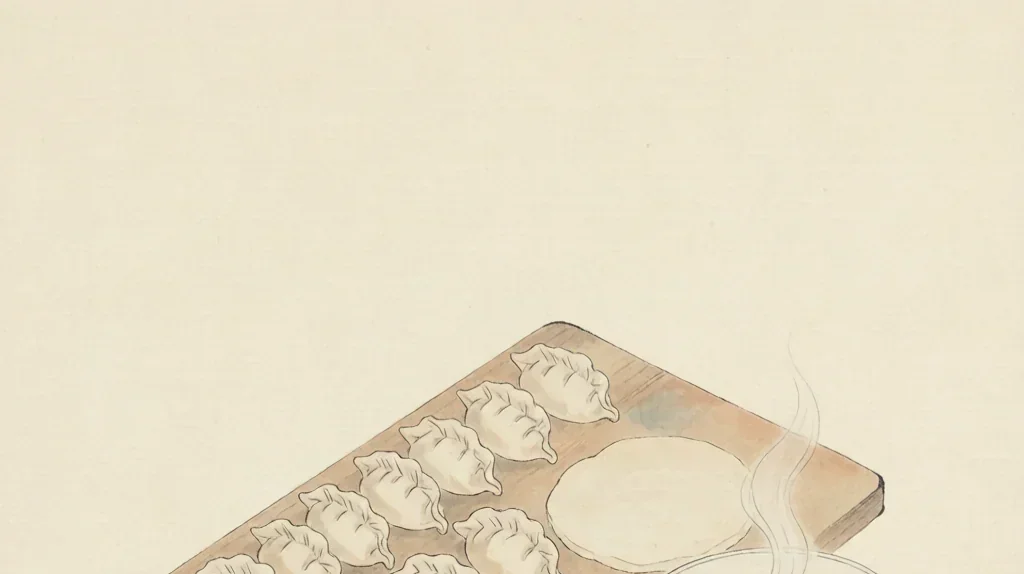
If noodles are the daily bread of northern China, jiaozi (饺子) are its festival food, its celebration food, its food of togetherness. A jiaozi is a half-moon of wheat dough wrapped around a filling of minced meat and vegetables—usually pork with cabbage, chives, or leeks—then boiled, steamed, or pan-fried. The shape is said to resemble ancient Chinese gold ingots (元宝, yuán bǎo), making jiaozi a symbol of wealth and good fortune.
Making jiaozi is a communal activity. During Chinese New Year, families gather around the kitchen table to roll out the wrappers, spoon in the filling, and pleat the edges closed. The work is shared, the conversation flows, and the finished dumplings are a collective achievement. Children learn to make jiaozi at their grandparents' elbows, and the skill passes from generation to generation. Eating jiaozi at midnight on New Year's Eve is said to ensure prosperity in the coming year. Some families hide a coin in one dumpling; whoever finds it will have special luck.
The jiaozi filling is infinitely variable. Pork and cabbage is the classic, but there are lamb and cumin dumplings from the northwest, shrimp and chive dumplings from the coast, and vegetarian dumplings filled with egg, mushroom, and vermicelli. The wrapper can be thick or thin, the pleats can be elaborate or simple. Dipping sauce—usually a mixture of soy sauce, vinegar, chili oil, and minced garlic—is essential. A jiaozi without dipping sauce is like a sentence without punctuation.
Baozi: Steamed Buns of Happiness
Baozi (包子) are the fluffy, steamed cousins of jiaozi. Unlike the thin-skinned dumpling, baozi are made from a yeasted wheat dough that puffs up during steaming, creating a soft, pillowy exterior around a savory or sweet filling. The most famous variety is char siu bao (叉烧包), filled with sweet barbecued pork and a glossy sauce. But the baozi universe is vast: there are soup-filled baozi (灌汤包, guàn tāng bāo) from Kaifeng, where the filling contains aspic that melts into broth during steaming; vegetable baozi stuffed with chopped greens and vermicelli; red bean baozi filled with sweet bean paste; and custard baozi filled with a molten salted egg yolk custard that oozes out when you break the bun open.
Shanghai's soup dumplings (小笼包, xiǎo lóng bāo) deserve special mention. These are not technically baozi—they use an unleavened wrapper similar to jiaozi—but they occupy a category of their own. Each dumpling is a self-contained soup course: a thin wrapper encloses a spoonful of rich, gelatinous broth and a ball of seasoned pork. The broth is created by mixing aspic (meat jelly) into the filling; when steamed, the jelly melts into liquid. Eating xiaolongbao is a delicate art. Pick one up with chopsticks, place it in your spoon, bite a tiny hole in the skin, and slurp the soup before eating the rest. Rookies burn their mouths. Veterans sip with reverence.
Regional Noodle Treasures
Beyond the famous lamian and daoxiaomian, China's noodle landscape is breathtakingly diverse. In Beijing, zhajiangmian (炸酱面) features thick wheat noodles topped with a savory fermented soybean paste sauce, shredded cucumber, and bean sprouts—it is the capital's unofficial official dish. In Sichuan, dandanmian (担担面) delivers the region's signature mala punch in noodle form, with sesame paste, chili oil, and preserved vegetables. In Wuhan, hot dry noodles (热干面, rè gān miàn) are tossed with sesame paste, soy sauce, and pickled vegetables for a breakfast that defines a city. In Guilin, rice noodles (桂林米粉, Guì lín mǐ fěn) swim in a clear broth with sliced beef, peanuts, and pickled beans.
In Fujian, there is a noodle so thin it is called "thread noodles" (线面, xiàn miàn), stretched by hand until a single kilogram of dough becomes strands that could circle a city block. In Yunnan, Crossing-the-Bridge Noodles (过桥米线, guò qiáo mǐ xiàn) arrive as a theatrical experience: a bowl of scalding broth covered with a layer of oil that keeps it hot, and separate plates of raw meat, vegetables, and rice noodles that the diner adds at the table, cooking them in the broth. The name comes from a legend of a devoted wife who carried her husband's lunch across a bridge every day, discovering that a layer of oil on the broth kept it warm during the journey.
The Philosophy of Mianshi
There is something deeply satisfying about mianshi that goes beyond taste. It is the satisfaction of transformation: flour, water, and human hands becoming something that nourishes and delights. It is the satisfaction of craft: the noodle-puller's rhythm, the dumpling-maker's pleats, the bao-steamer's timing. And it is the satisfaction of connection: food that is meant to be shared, that brings families together, that carries the memory of every meal that came before.
In a world of industrial food, mianshi remains stubbornly artisanal. Good noodles are still made by hand. Good dumplings are still wrapped one by one. The machines that can replicate these processes exist, but they cannot replicate the soul. There is a reason why the best bowl of noodles you will ever eat is likely to come from a tiny shop where the master has been pulling dough for thirty years. Some things cannot be automated. Some things should not be.
📝 Chinese Vocabulary
- 面食 (miàn shí) — Flour-based foods: noodles, dumplings, buns, and pancakes
- 拉面 (lā miàn) — Hand-pulled noodles, stretched and folded by hand
- 刀削面 (dāo xiāo miàn) — Knife-cut noodles, shaved directly into boiling water
- 饺子 (jiǎo zi) — Jiaozi dumplings, half-moon shaped with pleated edges
- 小笼包 (xiǎo lóng bāo) — Soup dumplings from Shanghai, filled with broth and meat
Mianshi and the Chinese Calendar
Wheat foods are woven into China's festival calendar. At the Lunar New Year, northern families gather to fold jiaozi, eating them at midnight to invite prosperity for the year ahead, while a coin hidden in one dumpling promises extra luck to its finder. Birthdays call for a bowl of long noodles, chang shou mian, eaten unbroken to wish for longevity, a custom traced back more than a thousand years. The Winter Solstice, Dongzhi, is another occasion for dumplings in the north, said to keep the ears from freezing. Even everyday milestones get a wheat dish, from breakfast buns to festival breads stamped with lucky patterns. These calendar moments show that mianshi is never only fuel; it is a recurring gesture of blessing, marking time and family with the same dough that feeds the table every day.
❓ Frequently Asked Questions
🎉 Fun Facts
- The oldest known noodles in the world were found in China—a 4,000-year-old bowl of millet noodles discovered at the Lajia archaeological site in Qinghai Province.
- Shanxi Province is said to have over 1,000 distinct noodle preparations, more than any other region in China.
- During Chinese New Year, families in northern China may make hundreds of jiaozi at a time, freezing the extras for quick meals throughout the holiday season.
- Northern university students often treat a neighborhood jiaozi shop as a second cafeteria, and a plate of boiled dumplings is a common homesick remedy far from home.
- At birthday meals the long noodle is traditionally slurped, never bitten through, so the unbroken strand becomes an edible wish for a long life.
- A plain bowl of boiled noodles with a spoonful of garlic vinegar is considered a complete, comforting northern meal, proof that mianshi needs little embellishment to satisfy.