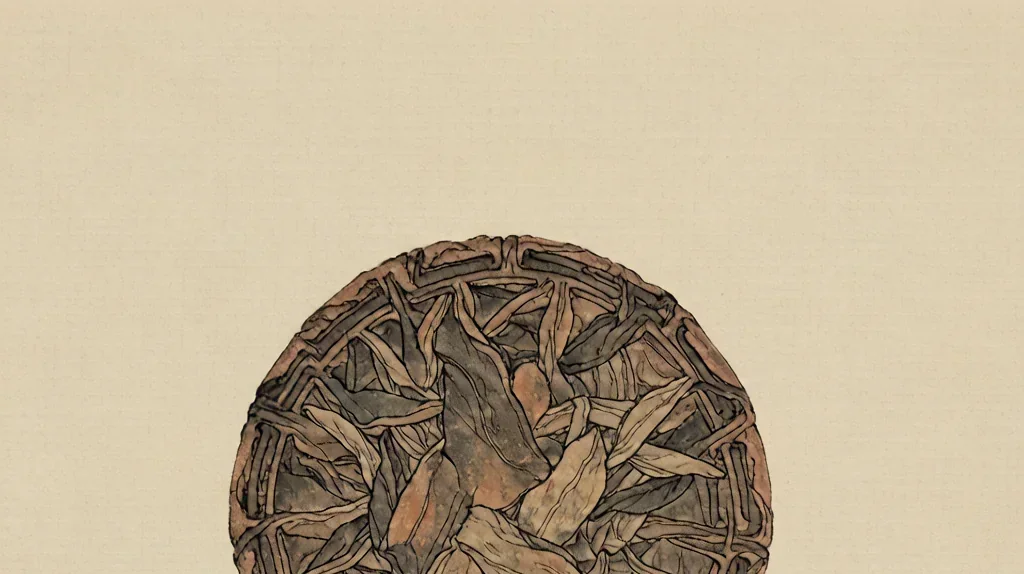
Pu'er tea (普洱茶, Pǔ'ěr Chá) occupies a singular position in the world of tea — it is simultaneously a beverage, a collector's item, and a living artifact that improves with age. Produced exclusively in Yunnan Province in southwestern China, Pu'er is a post-fermented dark tea (黑茶, hēi chá) made from the large-leaf variety of the tea plant (Camellia sinensis var. assamica), which grows abundantly in Yunnan's subtropical highlands. Unlike virtually every other tea, which is best consumed fresh, authentic Pu'er is designed to age, undergoing a slow microbial fermentation that transforms its character over years, decades, and sometimes even centuries. This unique quality has created an extraordinary culture of tea collecting and investment, with rare vintages of aged Pu'er fetching prices that rival fine wine and whisky. The tea takes its name from the ancient town of Pu'er (普洱市), which served as the primary trading hub where tea from the surrounding mountains was collected, processed, and dispatched along the legendary Tea Horse Road (茶马古道, Chá Mǎ Gǔ Dào) to Tibet, Sichuan, and beyond. The story of Pu'er tea is inseparable from the story of Yunnan itself — a land of staggering biodiversity, home to the world's oldest tea trees, and the birthplace of tea drinking as we know it.
Ancient Tea Trees: Living Giants of Yunnan
Yunnan Province is widely recognized by botanists as the birthplace of the tea plant, and it remains home to the world's oldest and largest tea trees. Unlike the manicured tea bushes of most producing regions — pruned to waist height for easy picking — Yunnan's ancient tea trees (古茶树, gǔ chá shù) grow wild and untamed in the province's subtropical forests, some reaching heights of over 30 meters and living for a millennium or more. The oldest documented tea tree, located in Fengqing County (凤庆县), is estimated to be approximately 3,200 years old — making it a contemporary of the Shang Dynasty — and still produces leaves that are harvested each year. In the famous 'Six Great Tea Mountains' (六大茶山, Liù Dà Chá Shān) of Xishuangbanna Prefecture — Gedeng (革登), Yibang (倚邦), Mangzhi (莽枝), Manzhuan (蛮砖), Mansa (曼撒), and Youle (攸乐) — entire forests of ancient tea trees create a unique ecosystem where the deep-rooted trees draw minerals and nutrients from soil layers inaccessible to cultivated bushes, and the natural biodiversity provides natural pest control. The leaves from these ancient trees are treasured for their exceptional complexity, depth of flavor, and powerful 'cha qi' (茶气, tea energy) — a term used by connoisseurs to describe the distinct physiological sensation, ranging from gentle warmth to pronounced euphoria, that high-quality Pu'er can produce. The concept of 'single-origin' (单株, dān zhū) and 'single-mountain' (单山, dān shān) Pu'er has emerged in recent decades as collectors seek teas from specific ancient trees or micro-regions, each with its own terroir-driven personality. A Pu'er from Lao Banzhang (老班章) village, for instance, is known for its aggressive, bitter power that transforms into lingering sweetness, while tea from Bingdao (冰岛) is celebrated for its immediate, honey-like sweetness and cooling aftertaste. These distinctions have created a connoisseurship culture as nuanced and passionate as that surrounding the finest Burgundy wines.
Sheng Pu'er vs. Shou Pu'er: Two Paths of Transformation
Pu'er tea exists in two fundamentally different forms: Sheng Pu'er (生普, raw Pu'er) and Shou Pu'er (熟普, ripe Pu'er). Understanding the distinction between them is essential to appreciating Pu'er culture. Sheng Pu'er is the traditional, original form of Pu'er, produced using methods that date back centuries. Fresh tea leaves are withered, pan-fired to deactivate enzymes (kill-green), rolled, and then sun-dried to create 'mao cha' (毛茶, rough tea), a loose-leaf product that is the foundation of all Pu'er. This mao cha can then be steamed and compressed into various shapes — most commonly the flat round cake (饼茶, bǐng chá, typically 357 grams), but also bricks (砖茶, zhuān chá), bowl-shaped nests called tuocha (沱茶, tuó chá), and even decorative forms like melons and mushrooms. When young, Sheng Pu'er is astringent, bitter, and intensely vegetal — more akin to a powerful green tea — and not particularly pleasant to drink. However, over years and decades of careful storage in the right conditions of temperature and humidity, the tea undergoes a slow, natural fermentation process driven by indigenous microorganisms. The harshness gradually mellows, the bitterness transforms into deep, complex sweetness, and the tea develops a remarkable array of aromas — camphor, dried plum, aged wood, medicinal herbs, and forest floor. A well-aged Sheng Pu'er of 20 or 30 years is among the most prized and expensive beverages on earth. Shou Pu'er, by contrast, was invented in 1973 by tea technicians at the Kunming Tea Factory who sought to satisfy growing demand — particularly from Hong Kong and Southeast Asian markets — for the smooth, earthy character of aged Pu'er without the decades of waiting. The 'wo dui' (渥堆, wet-piling) technique involves piling the mao cha in a controlled hot and humid environment, periodically turning it, and allowing a concentrated microbial fermentation to transform the tea in a matter of 45 to 60 days. The result is a tea that is immediately dark, smooth, earthy, and sweet, with characteristic notes of damp forest, old books, and Chinese dates (红枣, hóng zǎo). While some purists consider Shou Pu'er a shortcut that cannot replicate the depth and complexity of naturally aged Sheng, it has found a vast and appreciative audience and represents the majority of Pu'er consumed in China today.
The Tea Horse Road: Pu'er's Ancient Highway
The history of Pu'er tea cannot be separated from the Tea Horse Road (茶马古道, Chá Mǎ Gǔ Dào), the ancient network of trade routes that connected Yunnan's tea-producing regions with Tibet, Sichuan, and beyond. For over a thousand years, caravans of mules and horses carried compressed Pu'er tea cakes from the tea mountains of Xishuangbanna and Simao northward across some of the most treacherous terrain on earth — crossing the Hengduan Mountains, traversing the deep gorges of the Lancang (Mekong), Jinsha (Yangtze), and Nu (Salween) rivers, and climbing to the high-altitude Tibetan Plateau at elevations exceeding 4,000 meters. The journey from Pu'er to Lhasa covered approximately 3,000 kilometers and could take six months to complete. The compression of Pu'er into dense cakes and bricks was not an aesthetic choice but a practical necessity — loose tea leaves would have been crushed to powder during the long journey, while the compact forms maximized the amount of tea each horse could carry. Along the way, the tea was exposed to dramatic fluctuations in temperature and humidity — from the subtropical heat of Yunnan's valleys to the thin, cold air of the Tibetan Plateau — and this natural environmental cycling contributed to the tea's gradual fermentation and mellowing. By the time it reached Lhasa, the tea had already begun its transformation, and Tibetan consumers — for whom tea was an essential nutritional supplement in a diet dominated by yak meat and dairy — came to associate Pu'er's earthy, aged character with quality. The compressed tea cakes even functioned as a form of currency along the trade route, with standardized sizes and weights facilitating commerce. Today, the Tea Horse Road is recognized as a cultural heritage corridor, and the remaining sections of the ancient stone-paved paths, the caravanserai ruins, and the old tea warehouses in towns like Yiwu (易武) and Pu'er have become pilgrimage sites for tea enthusiasts seeking to connect with the deep history of their favorite beverage.
The Culture of Collecting: Pu'er as Investment
Perhaps no other beverage in the world has developed a collecting culture as elaborate and financially significant as Pu'er tea. The practice of laying down tea for aging — analogous to cellaring fine wine — has deep historical roots in Hong Kong and Guangdong, where traditional tea drinkers would purchase young Sheng Pu'er cakes and store them in their homes for a decade or more before consuming them. In the early 2000s, this practice exploded into a full-blown speculative market that came to be known as the 'Pu'er bubble.' Between 2003 and 2007, as newly affluent Chinese consumers discovered Pu'er collecting, prices for premium cakes rose by over 1,000%, with speculators buying entire warehouses of tea they had no intention of drinking. The bubble burst dramatically in 2007, wiping out fortunes and devastating the Yunnan tea industry. In the aftermath, a more mature and sustainable market emerged, built around genuine appreciation rather than pure speculation. Today, a well-documented cake of Sheng Pu'er from a famous origin such as Lao Banzhang, stored under ideal conditions for 20 years, can sell for tens of thousands of dollars. The 1950s 'Red Label' (红印, Hóng Yìn) and 'Blue Label' (蓝印, Lán Yìn) cakes produced by the state-owned Menghai Tea Factory are considered holy grails, with authenticated examples commanding prices exceeding $100,000 at auction. The collecting culture has developed its own sophisticated infrastructure: professional storage warehouses in Guangdong and Hong Kong that control temperature and humidity with scientific precision, authentication services using spectral analysis and microbial testing, tea investment funds, and even Pu'er futures markets. At its best, this culture preserves and celebrates Pu'er's unique aging potential; at its worst, it can obscure the simple pleasure of brewing and sharing a cup of tea. For most Pu'er drinkers in China today, the appeal is more modest — the ritual of breaking off a piece from a carefully stored cake, the evolving character of a tea that changes with each passing season, and the connection to an ancient tradition that stretches from the misty tea forests of Yunnan to the teahouses of modern Beijing and beyond.
How To Brew Pu'er: A Patient Ritual
Pu'er is usually brewed gongfu style, in a small gaiwan or Yixing clay pot, using near-boiling water and a high ratio of leaf to water. The first step is a quick rinse: pour hot water over the leaves, swirl, and discard it within seconds to wake the tea and clean away dust. Subsequent infusions are short, often ten to twenty seconds, and a good cake can be re-steeped a dozen times or more, each cup revealing a different layer of flavor. Ripe Pu'er tends to open quickly and stays rounded across many steeps, while young raw Pu'er can be astringent at first and only softens after several infusions. The practice rewards attention: small changes in water temperature, steeping time, and the vessel itself noticeably alter the cup. What looks like ceremony is really a conversation between brewer and leaf, tuned across an afternoon.
Tasting Notes: Reading A Cup Of Pu'er
A well-made raw Pu'er tastes dramatically different at age one than at age twenty. Young sheng is bright, bitter, and floral, sometimes with notes of green plum and fresh vegetation; with years of storage it mellows into honey, dried fruit, and old wood, while the mouthfeel grows thick and sweet. Ripe shou Pu'er, by contrast, is immediately dark and smooth, offering cocoa, damp forest floor, and a clean earthiness rather than bitterness. Connoisseurs also speak of 'cha qi', a warming, almost euphoric physical sensation that fine aged Pu'er can produce. Color is a useful clue: a lively amber for young raw tea, a deep reddish brown for aged or ripe teas. Learning to read these cues takes time, but the range within a single tea category is wider than almost any other.
Health Traditions And Modern Studies
In southern China Pu'er has long been valued as a digestive aid, drunk after heavy meals to cut grease and settle the stomach, and traditional belief holds that aged tea is especially soothing. Modern research has begun to examine these claims, with studies suggesting that Pu'er may help moderate blood lipids and support beneficial gut microbes through its fermented compounds. Ripe Pu'er in particular is low in caffeine compared with many teas and is often chosen as an evening drink. Scientists caution that much of the evidence remains preliminary and that results depend heavily on how a tea was stored and processed. Even so, the folk reputation is consistent across centuries and regions. As with any food, the sensible approach is enjoyment in moderation rather than treatment of illness.
Pu'er In The Modern Global Market
Once a regional Yunnan specialty, Pu'er is now traded and collected worldwide, with specialty shops from Singapore to Berlin offering aged cakes and young single-origin productions. The 2000s speculation bubble taught the market hard lessons, but a steadier international demand has remained, driven by tea enthusiasts, diaspora communities, and investors seeking tangible alternatives to conventional assets. Auction houses in Hong Kong and mainland China regularly feature historic cakes, and a new generation of boutique brands emphasizes transparent sourcing, village-level traceability, and clean storage. Travel and social media have also turned Pu'er's origin landscapes into destinations, drawing visitors to Xishuangbanna and Pu'er city to taste tea at the source. The result is a category that is at once ancient and thoroughly contemporary.