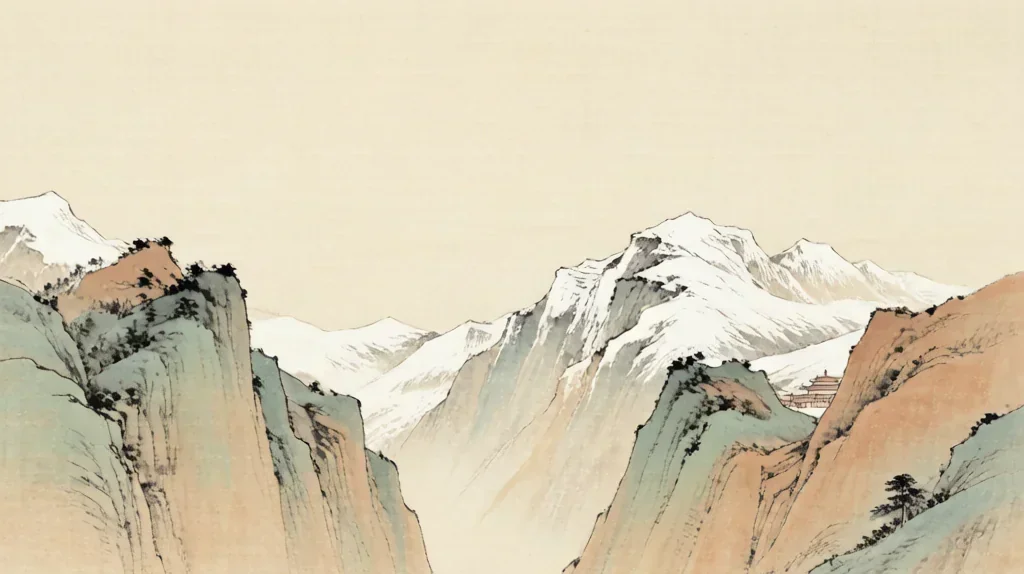
The Tea Horse Road (茶马古道, Chá Mǎ Gǔ Dào) is one of the most extraordinary yet least known of the world's great ancient trade routes. Stretching for over 3,000 kilometers through some of the most challenging terrain on earth — the deep gorges of southwestern China's great rivers, the snow-capped peaks of the Hengduan Mountains, and the thin-air highlands of the Tibetan Plateau — this network of footpaths and mule trails connected the tea-producing regions of Yunnan and Sichuan with the Tibetan world for over a thousand years. Unlike the more famous Silk Road, which traversed the relatively open landscapes of Central Asia, the Tea Horse Road cut directly across the grain of Asia's most formidable mountain ranges, following paths that were often no wider than a mule's shoulders and that climbed and descended thousands of meters in a single day's journey. The trade that gave the road its name was elegantly simple and mutually essential: Chinese tea for Tibetan horses. The Tibetan people, whose high-altitude diet of yak meat, dairy, and barley (tsampa) lacked vegetables and was consequently deficient in certain vitamins, had developed an absolute physiological dependency on tea to aid digestion and prevent deficiency diseases. Meanwhile, the Chinese empire, perpetually threatened by nomadic incursions from the north, needed the sturdy, high-altitude-bred horses of Tibet for its cavalry. This complementary exchange — tea moving west and north, horses moving east and south — created one of history's most durable and culturally significant trade relationships, one that not only moved goods but also facilitated the exchange of ideas, religions, languages, and technologies between the Chinese and Tibetan civilizations.
Origins and Historical Development
The Tea Horse Road did not emerge suddenly but developed organically over centuries from the convergence of several factors: the Chinese discovery of tea cultivation in Yunnan and Sichuan, the Tibetan adoption of tea as a dietary staple, and the political and military needs of successive Chinese dynasties. The earliest documented tea trade between China and Tibet dates to the Tang Dynasty (618–907 CE), when the Tibetan Empire under King Songtsen Gampo (松赞干布, Sōngzàn Gānbù) established diplomatic and marital ties with the Tang court. The marriage of the Chinese Princess Wencheng (文成公主) to Songtsen Gampo in 641 CE is traditionally credited with introducing tea drinking to the Tibetan aristocracy, though it likely took several more generations for the practice to spread throughout Tibetan society. By the Song Dynasty (960–1279 CE), the tea-horse trade had become a formal state monopoly, with the imperial government establishing a dedicated Tea and Horse Bureau (茶马司, Chá Mǎ Sī) to regulate the exchange. The Song state, facing constant military pressure from the Khitan Liao Dynasty and later the Jurchen Jin Dynasty to the north, was desperate for cavalry mounts and used its control of tea production — which was exclusively a Chinese monopoly, as tea plants would not grow in Tibet's harsh climate — as a strategic bargaining chip. Official exchange rates were set: in 1074, for instance, one horse was valued at approximately 50 kilograms of tea, though the exact ratio fluctuated based on the quality of both commodities and the political climate. The Ming Dynasty (1368–1644 CE) continued and expanded this system, establishing multiple Tea and Horse Bureaus along the Sichuan-Tibet border and enforcing strict prohibitions on private tea trading to maintain state control. The Qing Dynasty (1644–1912 CE) eventually relaxed many of these controls, and the trade expanded dramatically, with private merchants playing an increasingly important role alongside the official caravans. At its peak in the 18th and 19th centuries, it is estimated that over 7,500 metric tons of tea were transported along the Tea Horse Road each year, carried by tens of thousands of mules and horses and handled by a complex network of merchants, caravan leaders, innkeepers, and porters that constituted an entire economic ecosystem.
The Mule Caravans: Life on the Road
The mule caravan (马帮, mǎ bāng) was the fundamental unit of the Tea Horse Road, and the men who led these caravans — known as 'mǎ guō tóu' (马锅头, literally 'pot boss,' because the caravan leader was responsible for the communal cooking pot) — formed a distinctive subculture with its own customs, language, and codes of honor. A typical caravan consisted of between 50 and 200 mules and horses, each carrying approximately 60 to 80 kilograms of tea compressed into dense bricks or cakes, along with a support team of caravan leaders, muleteers, cooks, and armed guards to protect against bandits. The journey from the tea-producing regions of southern Yunnan (around what is now Xishuangbanna and Pu'er) to Lhasa, the Tibetan capital, covered approximately 3,000 kilometers and typically took five to six months to complete in each direction. The caravans followed a seasonal rhythm, departing Yunnan in the spring after the tea harvest and aiming to cross the high mountain passes before the arrival of winter snow. The terrain was staggeringly difficult. The route traversed the parallel gorges of the 'Three Parallel Rivers' region — where the Lancang (Mekong), Jinsha (upper Yangtze), and Nu (Salween) rivers carve channels up to 3,000 meters deep through the Hengduan Mountains — requiring the caravans to descend from alpine passes into subtropical valleys and then climb back out, sometimes multiple times in a single week. The highest pass on the route, the Daxue Mountain Pass in what is now northwestern Yunnan, sits at an elevation of over 4,300 meters, where the air contains only 60% of the oxygen found at sea level. Avalanches, landslides, flash floods, and sudden blizzards were constant dangers, and it was said that every section of the road was marked by the graves of men and animals who had perished along the way. The caravan men developed an elaborate system of signals and communications using gongs, horns, and distinctive calls that echoed through the mountains, as well as a rich oral tradition of songs and stories that chronicled the perils and romances of the road. They also evolved their own argot, a blend of Chinese dialects, Tibetan, and local minority languages, along with taboo words and euphemisms — for example, the word for 'tiger' was never spoken aloud for fear of attracting the real animal, and was replaced by the circumlocution 'the big cat.'
Cultural Exchange: The Road as a Bridge Between Civilizations
The Tea Horse Road was never merely a conduit for commercial goods; it was a powerful engine of cultural transmission that reshaped the societies along its length. The most visible legacy of this exchange is Tibetan Buddhism, which spread from Tibet into the ethnic minority regions of Yunnan and Sichuan along the trade routes. Monks frequently traveled with the caravans, using the established network of inns and trading posts as way stations, and Buddhist monasteries along the route grew wealthy by participating in the tea trade — some becoming major economic powers that operated their own caravans. The town of Zhongdian (now officially renamed Shangri-La, 香格里拉) in northwestern Yunnan, with its magnificent Songzanlin Monastery, became a major religious and commercial center where Tibetan lamas, Chinese tea merchants, and local Naxi and Bai traders mingled. The architectural heritage of the Tea Horse Road towns reflects this cultural fusion. The ancient town of Lijiang (丽江), a UNESCO World Heritage Site and the traditional capital of the Naxi people, developed a distinctive architectural style that blended Han Chinese courtyard houses with Tibetan decorative elements and Naxi spatial organization. The Naxi people themselves, who occupied a strategic position as middlemen in the tea-horse trade, became remarkably multicultural, with Naxi merchants typically speaking their own language plus Chinese, Tibetan, and often Bai and Yi as well. The Naxi Dongba script, the world's last living pictographic writing system, contains numerous references to tea and the horse trade, preserving a record of this history in one of humanity's most ancient forms of written communication. Culinary traditions also traveled the road: Tibetan butter tea (酥油茶, sūyóu chá) — made by churning brick tea with yak butter and salt — is a direct adaptation of Chinese tea culture to Tibetan dietary needs and tastes. The 'crossing-the-bridge noodles' (过桥米线, guòqiáo mǐxiàn) of Yunnan, now a beloved dish throughout China, is said to have originated with a loving wife who needed to deliver hot meals to her husband studying on an island, and who discovered that a layer of chicken oil on top of the broth would keep the soup piping hot during the long walk — a story that embodies the practical ingenuity of the Tea Horse Road culture. Even music traveled these routes: the horse-driving songs (赶马调, gǎn mǎ diào) of Yunnan, with their haunting melodies and lyrics about distant loved ones and dangerous journeys, were carried across the mountains and became part of the folk music traditions of multiple ethnic groups.
Decline, Memory, and Modern Revival
The Tea Horse Road began its decline in the early 20th century, accelerated by the political upheavals that transformed China. The British introduction of tea plantations in India and Ceylon (Sri Lanka) in the 19th century had already begun to erode China's monopoly on the international tea trade, and the opening of maritime routes provided alternatives to the arduous overland journey. The fall of the Qing Dynasty in 1912, the subsequent decades of warlordism and civil war, and the Japanese invasion of the 1930s and 1940s disrupted traditional trade networks. The establishment of the People's Republic of China in 1949 and the incorporation of Tibet into the new state brought the final end to the traditional caravan trade. Motor roads were built into Tibet — first the Sichuan-Tibet Highway (completed 1954) and then the Yunnan-Tibet Highway (completed 1973) — replacing the months-long mule journey with a truck trip of a few days. The caravans disbanded, the old caravan inns fell into disrepair, and the elaborate subculture of the mǎ bāng faded from living memory to legend. However, in recent decades, the Tea Horse Road has undergone a remarkable cultural revival. Academic research into the road's history, pioneered by scholars such as Mu Jihong of Yunnan University and the 'Six Gentlemen of the Tea Horse Road' — a group of young Chinese researchers who conducted a 100-day field survey of the route in 1990 — brought the forgotten trade network back into public consciousness. The road has been recognized as a cultural heritage corridor, and sections of the original stone-paved paths, ancient suspension bridges, and caravanserai ruins have been designated as protected sites. A new generation of tea enthusiasts has rediscovered the connection between the Tea Horse Road and Pu'er tea culture, and 'Tea Horse Road tourism' has emerged as a significant industry, with travelers following sections of the ancient route on foot, by bicycle, or in four-wheel-drive vehicles. In towns like Shaxi (沙溪) in Yunnan, the old market square — once the most important trading hub on the Yunnan-Tibet branch of the road, where caravans would rest for days, trading not just goods but news, stories, and songs — has been painstakingly restored and is now a gathering place for travelers seeking to connect with the road's history. Perhaps most poignantly, a few of the very last surviving mǎ guō tóu, now in their nineties, have been interviewed by historians and filmmakers, their memories of the road — the sound of mule bells echoing through mountain passes, the taste of butter tea after a hard day's climb, the camaraderie of the caravan men around the evening fire — preserved as the last living link to one of the world's great cultural journeys.
The Tea Horse Trade: Tea For Horses
At its core the road was a straight exchange that suited both sides perfectly. Tibet, with its high, cold plateau, could not grow tea, yet a diet of yak meat, dairy, and barley created a real need for tea to aid digestion and supply vitamins, so tea became a daily necessity rather than a luxury. China, meanwhile, constantly needed sturdy mountain-bred Tibetan horses for its cavalry against northern nomads. The imperial state formalized this through the Tea and Horse Bureau, setting official exchange rates, such as a horse for a fixed weight of tea, and banning private trade to keep control. Compressed bricks were ideal because they traveled well and, being standardized, could even function as a store of value. The trade thus bound two civilizations together for a thousand years on the backs of mules.
Towns And Way Stations Along The Route
The road was held together by a chain of towns and rest stops where caravans resupplied, slept, and traded. Pu'er and Yiwu in Yunnan were collection points where tea was compressed and packed; Lijiang became a wealthy crossroads where Naxi, Han, and Tibetan merchants mingled; and Zhongdian, now called Shangri-La, grew around the great Songzanlin Monastery as a religious and commercial center. Farther west, towns on the Tibetan Plateau served as the final markets where tea was redistributed across the highlands. Each stop developed its own blend of architecture and custom, mixing Han courtyard houses with Tibetan and local styles. These towns are the reason the road survived as a living culture rather than a mere trail, and many remain vibrant heritage sites today.
Geography: Crossing The Three Parallel Rivers
What made the Tea Horse Road extraordinary was the terrain it crossed. In the gorges of the Three Parallel Rivers region, the Lancang, Jinsha, and Nu rivers cut channels thousands of meters deep through the Hengduan Mountains, forcing caravans to drop into subtropical valleys and climb back out again, sometimes several times in a single week. Passes reached well over four thousand meters, where the air held little more than half the oxygen at sea level, and avalanches, landslides, and blizzards were constant threats. The path was often no wider than a mule's shoulders, carved into cliff faces and suspended on rope bridges over roaring water. This brutality is exactly why the trade was valuable: only tea, lightweight and compact, was worth carrying across such country, and only determined caravans could do it. The landscape, not any wall, was the road's true defense.
The Road In Literature And Memory
Long after the caravans stopped, the Tea Horse Road lived on in story. Monks, merchants, and travelers carried tales along the route, and later scholars and writers turned it into a symbol of cultural exchange between Han and Tibetan worlds. The rediscovery began in earnest in 1990, when a group of young researchers spent a hundred days surveying the route, and their work, followed by academic study, pulled the forgotten network back into public memory. Today the road appears in novels, documentaries, and the names of tea houses and products, and sections are protected as cultural heritage corridors. For many Chinese, it represents a gentler kind of history than wars and dynasties: a story of ordinary people, mules, and tea moving quietly across mountains and binding distant cultures together.