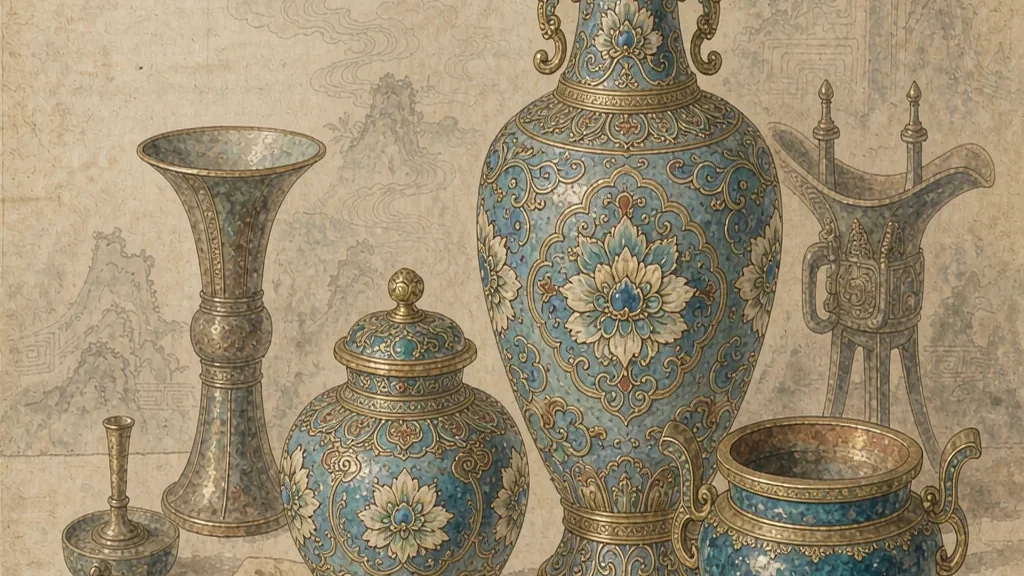
Cloisonne (景泰蓝, jǐngtài lán) is the brightest jewel in the crown of Chinese decorative arts — a technique in which metal wires are soldered onto a bronze body to create compartments that are filled with colored enamel and fired. The result is an object of brilliant, permanent color that never fades or tarnishes. Cloisonne reached its peak during the Ming and Qing dynasties, when the imperial workshops produced thousands of pieces for the Forbidden City.
The Technique of Cloisonne
The process begins with a bronze body, typically cast or hammered into shape. Thin copper wires are bent into patterns and soldered onto the bronze surface, creating compartments (cloisons). Colored enamel pastes are filled into each compartment and the piece is fired. The enamel shrinks during firing, so the filling and firing must be repeated until the compartments are full. Finally, the surface is ground smooth and the exposed wires are gilded.
The Jingtai Connection
Cloisonne is called 'Jingtai blue' (景泰蓝) after the reign of the Jingtai Emperor (1450-1456), who was a great patron of the art. The characteristic deep blue enamel of the Jingtai period remains the most prized color.
Ming Dynasty Cloisonne
Ming cloisonne is bold and vigorous, with deep colors and strong designs. The most common shapes are incense burners, vases, and ritual vessels. The colors are thicker and less refined than Qing work, but the effect is powerful.
Qing Dynasty Perfection
Qing cloisonne achieved technical perfection. The wires are finer, the colors more numerous, and the execution more precise. The Qianlong Emperor was a major patron, and his reign saw the production of enormous cloisonne screens, thrones, and architectural ornaments.
The Introduction of Cloisonne to China
The technique of cloisonne enamel was introduced to China from the Byzantine or Middle Eastern world during the Yuan dynasty (1271–1368). The Mongol Empire's vast trade network brought artisans and techniques from across Asia to China, and the imperial workshops in Beijing quickly adopted cloisonne, adapting it to Chinese aesthetic preferences.
Early Chinese cloisonne from the Yuan and early Ming periods shows clear Middle Eastern influence in its designs — arabesques, geometric patterns, and stylized floral motifs. Over time, Chinese motifs — dragons, phoenixes, clouds, and lotus scrolls — replaced the foreign designs, creating a distinctly Chinese cloisonne style.
The Imperial Cloisonne Workshops
The Ming and Qing imperial cloisonne workshops were located in the Forbidden City in Beijing. At their peak during the Qianlong reign (1735–1796), the workshops employed hundreds of artisans working in a highly specialized, assembly-line system. One worker formed the bronze bodies, another soldered the wires, others filled the enamels, and specialists handled the final firing and polishing.
The Qianlong Emperor was particularly passionate about cloisonne. His collections included cloisonne thrones, screens, censers, vases, and even architectural elements like handrails and roof ornaments. The emperor personally approved designs for important pieces, and his taste for elaborate, richly decorated works set the standard for Qing cloisonne.
Collecting and Appreciating Cloisonne
Cloisonne was one of the first Chinese decorative arts to be collected by Europeans. The Dutch East India Company and other trading companies brought cloisonne to Europe, where it was valued for its brilliant, permanent colors. European rulers, including Louis XIV of France and Frederick the Great of Prussia, collected Chinese cloisonne.
Authenticating cloisonne requires examining several features: the quality of the wire work (fine, even wires indicate high quality), the depth and purity of the enamel colors, the gilding quality, and the condition of the bronze body. The best pieces have a clear, resonant ring when tapped and show no cracks or chips in the enamel.
Cloisonne as Court Regalia and Diplomatic Gift
In the Ming and Qing courts cloisonne was more than decoration; it was a statement of rank and taste. The imperial workshops supplied altar vessels, incense burners, screens, and throne fittings whose durable, glowing surfaces suited both ritual and display. Because the technique was costly and closely controlled, owning fine cloisonne signaled proximity to power, and the court gave elaborate pieces to meritorious officials and to foreign envoys as tokens of favor. At the same time, the art traveled outward: displayed at world's fairs and presented to distant rulers, it became one of the luxury crafts by which China represented itself abroad. In this double role, inner regalia and outward gift, cloisonne shows how a workshop craft could carry the weight of state ceremony.
❓ Frequently Asked Questions
📝 Chinese Vocabulary
景泰蓝 — : cloisonne; literally 'Jingtai blue'.
掐丝 — : wire clamping; the cloisonne wire technique.
珐琅 — : enamel.
鎏金 — : gilding; gold-plating the wires.
景泰蓝 — : cloisonne; Jingtai blue
掐丝 — : wire clamping; the wire-work technique
珐琅 — : enamel; the colored glass paste
点蓝 — : The step of filling the cloisons with enamel paste, literally 'dotting the blue'.
🎉 Fun Facts
- Cloisonne was introduced to China from the Middle East during the Yuan dynasty.
- An imperial cloisonne screen in the Palace Museum contains over 10,000 individual wire compartments.
- Cloisonne was one of the first Chinese arts to be copied in Europe in the 19th century.
- The secret of Chinese cloisonne was so closely guarded that European attempts to replicate it did not succeed until the 19th century.
- The largest surviving cloisonne object is a pair of screens in the Palace Museum, each over 3 meters tall and containing hundreds of thousands of wire compartments.
- Cloisonne was prized as a diplomatic gift: Chinese envoys presented large pieces to foreign courts, and the art was shown at international exhibitions as a mark of imperial craft.