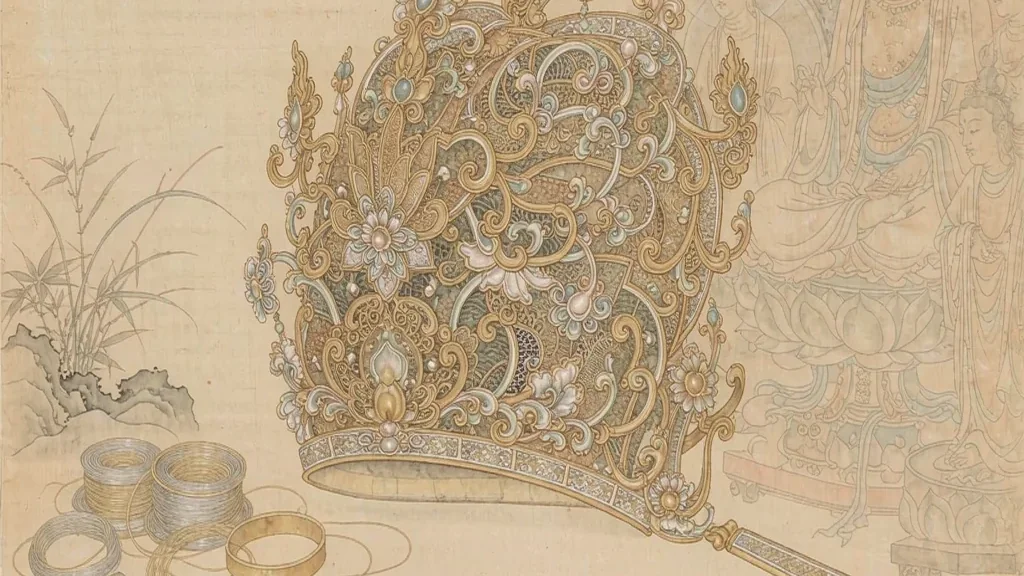
Gold and silver have been worked in China for over three thousand years, but the techniques of filigree (金银细工, jīnyín xìgōng) — the twisting and soldering of fine wires into intricate patterns — reached their peak during the Tang, Ming, and Qing dynasties. Chinese goldsmiths created objects of breath-taking delicacy: hairpins so fine they seemed woven from light, boxes covered with spiraling wire patterns, and ceremonial objects encrusted with filigree and gemstones.
Early Chinese Goldwork
Goldwork appeared in China during the Shang dynasty, but became more common during the Warring States period. The nomadic cultures of the northern steppes, particularly the Xiongnu, were masters of goldwork and influenced Chinese techniques.
Tang Dynasty Golden Age
The Tang dynasty was the golden age of Chinese metalwork. Gold and silver were used for cups, plates, incense burners, and jewelry. The imperial workshops employed hundreds of goldsmiths who created objects for the court and for diplomatic gifts.
Ming and Qing Filigree
Ming and Qing filigree reached extraordinary levels of refinement. The wire was drawn to hair-thinness, then twisted into patterns of clouds, dragons, and flowers. Filigree was used for hairpins, earrings, belt hooks, and small boxes.
Techniques
Filigree is made by drawing gold or silver through successively smaller holes until the wire reaches the desired thickness. The wire is then annealed, twisted, and shaped into patterns. The shapes are soldered onto a backing or assembled as openwork.
Tang Dynasty Gold and Silver: The Silk Road Connection
Tang dynasty gold and silver work was heavily influenced by the cultures of Central Asia and Persia, which were connected to China through the Silk Road. Tang goldsmiths adopted Sogdian and Sasanian techniques, including repoussé (hammering from the back), chasing (detailed surface carving), and granulation (attaching tiny gold balls to a surface).
The most spectacular Tang gold objects were discovered in the underground palace at the Famen Temple, where a Tang emperor had deposited gold and silver offerings. The Famen hoard includes gilded silver incense burners, gold bowls decorated with flying horses, and a silver box with a design of musicians playing Central Asian instruments. These objects show the cosmopolitan world of Tang China.
Women's Jewelry and Hair Ornaments
Gold and silver hairpins and hair ornaments were among the most important categories of Chinese metalwork. A wealthy woman's hair was adorned with multiple pins, combs, and ornaments arranged in elaborate configurations. The finest hairpins were made from gold filigree, with details so fine that the metal seemed as delicate as thread.
The phoenix hairpin (凤钗, fèngchāi) was the most prestigious form, reserved for empresses and imperial concubines. The phoenix was rendered in filigree with outstretched wings and a long tail, sometimes with pearls and kingfisher feathers added for color. These hair ornaments were not just decoration but markers of rank and status.
The Preservation and Restoration of Ancient Metalwork
Gold survives well in archaeological contexts because it does not corrode, but silver and gilded objects are more vulnerable. Silver tarnishes to a black or dark gray color, and gilding can wear away over centuries of handling. Conservators use specialized techniques to clean and stabilize ancient metalwork, revealing the original beauty of the pieces.
The restoration of metalwork requires understanding the original techniques. Modern forgers often fail to replicate the exact composition of ancient alloys or the characteristic wear patterns of genuine antiques. Scientific analysis — X-ray fluorescence, metallography, and isotope analysis — helps distinguish authentic ancient works from modern imitations.
Motifs and Meaning in Filigree
Chinese filigree favored a settled vocabulary of auspicious motifs drawn from court and popular belief. Dragons and phoenixes signaled imperial authority and marital harmony; clouds, ruyi heads, and floral scrolls stood for good fortune and long life; and insects or scholars' objects appeared on personal adornment. The wire was rarely left to speak for itself: granules, sheet gold, and inlaid gems or kingfisher feathers were combined so that a single hairpin could show twisted wire, tiny fused beads, and set color at once. Reading the motif was part of the pleasure, since the same openwork that delighted the eye also declared the wearer's wishes, for rank, for sons, for a long and fortunate life. In this way filigree was both jewelry and a small, worn blessing.
❓ Frequently Asked Questions
📝 Chinese Vocabulary
金银细工 — : gold and silver filigree work.
花丝 — : flower wire; filigree.
鎏金 — : gold gilding.
镶嵌 — : inlay with gemstones.
金银细工 — : gold and silver filigree work
花丝 — : flower wire; filigree technique
鎏金 — : gilding; gold-plating with mercury amalgam
累丝 — : Lei si, the technique of building filigree by coiling and soldering fine wire into openwork lattice patterns.
🎉 Fun Facts
- Some Tang gold hairpins were so fine they could be bent by a breath of air.
- Qing dynasty filigree sometimes combined gold wires with kingfisher feathers for brilliant blue highlights.
- The Famen Temple gold and silver hoard, discovered in 1987, contained over 120 gold and silver objects weighing over 200 kilograms.
- Kingfisher feathers were used in combination with filigree to create brilliant blue highlights that could never be achieved with enamel.
- Filigree was often made as openwork, so light passing through the wire patterns gave the metal a lace-like, almost weightless appearance unlike solid cast gold.
- Because the wire is so fine and the joins so tiny, filigree pieces were traditionally repaired by specialist goldsmiths, and damaged objects were sometimes melted down and reworked rather than thrown away.