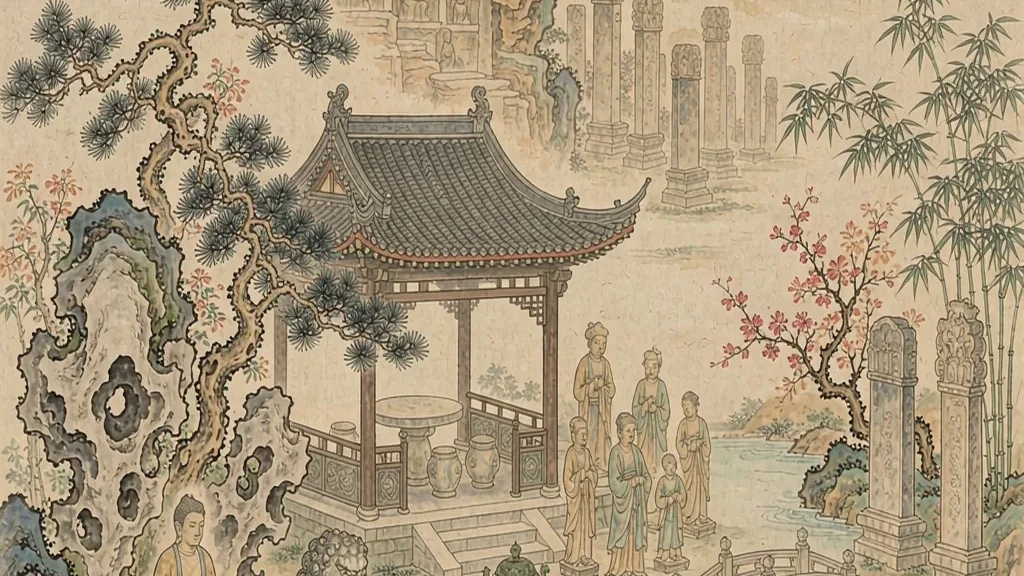
The Chinese scholar who could not retire to the mountains brought the mountains to his desk. Miniature gardens (盆景, pénjǐng) — potted landscapes of miniature trees, rocks, and moss — are living sculptures that represent the pinnacle of the Chinese art of miniaturization. These tiny landscapes require years of training to create and a lifetime of care to maintain.
Origins of Penjing
Penjing (盆景, 'tray scenery') originated during the Han dynasty and reached its peak in the Tang and Song. Scholars created miniature versions of famous landscapes, capturing the essence of mountains, rivers, and ancient trees in a shallow tray.
The art of penjing is closely related to Chinese landscape painting — both seek to capture the spirit of nature in a confined space.
Techniques of Penjing
Creating a penjing requires mastering several arts: horticulture (keeping a tree alive in a shallow pot), sculpture (shaping branches and trunk through wiring and pruning), and composition (arranging rocks, moss, and figures to create a harmonious whole).
The most prized penjing specimens are hundreds of years old, passed down through generations of a family.
The Scholar's Garden
A scholar's studio was incomplete without a penjing on the desk or windowsill. The miniature garden provided a focus for meditation and a reminder of the natural world that the scholar had left to serve the state.
The Relationship Between Penjing and Chinese Painting
Penjing is often described as 'three-dimensional painting.' Like a landscape painting, a penjing arrangement compresses a vast natural scene into a small space, using the same compositional principles: foreground, middle ground, and distance; the balance of yin and yang; and the use of empty space. A master penjing artist thinks like a painter, arranging rocks and trees as if placing brushstrokes on silk.
Many Chinese painters were also penjing enthusiasts. Shen Zhou and Wen Zhengming, the Ming painting masters, both created penjing for their studios. The scholar's studio was a space where painting, calligraphy, poetry, and penjing came together in a unified aesthetic experience.
The Living Art: Caring for a Penjing
A penjing is a living sculpture that requires constant care. The miniature tree must be watered daily — sometimes twice a day in summer. It must be pruned to maintain its shape, with new growth carefully trimmed to preserve the design. The branches are trained with copper wire to grow in the desired direction, a process that must be adjusted as the tree grows.
The soil must be replaced every few years, the roots pruned to keep the tree small, and the tree protected from pests and diseases. A penjing that is neglected for even a few weeks can die. The relationship between the owner and the penjing is a long-term commitment, often spanning decades or even generations.
Penjing Styles and Classifications
Chinese penjing is classified into several styles. 'Literati style' (文人式, wénrén shì) features a tall, slender trunk with minimal branches, suggesting the resilience of a scholar. 'Cascade style' (悬崖式, xuányá shì) has branches that fall below the pot's base, suggesting a tree growing on a cliff. 'Forest style' (丛林式, cónglín shì) uses multiple trees to create a miniature woodland.
The 'rock penjing' (山水盆景, shānshuǐ pénjǐng) focuses on rocks as the primary element, with small plants as accents. These landscapes use the same classification as full-size gardens: mountains of stone, water of empty space, and tiny figures or buildings to provide scale.
Design Principles: Asymmetry, Age, and the Living Line
Fine penjing obeys a grammar of restraint. Trunks are tilted rather than upright, roots are allowed to show, and the canopy is thinned on one side to suggest a tree bent by wind and time. Symmetry is avoided because nature rarely mirrors itself, and a single exposed root or a gap in the foliage can carry more feeling than a balanced form. Age is prized: rough bark, scarred branches, and a shallow, aged pot all signal a long life compressed into a tray. The ideal, captured by the phrase shrinking a dragon to an inch, is to make a viewer sense a whole mountain or old forest from a few inches of wood and stone. Mastery lies not in making the tree small but in making the small tree seem large, ancient, and alive.
Penjing as a Living Heirloom
More than most arts, penjing is measured in generations. A tree trained over decades becomes a record of its keeper's patience and eye, and the finest specimens pass from parent to child or from master to disciple, gaining value with each year of surviving care. In the scholar's world this longevity carried moral weight: to tend a small living landscape was a daily lesson in balance, restraint, and respect for slow growth. Today penjing is shown in competitions and museum courts, with famous old trees insured and admired like paintings. Yet the art remains domestic at heart, a tray of living scenery kept on a windowsill or study desk, where its quiet changes across the seasons keep the grower attuned to weather, time, and the limits of human control.
❓ Frequently Asked Questions
📝 Chinese Vocabulary
盆景 — : tray landscape; miniature garden.
盆栽 — : potted plant; bonsai.
山水盆景 — : landscape penjing with rocks.
盆景 — : tray landscape; miniature garden
山水盆景 — : rock penjing; landscape with rocks
文人式 — : literati style; minimalist penjing style
树石 — : Shu shi, tree and rock, a penjing mode that pairs a trained tree with a stone landscape in one tray.
缩龙成寸 — : Suo long cheng cun, shrinking a dragon to an inch, the penjing ideal of condensing vast scenery into a small tray.
🎉 Fun Facts
- The oldest surviving Chinese penjing is over 1,000 years old and is kept in a Buddhist temple in Guangdong.
- Penjing trees must be pruned and watered every day; missing a week can kill a specimen.
- A famous penjing at the Guangzhou Garden named 'Century of Life' is over 500 years old.
- The oldest surviving penjing with documented ownership history is in a Buddhist temple in Guangdong.
- A penjing is never finished: its keeper must rewire, prune, and repot it across decades, so the same tree can outlive its creator and pass to heirs.
- Beyond trained trees, landscape penjing uses rocks, moss, and tiny figures to evoke a whole mountain gorge or riverside in a single shallow tray.