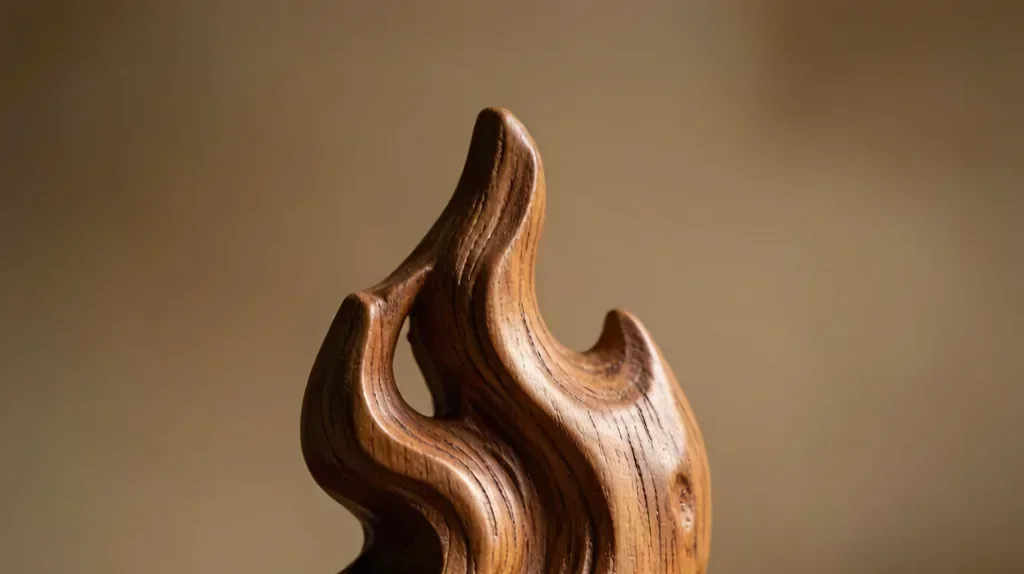
Wood has been the most accessible and widely used material in Chinese sculpture, used for everything from monumental temple figures to intimate desk ornaments. Chinese wood carving (木雕, mùdiāo) spans more than two thousand years, producing works that range from the simple to the spectacular. In the great temple complexes of China, gilded wood bodhisattvas stand as tall as buildings; in the scholar's studio, tiny carved figures sit on inkstone stands. Wood is the humble material that Chinese sculptors have transformed into the sublime.
Religious Wood Carving: The Great Temple Figures
The most important works in Chinese wood carving are the gilded and polychromed figures that fill Buddhist and Daoist temples. These sculptures, often several meters tall, are carved from wood, then covered with lacquer, gesso, and gold leaf or bright paint. The earliest surviving examples date to the Tang dynasty but the tradition continued through the Qing.
The Bodhisattva Guanyin (观音, Guānyīn) is the most commonly depicted figure in Chinese wood carving. Song dynasty Guanyin figures are particularly beautiful, showing the bodhisattva in a relaxed posture — 'water-moon Guanyin' (水月观音) or 'white-robed Guanyin' (白衣观音) — with naturalistic proportions and gentle expressions that convey compassion.
Architectural Wood Carving
Chinese architecture is primarily a wood-based tradition, and carved wood was used extensively to decorate buildings. Beams, brackets, window lattices, and door panels were carved with dragons, phoenixes, flowers, and auspicious symbols. The craftsmen who built the Forbidden City were also master carvers, and their work covers the palace complex.
The center of Chinese architectural wood carving was Dongyang (东阳) in Zhejiang Province, which has produced carvers for over a thousand years. Dongyang wood carving is characterized by its multi-layered relief, with figures and scenes carved to different depths to create a sense of recession and space.
Folk Wood Carving: Everyday Beauty
Beyond religious and architectural carving, Chinese wood carving flourished in folk traditions. Woodblock printing (雕版印刷, diāobǎn yìnshuā) — which produced books and images — required expert carvers to cut the characters and illustrations into the wood blocks. The New Year pictures (年画, niánhuà) that decorated homes during the Spring Festival were printed from carved woodblocks.
Folk wood carvings also included household objects: stools, boxes, brushes, combs, and toys. These objects were often carved with simple but charming designs — a fish for abundance, a peach for longevity, a child for many descendants.
Techniques of Chinese Wood Carving
Chinese wood carving employs a range of techniques. Round carving (圆雕, yuándiāo) produces fully three-dimensional figures that can be viewed from all sides. Relief carving (浮雕, fúdiāo) creates images that project from a background surface. Openwork carving (镂空雕, lòukōng diāo) cuts through the material to create patterns of negative space.
The choice of wood is critical. Softwoods like willow and pine are used for large carvings; hardwoods like rosewood, mahogany, and boxwood are used for finer work. The wood must be properly seasoned — dried slowly over years to prevent cracking. A poorly seasoned piece can destroy months of carving.
Regional Traditions
Different regions of China developed distinctive wood carving styles. Dongyang (Zhejiang) is famous for multi-layered relief. Chaozhou (Guangdong) produces gold-leafed architectural carvings of extraordinary richness. Suzhou specializes in fine furniture carving. Yunnan produces carvings of peacocks and tropical flowers.
Each tradition uses local woods and serves local markets, creating a diversity of styles that reflects China's regional cultures.
Chaozhou Gold Wood Carving
Chaozhou in Guangdong Province developed a distinctive style of wood carving that involved covering the carved wood with gold leaf. Chaozhou gold wood carving (潮州金漆木雕, Cháozhōu jīn qī mùdiāo) was used primarily for architectural decoration — door panels, window grilles, beams, and ancestor altars in temples and clan halls.
Chaozhou carving is characterized by its extreme density. Every surface is covered with figures, animals, plants, and clouds, often arranged in multiple layers of openwork. A single panel might contain dozens of figures from Chinese opera, history, or mythology, all carved with lively expressions and active poses.
The Wood Carvers of Dongyang
Dongyang in Zhejiang Province is the most famous center of Chinese wood carving, with a tradition spanning over 1,000 years. Dongyang wood carving is characterized by its many-layered relief (多层浮雕, duō céng fúdiāo), where figures and elements are carved at different depths to create the illusion of deep space. The most skilled carvers could create more than ten layers of depth.
Dongyang carvers were employed to decorate the Forbidden City during the Ming dynasty. Their work covers the palace's wooden structures — the carved panels, window frames, and furniture of the imperial halls. The Dongyang style is also found in the great temples and gardens of the Jiangnan region.
The Preservation of Ancient Wood Carvings
The survival of ancient Chinese wood carvings is remarkable considering the vulnerability of wood to fire, insects, moisture, and war. The finest collections of ancient wood carvings are in Buddhist temples, particularly in the dry climate of northern China. The Nanchan Temple (南禅寺) in Shanxi contains Tang dynasty wood sculptures that have survived for over 1,200 years.
Conservation of wood carvings involves controlling environmental conditions (temperature, humidity, light), treating for insect infestation, and repairing damage. Lost parts can be replaced with new wood carved in the original style, but conservators prefer to preserve as much original material as possible.
❓ Frequently Asked Questions
📝 Chinese Vocabulary
木雕 — : wood carving
圆雕 — : round carving; fully three-dimensional carving
浮雕 — : relief carving; carving that projects from a background
东阳木雕 — : Dongyang wood carving; the most famous regional style
镂空雕 — : openwork carving; through-carving
金漆木雕 — : gold lacquer wood carving; Chaozhou style
东阳木雕 — : The celebrated wood-carving school of Dongyang in Zhejiang, famous for deeply layered relief panels used on furniture, screens, and architecture.
金漆木雕 — : Gold-lacquer wood carving, a southern Chinese tradition in which carved wood is finished with black lacquer and gold leaf for a brilliant surface.
🎉 Fun Facts
- The largest surviving wooden sculpture in China is the Guanyin of the Dule Temple in Tianjin, which stands over 15 meters tall.
- Dongyang wood carvers were sent to the Forbidden City during the Ming dynasty to decorate the imperial palace.
- Some Chinese wood carvings are over 1,000 years old and preserved in remarkable condition thanks to the dry climate of northern China.
- The Dule Temple Guanyin was built in 984 CE and is the oldest surviving wooden structure in China.
- Dongyang carvers were treated as imperial artisans during the Ming dynasty, with special privileges and protection.
- During festivals in southern China, intricately carved wooden deity figures are carried through the streets on portable sedans, blurring the line between sculpture and public performance as the gods are paraded among the crowds.