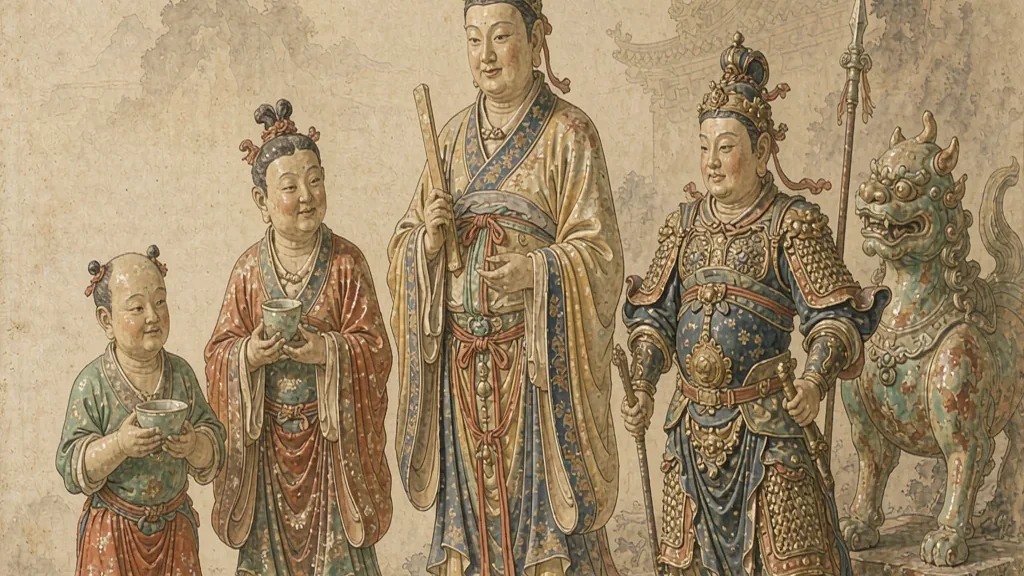
Chinese clay figurines (泥塑, ní sù) are among the oldest and most beloved forms of Chinese folk art. For thousands of years, craftspeople have taken humble earth, mixed it with water, and shaped it into children, gods, animals, and opera heroes — small works meant to be held, gifted, and displayed rather than kept behind glass. Unlike the monumental stone Buddhas carved into cliffs, clay figurines belong to everyday life: they are toys at the New Year, charms against misfortune, and quiet portraits of the people and stories a community holds dear. The tradition stretches from Neolithic fertility idols to the painted tomb figures of the Han, the glazed splendor of Tang sancai, and the lively folk workshops of Wuxi, Tianjin, and Shaanxi that flourish to this day.
From Earth to Image: The Nature of 泥塑
At its simplest, 泥塑 (ní sù) means "clay modeling": a figure built by hand or in a mold from fine local clay, then left to dry, lightly baked, or kiln-fired, and finally painted in bright mineral or lacquer colors. The word covers a wide range, from a thumb-sized toy sold for a few coins to a carefully observed portrait of a living person. What unites them is scale and intimacy — these are objects made to be close to the body and the household, not monuments viewed from afar.
Because clay is cheap, plentiful, and easy to work, the art spread far beyond courts and temples. A village child could own one, a merchant could carry one on the road, and a family could set one on the altar or the windowsill. Over centuries this democratization produced an astonishing variety of regional styles, each tied to the clay beds, festivals, and stories of its home place — yet all sharing the same basic conversation between a pair of hands and a lump of earth.
Ancient Roots: Neolithic and Han Figurines
The earliest Chinese clay figures reach back to the Neolithic. Cultures such as Yangshao and Hongshan hand-formed small human and animal figures, sometimes fired at low temperature and daubed with mineral pigment; a few Hongshan female figurines are thought to have served fertility or ancestor rites. These are the distant ancestors of the folk toy, the first evidence that Chinese hands used clay not only for pots but for images of life itself.
The Han dynasty (206 BCE–220 CE) brought the first great flowering of clay sculpture as a named craft. Burials were furnished with 明器 (míng qì), "spirit objects," placed so the dead might keep a household in the afterlife — models of servants, musicians, dancers, farms, wells, and mills, all in painted clay. The most famous large-scale relative is the Terracotta Army of Qin Shi Huang, life-size earthenware warriors built to guard the first emperor's tomb. Together these works show clay figure-making already mature, lively, and woven into both ritual and daily imagination two thousand years ago.
Tang Sancai: Clay in Glazed Color
The Tang dynasty (618–907) gave Chinese clay figures their most dazzling surface: 三彩 (sān cǎi), the "three-color" lead glaze whose greens, ambers, and creams run into one another like watered silk. Tang sancai figures — plump court ladies, prancing horses, and laden camels — were made as tomb furnishings for an aristocracy that loved movement, color, and the cosmopolitan bustle of the Silk Road. The camels and foreign merchants captured in clay are a small portrait of a world empire on the move.
Sancai pieces were press-molded for repeated forms, then coated in glaze and fired so the colors pooled and dripped in controlled ways. Though buried rather than played with, they inherited the figurine's gift for vivid storytelling: a single sancai lady, with her round face and swinging sleeve, tells us more about Tang taste than a shelf of documents. The style influenced ceramic sculpture across East Asia for centuries afterward.
Huishan Clay Figurines of Wuxi and the 大阿福
The Huishan (惠山, Huìshān) tradition of Wuxi in Jiangsu Province is one of China's most cherished folk-arts, popular since the Ming dynasty (1368–1644) and thriving through the Qing. Artisans drew on a single dark, unusually fine clay bed at the foot of Huishan hill, shaping small, brightly painted figures of children, opera characters, and auspicious beings. By the Qing the little figures had become a favorite New Year's gift, carried home by visitors to the nearby temples and markets.
The best-loved Huishan image is 大阿福 (dà ā fú), the "Great Fortune Child" — a chubby, smiling boy (often paired as a boy and girl) who embodies double blessing, plump health, and family happiness. Painted in rosy cheeks and holding a lion or lotus, Da Afu was believed to bring good luck and ward off harm, and it remains the emblem of the whole Huishan craft. Its rounded, gentle form is exactly the intimacy that sets folk clay apart from temple sculpture.
Niren Zhang: The Tianjin School of 张明山
In the 19th century, Tianjin gave clay figure-making a famous name: 泥人张 (ní rén zhāng), "Clay Figure Zhang." The school was founded by 张明山 (Zhāng Míngshān), a sculptor renowned for modeling accurate, lifelike portraits of opera performers and ordinary people from life. His painted clay heads and small groups captured a sitter's features and mood with such precision that viewers could recognize the real actor from the figure alone.
What made Niren Zhang distinct was its blend of folk material with fine observational skill. Later generations turned the family workshop into a recognized tradition, producing both comic single figures and multi-figure scenes drawn from opera and daily life. The name became a byword for the painted clay portrait across northern China, and the workshop's emphasis on likeness helped lift the humble toy toward the status of portrait art.
Fengxiang Clay Sculpture of Shaanxi
Shaanxi's Fengxiang (凤翔, Fèngxiáng) clay sculpture is the great folk tradition of the northwest, made in Fengxiang County near Baoji for New Year and wedding celebrations. Fengxiang figures — plump animals, zodiac creatures, and round-faced children — are boldly painted in primary reds, greens, and yellows, outlined in black, with a naïve, almost heraldic strength that reads clearly across a room. They were long given as luck-bringing gifts and hung on walls to guard the home.
The same region is known for 马勺 (mǎ sháo) "mask faces," painted on wooden ladles in the stylized features of opera and guardian spirits. Although the mashao are wood rather than clay, they belong to the same Shaanxi folk impulse — bright, protective faces for the threshold of the house. Together they show how a single rural tradition could speak in both clay and wood, always in saturated color and always with an eye to warding off evil.
Clay, Paper, and Paint: How Figures Are Made
The making of a clay figure follows a few dependable steps. The base is local clay, often tempered with 纸筋 (zhǐ jīn), paper fiber or cotton, which binds the material and keeps small pieces from cracking as they dry. The form is built by pinch-modeling for tiny toys, by hand-building over a simple armature for larger works, or by press-mold for repeated shapes; surface details — a fold of robe, a curl of hair — are then added by the sculptor's thumb and tool.
After shaping, the figure is dried, lightly baked, or kiln-fired depending on its purpose, then painted. Folk toys are usually finished in mineral or lacquer pigments with a glossy top coat; temple and portrait pieces may receive many layers of color and even gilding. The meeting of hand, tempered clay, and fired-and-painted surface is what gives each figure its particular life — a Huishan toy feels spontaneous, while a solemn painted image feels monumental, though both begin as the same wet earth.
Subjects of the Clay: Opera, Zodiac, and Deities
Clay figurines take their subjects from the full cast of Chinese popular culture. 戏曲人物 (xì qǔ rén wù), opera characters, are everywhere — individual performers frozen mid-aria or small tableaux that stage a whole scene on a single shelf. The twelve animals of the Chinese zodiac appear year after year as children's toys and New Year decorations, each one a small, friendly portrait of the year to come.
Alongside entertainment, the figurines carry belief. Folk deities, auspicious children like Da Afu, and protective spirits were made to sit on altars and windowsills, bringing fortune or standing guard against misfortune. In this way a single craft served play and piety at once: the same hands that shaped a comic opera clown might also shape a household god, and a family's shelf could hold both without contradiction.
Regional Traditions Across China
Although Wuxi, Tianjin, and Fengxiang are the best known, clay-figurine making spread through many provinces, each with its own clay and character. Jiangsu gave the refined Huishan toy; Tianjin the realistic Niren Zhang portrait; Shaanxi the bold Fengxiang animal and mask; and Henan and other regions contributed their own local styles of painted clay. The differences are easy to feel — a southern child-figure is soft and rounded, a northern one bright and blunt — yet all answer the same human wish to hold a small, hopeful image in the hand.
This regional spread is the real measure of 泥塑's importance. It was never a court secret or a temple monopoly but a cottage craft practiced wherever good clay and a festival coincided. That breadth is why, when the tradition is listed among China's intangible cultural heritage, it is spoken of in the plural — as many living local arts rather than one fixed form.
A Living Folk Art Today
Clay figurines are not museum pieces alone; they remain a working folk art. Huishan and Fengxiang workshops still turn out Da Afu and zodiac animals for the New Year, and the Niren Zhang name continues in Tianjin as both craft and institution. Master makers are recognized among China's intangible-cultural-heritage bearers, and their students keep the old tempering, molding, and painting methods alive while adapting subjects to modern tastes.
What explains this survival is the figurine's closeness to ordinary life. A clay child costs little, fits the palm, and carries a wish anyone can read — for health, for luck, for a happy family. In an age of mass-produced toys, that direct, handmade warmth is precisely the quality people still come back for, and it is why the small earth figures of Wuxi, Tianjin, and Shaanxi keep speaking to new generations.
❓ Frequently Asked Questions
Seen together, these small figures trace a long conversation between ritual and play. From Neolithic fertility idols to the comic clay children of Wuxi, the figurine has never lost its closeness to ordinary life; it is held, gifted, and laughed at rather than kept at a distance. That intimacy is the quiet source of its lasting charm as a Chinese folk art.
📝 Chinese Vocabulary
泥塑 — : clay figurine; the Chinese tradition of modeling clay into figures.
明器 — : burial objects placed in tombs to serve the deceased.
三彩 — : "three-color" lead glaze used on Tang figurines and wares.
彩塑 — : painted sculpture; clay figures finished with color.
泥人张 — : "Clay Figure Zhang," the Tianjin painted-clay school founded by Zhāng Míngshān.
大阿福 — : Da Afu, the Huishan good-luck child figurine.
惠山 — : Huishan, the Wuxi hill and clay-figurine center in Jiangsu.
凤翔泥塑 — : Fengxiang clay sculpture, the bright folk tradition of Shaanxi.
马勺 — : mashao, a painted wooden mask face from Shaanxi folk art.
戏曲人物 — : opera characters, a favorite subject of clay figurines.
纸筋 — : paper fiber mixed into clay to strengthen it against cracking.
🎉 Fun Facts
- The Huishan 大阿福 is usually shown as a chubby boy-girl pair, a motif of double blessing long given as a New Year gift.
- Tianjin's Nírén Zhāng founder Zhāng Míngshān modeled opera performers so lifelike that viewers could name the real actor from the figure alone.
- Fengxiang clay figures of Shaanxi are painted in bold reds, greens, and yellows and given at New Year and weddings to bring luck and ward off harm.
- Huishan figurines are made from one unusually fine, dark clay bed at the foot of Huishan hill, prized for polishing to a smooth finish.
- Many clay figurines are strengthened with paper fiber (纸筋) or cotton mixed into the clay, then dried or fired and painted in layers.
- Clay figurines depict the full Chinese zodiac, one animal per year, making them a favorite children's toy at spring festivals.
- Tang sancai camels and horses were buried as tomb furnishings, a clay echo of the Silk Road caravans their owners knew in life.